


18 Oct Gem Handmade Soap OEM 2026: The Artisan Gemstone Format & Export Playbook
Table of Contents
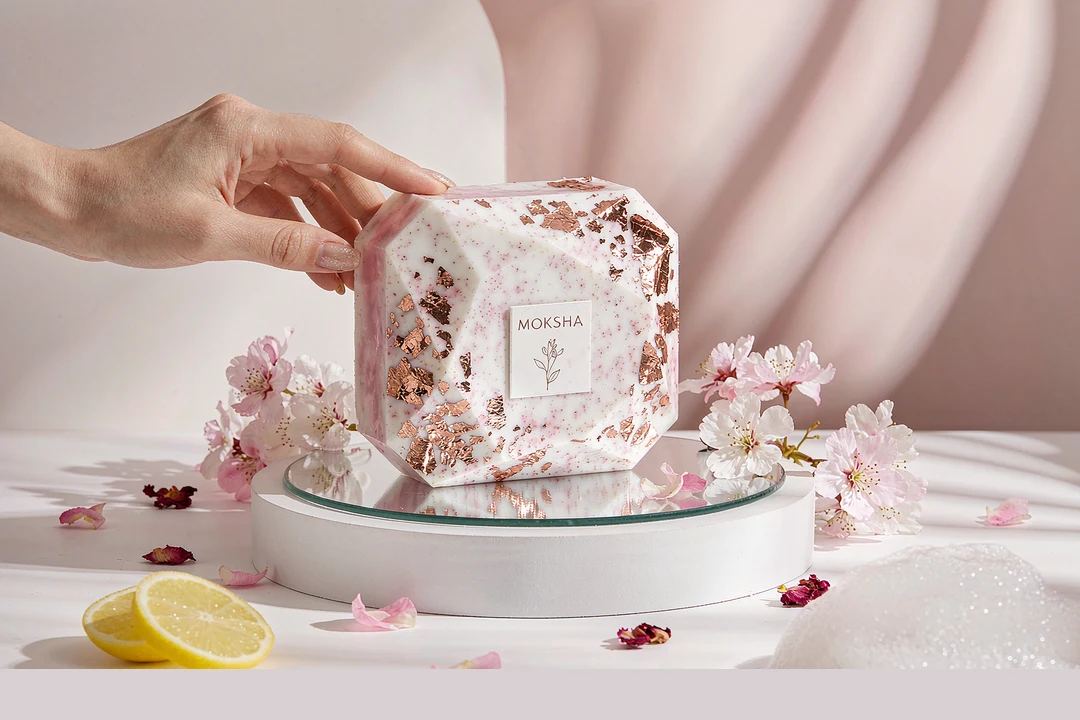
A gemstone-shaped soap bar with rose gold foil on the label card is not a soap decision; it is a shelf decision. In a category where the average unit competes on price per 100 g, the gem format moves the product into gift and decor territory — the same shelf psychology that sells candles. This guide is the spec conversation we run through with private-label partners before a quote goes out, written from our own 2026 production files.
The live program behind it: our Gem Handmade Soap OEM line — a faceted, gem-cut cold-process bar with rose gold foil and a four-scent essential oil range, MOQ 1,000 with contract tiers from 3,000 — plus the wider Bath Soap OEM catalog where the same base runs as classic ovals and loofah-embedded bars.
A soap that photographs like jewelry
The bar soap category is enormous, flat in price and quietly premiumizing at the edges. What changed the edge is the same force that changed the candle category: the product became decor. A Gem Handmade Soap bar sells a second time in the photograph — the facet, the foil, the dried petal — and that second sale is what pays for the mold.
Three buyer currents keep the artisan soap shelf moving in 2026: the clean-beauty shift toward short ingredient lists, the gifting economy (a gem bar in a kraft sleeve is a ready-made favor or gift), and the zero-waste angle (a bar replaces a pump bottle). A Handmade Soap OEM program rides all three with one base and one mold family. The Essential Oil Soap story is the clean-beauty argument in its purest form: a short list, a named scent, no pump bottle.
Cold process, hot process, melt-and-pour: what “handmade” can mean
“Handmade” is not a regulated term in most cosmetics regimes, which means the buyer has to define it — and the method decides the lead time, the label claims and the texture. The four routes, and what each is actually good for:
| Method | Process | Texture and feel | Best for | Lead-time consequence |
|---|---|---|---|---|
| Cold process (CP) | Saponification at low temperature, then 4–6 week cure | Creamy, long-lasting, natural glycerin retained | True artisan bars, gem molds, premium scent story | Cure room time is the schedule gate — plan 6–8 weeks total |
| Hot process (HP) | Cooked to complete saponification, then pressed | Slightly translucent, rustic look | Faster launch, heavier textures | Cure drops to about 1–2 weeks |
| Melt-and-pour (MP) | Melt a pre-made base, add color and scent, pour | Very smooth, consistent | Embedded objects, novelty shapes, samples | Ready in days — but “glycerin stripped” bases read less premium |
| Re-batch | Grate and re-melt cured CP soap | Textured, homely | Upcycling imperfect batches | Adds a week; useful for small trial lots |
Our Gem Handmade Soap bar is cold process with a controlled superfat, which is what gives it the creamy feel and the retained-glycerin story. Buyers should note the trade: the authentic method is also the slow one, so the launch calendar starts at the cure room, not the mold. For a Handmade Soap Private Label launch that usually means booking the cure room one quarter ahead of the shelf date.
What the 2026 bar soap market pays for
Grand View Research puts the global skin/body-care bar soap market at USD 17,394.4 million in 2022, projected to reach USD 24,041.7 million by 2030 at a 4.2% CAGR, with the U.S. market at USD 5,170.0 million in 2022 growing at 3.7% through 2030. The detail that matters for an artisan program:
- Organic is the fastest-growing type segment across the report’s regional cuts — the clean, short-list bar is where the growth sits, which is why our gem bar runs a short INCI list by default.
- Asia-Pacific held 39.9%% of the global market in 2022 and is the fastest-growing region — a natural home for a giftable, decor-forward bar format.
- Europe’s bar soap markets grow steadily (France at 4.4%% CAGR, the U.S. at 3.7%%), so a gem bar is not a regional novelty — it is a global format.
- Sustainability is the tailwind: the report ties bar soap’s resilience to minimal plastic packaging — the kraft-sleeved gem bar is the strongest version of that argument.
The read-through for a wholesale handmade soap buyer: the mass of the market is flat and price-driven, but the artisan gem slice grows with the gifting and clean-beauty currents — and it defends a price point three to five times a commodity bar.
Cure time is the hidden lead time
Every Gem Handmade Soap program lives or dies in the cure room. During those four to six weeks the bar loses water, hardens, finishes saponification and settles to a mild alkaline pH — typically around pH 9–10 for a fully cured superfatted bar. The QC gates our Handmade Soap OEM program runs before a bar is allowed into a carton:
| Test | Spec we hold | Why it matters to the buyer |
|---|---|---|
| Drop test | Survives 1 m drop onto hardwood, no fracture | The single best predictor of a bar arriving intact |
| Friability | No crumble under standard rub | A crumbly bar reads as old stock on the shelf |
| pH | pH 9–10 on a 10% solution at end of cure | Confirms saponification is complete; protects the mildness claim |
| Moisture | Within the formula spec band at T4 weeks | Too wet and the bar dissolves in one shower |
| Weight | Within ±3% of target | Keeps the per-unit economics honest at 100k scale |
| Scent panel | Match to reference at T0 and T6 | The essential oil story has to survive the cure |
Planning a launch date? The cure room is the gating item, not the mold — our production calendar comes with every quote so you can work backwards from your shelf date. Request the production calendar →
Rose gold foil, dried petals and the mold bill
The gem look is three craft layers on one cold-process base: the faceted mold, the rose gold foil application, and the dried botanical. Each has a cost and a failure mode:
- The mold: a faceted silicone mold is a one-time tooling bill (typically USD 400–900 per shape at our suppliers), amortized across the program — it is the reason MOQ and mold amortization belong in the same sentence.
- The foil: edible-grade style gold or rose gold flakes applied to the surface or pressed into the top — decorative only, and it must be declared as a decorative ingredient on the INCI where required.
- The botanicals: dried petals or blossoms set into the surface; they must be dry, debris-free and lot-controlled, or they become a stability and a micro problem.
- The scent range: our four-scent Essential Oil Soap range (rose, blue bells, lemon, sakura) runs on one base with four fragrance lots — the same one-base logic as our body oil trio — the structure that makes a Handmade Soap Private Label reorder economic.
One process note buyers should ask about: we press and cure in humidity-controlled rooms and batch by scent, so a rose reorder does not force a sakura line clearance. That is what keeps small reorder quantities economic in a Handmade Soap Private Label program.
Claims that survive a “handmade” label
The handmade soap OEM shelf invites claims that regulators read differently. The positions we hold per market:
- EU: “natural” has no legal definition, so we use it only with a defined ingredient list; “organic” requires certification to the organic cosmetics standard — we run it only when the client holds the certificate. Claims follow the common criteria of Regulation (EU) 655/2013.
- US: claims must be truthful and substantiated; since MoCRA facility registration and product listing run alongside — keep the substantiation file with the listing.
- Preservative-free: a fully cured superfatted CP bar is self-preserving by its alkalinity, but the claim must still be consistent with the full formula and any additives — we make the call per formula, not per marketing deck.
- Brazil / Gulf / SEA: Portuguese and Arabic INCI on label; no mercury or hydroquinone anywhere in the chain; Indonesia halal mandatory for cosmetics from 17–18 Oct 2026 (BPJPH).
Market entry notes: EU, US, Brazil, Gulf and SEA
| Market | Regime | Notification / filing | The watch-out for a gem soap bar |
|---|---|---|---|
| EU | Regulation (EC) 1223/2009 | CPNP notification; PIF signed by a safety assessor | Botanicals and foil documented in the PIF; claim wording per 655/2013 |
| US | FD&C Act + MoCRA | Cosmetics facility registration and product listing | Color additives per 21 CFR Parts 73/74 for any tint; “organic” claims need substantiation |
| Brazil | ANVISA RDC 15/2013 | Notification via local importer with AFE | Portuguese INCI; importer CNPJ on label |
| Middle East | GSO standards; Saudi SFDA | SFDA registration; halal certificate | Arabic labeling; botanical sourcing declared for halal review |
| Southeast Asia | ASEAN Cosmetic Directive | National notification (BPOM etc.) | Indonesia halal mandatory from 17–18 Oct 2026 — BPJPH |
Scale economics at 1k, 3k, 10k, 50k and 100k bars
The cost curve on the gem bar program from our 2026 files — note the mold amortization visible in the first two tiers:
| Program volume | Unit FOB band (bar) | Tooling | Lead time | What changes |
|---|---|---|---|---|
| 1,000 (entry MOQ) | USD 1.60–2.10 | Shared gem molds, kraft sleeve | 6–8 weeks (cure-gated) | You validate the four scents; mold cost sits in this tier |
| 3,000 | USD 1.20–1.55 | Dedicated mold amortized | 6–8 weeks (cure-gated) | Custom sleeve and scent card unlocked |
| 10,000 | USD 0.90–1.20 | Multi-cavity molds, dedicated cure slots | 6–7 weeks | Priority cure-room scheduling; seasonal peaks reserved |
| 50,000 | USD 0.70–0.95 | Full line booking | 6–7 weeks | Rigid gift-box upgrades; DDP options to EU/US |
| 100,000+ | USD 0.55–0.78 (annual contract) | Reserved capacity | 6–7 weeks + reserved capacity | Quarterly PIF reviews; halal and GSO documentation maintained on file |
Two logistics notes for a wholesale handmade soap program: a cured bar is a weight-stable, non-fragile carton filler — the freight math is the friendliest in the bath category; and because the schedule is cure-gated, the practical planning rule is to order against the cure calendar one quarter ahead of the shelf date.
Our facility is certified under ISO 22716 and GMPC, exports to 30+ countries, and runs the Gem Handmade Soap platform with humidity-controlled cure rooms, drop and pH testing per lot, and a per-market claim matrix. If you are building an artisan soap line for 2027 planograms, the fastest next step is a mold-and-cure review against your launch calendar.
Ready to Launch Your Artisan Soap Line? Talk to Us
☎ Phone / WhatsApp: +86 133 6440 1300
✉ Email: sales@moksha-bio.com
🕐 Working Hours: Monday – Saturday, 9:00 – 18:00 (GMT+8)
✉ Inquiry This Product — Get a Free Quote
📍 Book a Factory Visit
Keep reading: Hand Foot Cream OEM 2026: The Best Shea Butter Repair Formula & Export Playbook · Candy Body Scrub OEM 2026: The Best Sugar Cube Exfoliating Format & Export Playbook · Vitamin C Face Cream OEM 2026: The Best Brightening Moisturizer & Export Playbook · Ginger Foot Mask OEM 2026: The Best Exfoliating Peeling Socks & Export Playbook · Peach Squalane Stick OEM 2026: The Best 4-in-1 Repair Balm & Export Playbook · V Line Lifting Mask OEM 2026: The Best Ultimate Double V Chin Mask & Export Playbook · Avocado Foot Mask OEM 2026: The Best 80 g Booties Formula & Export Playbook · BB Cream OEM 2026: The Best Color-Correcting Format & Export Playbook
More export playbooks: Whitening Hand Cream OEM 2026: The Best Brightening Balm & Export Playbook · Urea Foot Cream OEM 2026: The Best 40% Formula & Export Playbook · Hair Care Set OEM 2026: The Best Formulas, Bottles & Export Playbook · BB Cushion OEM 2026: The Best Shade Range, Puff Tech & Export Playbook · Mud Mask OEM 2026: The Best Clay, Set Economics & Export Compliance · Sunscreen OEM 2026: The Best SPF Testing Costs, Regulatory Path & Private Label Playbook · Body Moisturizing Oil OEM 2026: The Best Brightening Body Oil & Export Playbook · Bath Bomb Set OEM 2026: The Best Cake Home Spa Format & Export Playbook
Sorry, the comment form is closed at this time.