

15 Oct Mud Mask OEM 2026: Clay, Set Economics & Export Compliance
Sourcing a mud mask OEM in 2026 is less about finding a factory that mixes clay, and more about finding one that can quote cation exchange capacity, slurry pH and a defensible claim file in the same email. Clay is the oldest skincare raw material still sitting in every top-10 mask SKU — and it is also one of the most over-specified items in sourcing RFQs. Buyers ask for “natural clay mask” and get three quotes that cannot be compared, because nobody pinned down the clay type, the pH of the slurry, or the humectant load that keeps the mask comfortable after twelve minutes on the face.
This guide is the short version of the spec conversation we walk through with every clay mask OEM partner: which clay to pick for which claim and margin, which set formats move volume at big-B quantities, and exactly what the EU, the US, Brazil, the Middle East and Southeast Asia will ask you for before your first container ships.
The category is growing, not fading. Grand View Research values the hydrogel face mask market at USD 157.8 million in 2026, growing at an 11.0% CAGR through 2033, and lists serums & masks as the fastest-growing segment of Asia-Pacific facial skincare. Rinse-off clay masks remain the volume backbone of that growth in pharmacy, masstige and travel-retail channels — which is exactly where big-B buyers play.
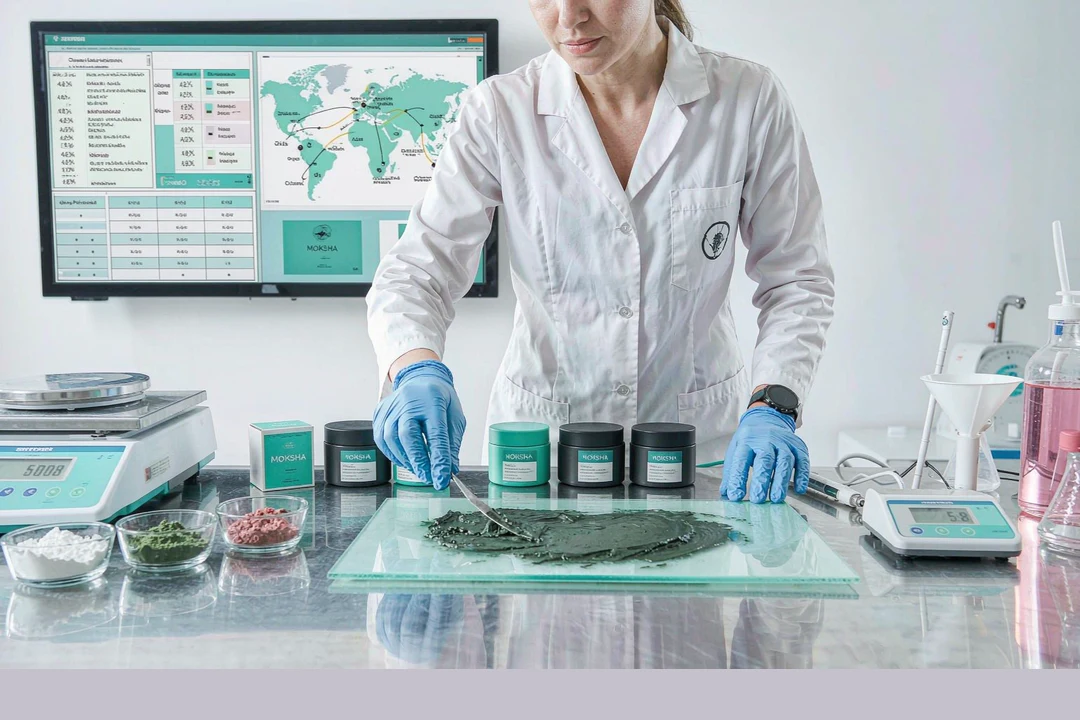
Everything below is drawn from our own 2026 production files for the Mud Mask Set OEM 3-pack, the Dead Sea Mud Mask OEM program and the rest of our Face Mask OEM line — the same products running through our ISO 22716 facility every week.
Table of Contents
Why the clay you choose decides your margin, not your marketing
Most buyers treat clay as a commodity line item. It is the single biggest lever on cost position and claim strength at the same time. The technical spec that matters is cation exchange capacity (CEC) — how many milliequivalents of cations 100 g of clay can bind. Kaolin sits around 5–15 meq/100 g; bentonite runs 80–100+ because its montmorillonite structure swells and adsorbs. Higher CEC means stronger oil pull and a more dramatic tightening feel — and a higher risk of the over-drying complaint that shows up in your reviews six weeks post-launch.
| Clay type | CEC & behaviour | Sets in | Indicative cost band* | Claim it supports | Watch-out |
|---|---|---|---|---|---|
| Kaolin (white) | 5–15 meq/100 g, gentle oil absorption | 8–12 min | Lowest | Daily use, sensitive skin, teen lines | Weak “detox” story |
| Bentonite | 80–100+ meq/100 g, strong adsorption, swells | 10–15 min | Low–medium | Oily / combination skin, deep clean | Over-drying; slurry pH 8–9.5 |
| Illite / French green | Moderate, trace mineral content | 10–14 min | Medium | Premium mineral positioning | Colour varies batch to batch |
| Rose clay (kaolin + iron oxide) | Mild, softly brightening | 8–12 min | Medium | Brightening, gift sets | Colour must be standardized against artwork |
| Activated charcoal | Adsorbs oils and odour | 8–12 min | Medium | Urban pollution, men’s lines | Gritty feel if poorly milled |
| Dead Sea silt | Minerals + polysaccharides | 12–15 min | Highest | Spa / premium | Cost swings with magnesium content |
*Indicative bands from our 2026 formulation files at 10,000+ unit volumes; ask for the current dossier for a live quote.
Ask every candidate factory for the CEC and the pH of a 10% clay slurry. Most cannot answer within a day — and that tells you what the first six months of QC will look like.
The pH problem nobody puts in the mud mask RFQ
Bentonite slurry in water reads pH 8.0–9.5. Skin-compatible rinse-off targets sit at 5.5–6.5. That gap is not academic: at pH 8+ the mask feels “cleaner” for the first week and increasingly stripping by week six, and your “suitable for sensitive skin” claim becomes indefensible the moment a retailer QA team or a regulator asks for the substantiation file.
- Adjust, then re-verify: bring the slurry to 5.5–6.5 with citric acid and re-measure at 25 °C after a 24-hour rest. Clay buffers — a one-point adjustment drifts.
- Balance drying time with humectants: 5–8% glycerin, betaine or sodium PCA keeps a 10-minute mask comfortable and the “non-drying” claim defensible.
- Control cracking: magnesium aluminum silicate (thixotropic) plus a light film former. A mask that cracks on the drawdown will crack in the jar at 45 °C in a Santos warehouse.
- Stability, run in parallel: real-time (25 °C / 60% RH) plus accelerated (40 °C / 75% RH). Twelve weeks accelerated is the entry ticket, not the finish line — get the real-time read before a 100k-unit commitment.
The set formats that actually move volume
Single jars sell, but sets carry the margin. Our 2026 production files show the 3-pack coffret is the format big-B buyers reorder fastest: one tooling set carries three claims (cleansing, hydrating, brightening), and a carton-packed set survives freight damage better than three loose jars.
| Format | Typical spec | MOQ | Indicative FOB* | Best channel |
|---|---|---|---|---|
| Single jar | 200 g PP/PET jar | 3,000 | USD 0.95–1.60 | Pharmacy, e-commerce |
| 3-pack coffret | 3 × 100–200 g + printed carton | 3,000 sets | USD 2.40–3.90 | Masstige, gifting |
| Sachet | 8 g aluminium laminate | 10,000 | USD 0.13–0.22 | Hotel, travel retail, GWP |
| Stick | 30 g twist-up | 5,000 | USD 0.55–0.90 | Travel retail, duty-free |
*FOB bands, indicative 2026 pricing at stated volumes; first-order tooling quoted separately.
The 3-pack is exactly how we built our Mud Mask Set OEM — cleansing, hydrating and brightening clay variants sharing one jar tooling and one carton print run. The same mud mask OEM platform sits behind our pearl & collagen cleansing mud mask, rose clay brightening mask and Dead Sea mud private label lines, and the Dead Sea Mud Mask OEM variant shares the same silt sourcing, so a buyer can extend a proven mud mask private label format instead of gambling on a new one.
Getting the clay spec, pH and format right is 80% of the sourcing work. Send us your target market and format — we will reply with the matching formula dossier, clay certificates and samples. Request the clay dossier →
What each export market will ask you for in 2026
| Market | Regime | Notification / filing | The watch-out |
|---|---|---|---|
| EU | Regulation (EC) 1223/2009 | CPNP notification before placing on market; PIF signed by a safety assessor | Claims follow the 2013 common criteria — “purifying” and “mattifying” are defensible; “treats acne” is not a cosmetic claim |
| US | FD&C Act as amended by MoCRA | Facility registration + product listing via Cosmetics Direct; foreign facilities appoint a US Agent; first biennial renewals ran through July 1, 2026 | Salicylic acid ≤2% or sulfur turns the mask into an OTC acne drug; serious adverse events must be reported within 15 business days |
| Brazil | ANVISA RDC 15/2013 | Cosmetic notification filed by the local importer holding AFE | Portuguese INCI list, importer CNPJ on label, claims restricted to ANVISA’s approved lists |
| Middle East | GSO standards; Saudi SFDA | Product registration via SFDA; halal certificate expected by major retail | Arabic labelling; glycerin and any animal-derived additives need documented halal status |
| Southeast Asia | ASEAN Cosmetic Directive | National notification (BPOM for Indonesia, etc.) | Indonesia: halal certification mandatory for cosmetics from 17–18 Oct 2026 under Gov. Reg. 42/2024 — self-declaration is not accepted |
Two of these deserve emphasis for Q4 2026 planning. Indonesia’s halal deadline lands this month — BPJPH has publicly rejected further delays, and uncertified cosmetics face withdrawal from circulation. And in the US, MoCRA moved cosmetics from voluntary registration to mandatory facility registration and product listing with a biennial renewal cycle that just closed its first round in July 2026; NSF published NSF/ANSI 527 in March 2026, giving brands an emerging third-party benchmark for claims like “sensitive skin”. A mud mask OEM that already holds halal documentation and supports MoCRA paperwork removes both problems from your critical path.
A 12-week launch playbook for a 3-SKU clay line
This is a real timeline, not a brochure: a German dermo-cosmetics brand took its three-SKU clay line from RFQ to first container in twelve weeks on our mud mask set platform.
| Week | Milestone | Deliverable |
|---|---|---|
| 1 | RFQ + clay dossier | CEC, pH, COA and MSDS for every clay on the quote |
| 2–3 | Sample rounds | Three formula variants with drawdown and rub-out panels |
| 4 | Stability start | Real-time + accelerated protocol launched |
| 5–6 | Artwork + claim review | Market-specific claim matrix signed off |
| 7 | Notifications | CPNP / ANVISA / SFDA filings prepared |
| 8–9 | Pilot batch + QA | pH, viscosity, microbial, 30-person feel panel |
| 10–11 | Bulk production + inspection | Pre-production photos, AQL final inspection |
| 12 | Booking + shipping | LCL/FCL booked, DDP terms confirmed |
Clay mask OEM scale economics: what changes at 10k, 50k and 100k+ units
Big-B buyers do not need the lowest unit price — they need the steepest cost curve as volume grows. Here is the shape of that curve on a 200 g clay jar from our 2026 wholesale clay mask files:
| Annual volume | Unit FOB band | Tooling | Lead time | What changes |
|---|---|---|---|---|
| 3,000 (entry MOQ) | USD 1.40–1.60 | Shared / pilot tooling | 35–45 days | You validate the market; we validate the formula |
| 10,000 | USD 1.10–1.35 | Dedicated jar tooling amortized | 30–40 days | Unit tooling cost drops 12–18%; carton print unlocked |
| 50,000 | USD 0.95–1.15 | Multi-cavity tooling, dedicated line slot | 25–35 days | Priority scheduling; sachet and coffret variants unlocked |
| 100,000+ | USD 0.85–1.05 (annual contract) | Full line booking | 25–30 days + reserved capacity | DDP to EU/US/Brazil; quarterly formula reviews; halal and GSO documentation maintained on your file |
Two logistics notes decide wholesale clay mask landed cost more than unit price: sea LCL is fine up to roughly 15 cbm, beyond which FCL to Hamburg, Santos or Jebel Ali typically saves 20–30% per unit on freight; and air freight for launch quantities should be treated as marketing spend, not supply chain — plan the first container by sea.
How to audit a mud mask OEM in one call
- Ask for the CEC and 10%-slurry pH of every clay on the quote. A real formulator answers in numbers, not adjectives.
- Ask for the stability protocol (real-time + accelerated) and who signs the cosmetic product safety report.
- Ask for the claim substantiation file for “purifying”, “mattifying” or “sensitive skin” — in the EU these need evidence under the common criteria.
- Ask for the halal certificate now, even if you are not selling to Indonesia yet; in 2026 it is a market-entry ticket, not a niche.
- Ask whether rinse-off and leave-on products run on shared lines, and how changeover is validated.
- Then visit: check clay storage humidity control, the filling line’s CIP routine, and whether the QC lab runs viscosity and microbial testing in-house.
Our facility is certified under ISO 22716 and GMPC, exports to 30+ countries, and assigns every mud mask OEM partner a dedicated account manager from sampling to shipment with a 12-hour response window. If you are building a clay mask OEM line for 2027 planograms, the fastest next step for a mud mask private label project is a formula dossier against your target claims.
Need Help? Contact Us
☎ Phone / WhatsApp: +86 133 6440 1300
✉ Email: sales@moksha-bio.com
🕐 Working Hours: Monday – Saturday, 9:00 – 18:00 (GMT+8)
✉ Inquiry This Product — Get a Free Quote
📍 Book a Factory Visit
Keep reading: Sunscreen OEM 2026: SPF Testing Costs, Regulatory Path & Private Label Playbook · Collagen Bandage Mask OEM: Osmosis Pressure Test Data · Peptide Complex Facial Mask Manufacturer: 2026 OEM Guide
No Comments