


17 Oct Avocado Foot Mask OEM 2026: The Proven 80 g Booties Formula & Export Playbook
Table of Contents
Every avocado foot mask OEM brief from a volume buyer starts with the same three words: booties, avocado, repair. The conversation then gets specific fast — how much essence is actually soaked into each pair, whether a heel-repair claim survives retail scrutiny in three or four markets at once, and what the landed cost looks like at the 50,000-pair mark. This guide is the working spec behind our own program, assembled from 2026 production and export files for buyers planning 2027 shelf space.
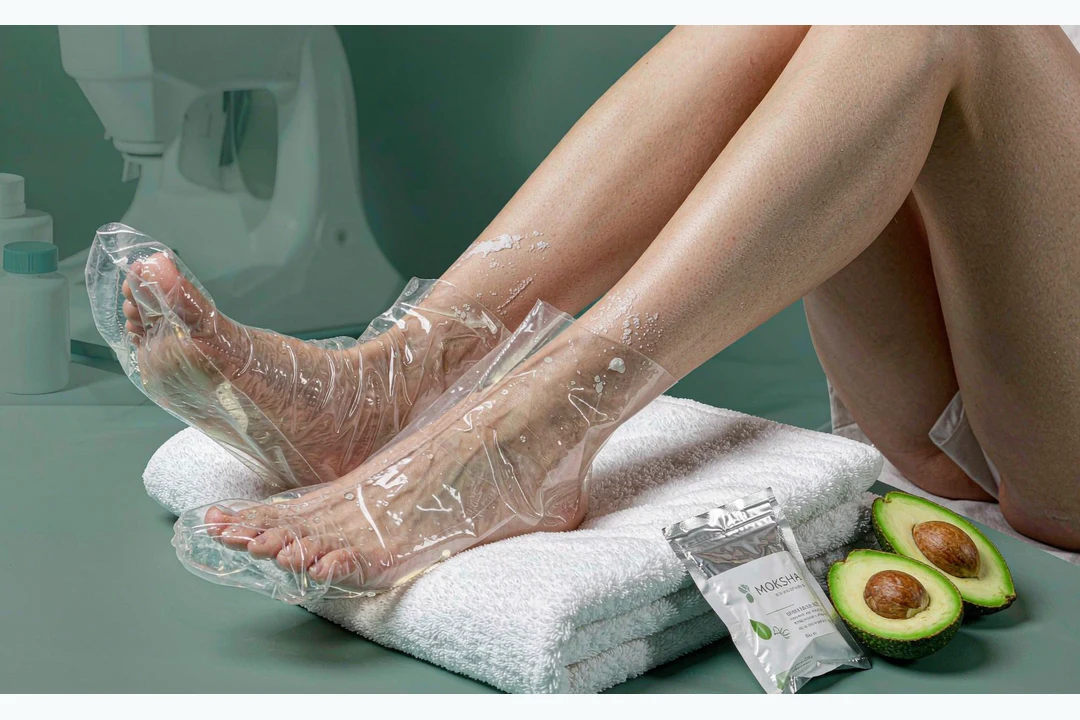
The live program behind it: our avocado foot mask — a booties-type pair soaked with 80 g of avocado extract and petroleum jelly essence, private label from MOQ 3,000 pcs — plus the wider foot mask OEM catalog and the bath salt ball line that shares the same spa-ritual shelf.
Why the booties format won the at-home pedicure aisle
The booties foot mask OEM category exists because of a simple mechanical truth: a cream can be rubbed off by socks within an hour, while a sealed booties pair keeps the essence in contact with the skin for the full treatment window. That occlusive design is what turned foot masks from a salon service into a retail SKU — the consumer puts the pair on, watches something for twenty minutes, and peels them off with visibly softer heels.
Retail data supports the format. Foot care is one of the defined segments inside the global foot care products market, alongside creams, scrubs, sprays and insoles, and market researchers consistently flag spa-inspired at-home treatments as a growth driver. For a private label buyer the booties format carries a second advantage: it photographs like a treatment, not like a tube, which is why it anchors gift sets and holiday planograms rather than everyday shelves.
What 80 g of avocado essence actually does to cracked heels
The 80 g load per pair is the spec that matters, because a booties foot mask is an occlusion device with a formula budget. Avocado oil brings a fatty-acid profile rich in oleic acid plus an unsaponifiable fraction containing beta-sitosterol and tocopherols — the same conditioning chemistry used in dry-skin emulsions. Petrolatum then does the sealing: in dermatology patch studies it remains the benchmark occlusive, cutting transepidermal water loss by more than 95%.
The exfoliation half of the program is a separate decision. Urea at 10–40% is the standard cosmetic keratolytic for callused heels, with salicylic acid as the alternative; both are permitted in the EU and US as cosmetic actives at defined concentrations, and both push the formula toward a claims conversation. Our avocado foot mask platform keeps the base essence avocado-and-petrolatum for broad-market launch, with an optional urea variant for lines that want a harder repair positioning.
What the foot care market pays for in 2026
Foot care has quietly become one of the steadier categories in personal care. Research and Markets sizes the global foot care products market at US$11.891 billion in 2025, growing at a 6.23% CAGR to US$16.072 billion by 2030, with an ageing population and sports-related foot problems as the structural drivers. Coherent Market Insights puts the 2025 base at US$8.33 billion on a narrower scope, heading to US$13.55 billion by 2032 at 7.2% — the honest read for buyers is a market compounding in the 6–7% band, with the spread between analysts reflecting scope rather than disagreement.
| Research house | 2025 base | Forecast | CAGR |
|---|---|---|---|
| Research and Markets (2025–2030) | US$11.891 B | US$16.072 B by 2030 | 6.23% |
| Coherent Market Insights (2025–2032) | US$8.33 B | US$13.55 B by 2032 | 7.2% |
What that means for a sourcing plan: the category rewards programs that can hold a 3,000-piece entry order without quality drift, because most of the volume sits with regional brands and private label retailers rather than the multinational top ten. A private label foot mask line competes on essence load and claim discipline, not on advertising spend.
Cracked-heel claims and the cosmetic-drug line
The single most expensive mistake in this category is a claim that quietly reclassifies the product. In the United States, a mask that says it treats or prevents athlete’s foot is an OTC drug under the FDA monograph — facility registration, drug facts labeling and active-ingredient compliance all follow. A mask that says it softens dry, cracked-looking heels is a cosmetic. The wording difference is one line of copy; the regulatory difference is a year of paperwork.
The EU approach is claims-substantiation rather than classification: under Regulation (EC) No 1223/2009 the product is a cosmetic, the common claims principles (Regulation 655/2013) require evidence behind every efficacy statement, and the CPNP notification plus a signed Product Information File must be in place before the product goes on the shelf. Brazil is stricter on anti-aging-adjacent language, so heel-softening wording travels there better than repair wording.
Market entry notes: EU, US, Brazil, Gulf and SEA
| Market | Regime | What the buyer files | Watch-out |
|---|---|---|---|
| EU | Regulation (EC) 1223/2009 | CPNP notification, PIF, safety assessment | Every efficacy claim needs substantiation (655/2013) |
| US | MoCRA cosmetics regime | Facility registration, product listing | Antifungal or treatment wording turns it into a drug |
| Brazil | ANVISA RDC 907/2024 | Notification via a local holder with AFE | Portuguese label; anti-aging language scrutinized |
| Gulf | GSO standards, Saudi SFDA | Product listing, halal certificate if claimed | Arabic label panels; heat-stability testing |
| SEA | ASEAN-aligned national regimes | BPOM notification (Indonesia) and equivalents | Local-language ingredient lists |
Our facility runs ISO 22716 and GMPC manufacturing, exports to 30+ countries, and keeps CPNP, ANVISA and SFDA filing packages on file — a new private label foot mask program normally inherits the existing dossier rather than building one from zero.
Pouches, booties and the component spec
A booties foot mask OEM line is really a packaging project with a formula attached. The functional unit is a non-woven booties pair saturated with the 80 g essence, sealed in an aluminum-plastic sachet that doubles as the treatment chamber; the outer unit is a printed carton, usually 1–5 pairs per carton for retail and 20–50 for the professional channel. Essence viscosity is specified so the pair stays fully soaked at the end of the 20-minute window without dripping.
Three component decisions drive the landed cost: sachet laminate structure (the aluminum layer is what makes the export shelf life possible), booties fabric weight, and whether the ear or ankle closure is adhesive or elastic. Elastic closure costs more per unit but removes the adhesive residue complaint that shows up in retail reviews; our standard spec runs elastic with a resealable sachet for the premium tier and adhesive for the entry tier.
Scale economics at 3k, 10k, 50k and 100k pairs
Entry orders for the avocado foot mask OEM program start at 3,000 pairs with a 15–25 day lead time, which is low enough to test a single retail account before committing to a line extension. The economics improve in steps rather than smoothly, because the tooling and artwork amortization — not the essence — dominates the first 10,000 units.
| Order size | Unit economics | Packaging | Lead time |
|---|---|---|---|
| 3,000 | Test order; artwork amortized across fewer units | Digital-print sachets, stock cartons | 15–25 days |
| 10,000 | First real step down in unit cost | Digital-print sachets, custom cartons | 20–30 days |
| 50,000 | Plate-print sachets amortize; essence lot control starts to pay | Plate-print sachets, shipper cartons | 30–40 days |
| 100,000+ | Annual contract pricing; reserved line capacity | Full plate-print program, DDP shipping | 35–45 days + reservation |
Building a foot-care line for 2027? Request an avocado foot mask quote — or WhatsApp +86 133 6440 1300 for samples, spec sheets and lead times within 24 hours.
One last practical note for buyers: sachets are cube-heavy relative to unit count, so container planning starts with carton dimensions rather than pair count, and a program that mixes booties masks with bath salts fills a 40HQ container more efficiently than either line alone. Our avocado foot mask OEM team can quote a combined foot-ritual program — mask, salt ball and cream — against a single artwork calendar.
If you are scoping a heel-care or spa-ritual line, the fastest next step is a spec review against your target markets: essence load, closure type, claim wording and the filing package your retail partners will ask for.
Ready to Launch Your Foot Mask Line? Talk to Us
☎ Phone / WhatsApp: +86 133 6440 1300
✉ Email: sales@moksha-bio.com
🕐 Working Hours: Monday – Saturday, 9:00 – 18:00 (GMT+8)
✉ Inquiry This Product — Get a Free Quote
📍 Book a Factory Visit
Keep reading: Urea Foot Cream OEM 2026: The 40% Formula & Export Playbook · Whitening Hand Cream OEM 2026: The Brightening Balm & Export Playbook · BB Cream OEM 2026: The Color-Correcting Format & Export Playbook · BB Cushion OEM 2026: Shade Range, Puff Tech & Export Playbook · Hair Care Set OEM 2026: Formulas, Bottles & Export Playbook · Mud Mask OEM 2026: Clay, Set Economics & Export Compliance · Sunscreen OEM 2026: SPF Testing Costs, Regulatory Path & Private Label Playbook
No Comments