


26 Oct Mango Eye Cream OEM 2026: 3 Fixes for Eye Cream That Pills
Table of Contents
The WhatsApp message arrived on a Thursday afternoon from a private-label buyer in Miami who had taken 3,000 tubes of our mango eye cream five months earlier. “The samples were perfect,” she wrote. “But my customers say the eye cream rolls into little balls under concealer and SPF. Is the formula wrong?” The formula was not wrong — and that is precisely the point. Every Mango Eye Cream OEM buyer who sells into a makeup-wearing market meets the same physics eventually, and this article is the full answer we sent back.
Here is who should read it. If you are sourcing a Mango Eye Cream OEM program for a market where customers layer serum, sunscreen and concealer over the eye area, or reordering a Wholesale Eye Cream line that quietly collected “pills under makeup” reviews, the six sections below are the diagnostic we now run for every Mango Eye Cream OEM order above 3,000 pieces: texture architecture, usage protocol, compatibility testing — plus the five questions we would ask any Eye Cream OEM factory before wiring a deposit. An Eye Cream Private Label program that survives its first makeup-pilling review cycle is a program that survives, and the failure mode is almost never the ingredient list.
The Miami Message That Started It
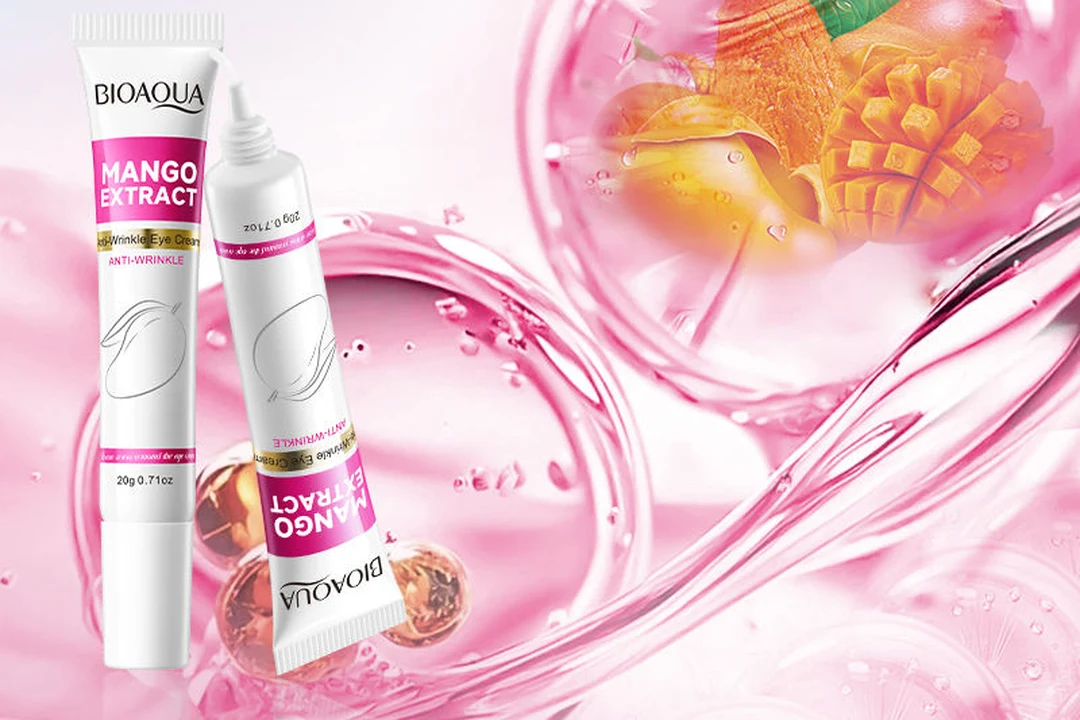
Here is what we knew about that order. The buyer had launched a 20 g Mango Eye Cream OEM tube — mango extract, hyaluronic acid, niacinamide, glycerin and vitamin E in a light, fast-absorbing cream — through her own e-commerce store and two Florida beauty boutiques. The positioning was honest and simple: anti-wrinkle firming, dark-circle care, and a 0-oil feel that absorbs without a greasy finish. Reviews in the first weeks used words like “light” and “soaks right in”.
Then the layering reviews arrived: “rolls up under my concealer,” “little balls when I put SPF on top,” “great alone, pilling with makeup.” Her first suspicion was a batch change; her second was the mango extract. Neither was correct, and walking her through why — with the mechanism, not apologies — turned a cancellation threat into a 6,000-tube reorder. That diagnostic is now the standard onboarding pack for every Mango Eye Cream OEM order we ship to North America, and the Mango Extract Eye Cream variant built on the same base inherits it too.
Why a Mango Eye Cream OEM Formula Pills Under Makeup
Start with the mechanism, as we explained it to that Mango Eye Cream OEM client. Pilling is not an ingredient failing; it is two films meeting. A light eye cream that promises a 0-oil finish almost always carries film-forming polymers — they give the fast, dry-touch feel consumers love. Concealers and modern sunscreens are also film systems: they need to stay put for hours. Rub a polymer film against another polymer film with a rice-grain of excess product in between, and the films ball up exactly like rubber cement rubbed between fingers. Nothing in the formula failed. Two good films met.
Three variables decide whether that meeting is visible. The table below is the failure-mode map we sent Miami — four rows, and only one of them lives inside the tube.
| Variable | Pilling-prone | Pilling-resistant | Whose side |
|---|---|---|---|
| Film load in the cream | Heavy polymer load for a fast dry-touch finish | Balanced film-to-emollient ratio; dry feel carried by emollients, not polymers | Factory (formula architecture) |
| Application dose | A full pea-sized layer per eye | A rice-grain per eye, patted not rubbed | Consumer protocol |
| Layer timing | Concealer applied within seconds, wet-on-wet | 60–90 seconds of set time before the next layer | Consumer protocol |
| Compatibility testing | Formula tested alone in the lab | Formula tested under SPF and concealer in the lab | Factory (QC scope) |
Read the table as a split of responsibility: two rows belong to the Mango Eye Cream OEM factory and two belong to the consumer protocol. A supplier who only owns the first two rows is selling you a summer sample; a supplier who owns all four is selling you a program that still has five-star reviews after the makeup-wearing quarter of your customer base starts layering.
What the Clinical Data Says
The literature supports the claims a Mango Extract Eye Cream program can honestly make, and it also draws the boundaries. Three references are worth your time before you lock a Mango Eye Cream OEM spec.
First, the dark-circle positioning has a real prevalence base: periorbital hyperpigmentation was found in about 30.8% of dermatology-clinic attendees in a large survey, peaking at 47.5% in the 16–25 age group, with stress reported by 71% and sleep deprivation by 40% of affected patients (PMID 24700933). That is why “dilutes the look of tired under-eye shadows” is an appearance-level claim worth printing — the audience is huge and the claim stays cosmetic.
Second, the niacinamide in the formula has real support: 2% niacinamide with sunscreen significantly decreased facial pigmentation versus vehicle in a 120-person, four-week study (PMID 12100180).
Third, the hydration architecture is benchmarked at a fraction of a percent: a 0.1% hyaluronic acid cream significantly improved hydration and elasticity in 76 women over 60 days (PMID 22052267) — more is not the story, the film-to-emollient balance is. Those three references are the whole claims file for a Mango Eye Cream OEM program. Note what is not in it: no “grows skin”, no “cures dark circles” — growth and repair language risks drug classification in both the EU and the US, so keep every claim at the appearance level.
The 3 Fixes We Shipped for Every Mango Eye Cream OEM Program
We did not redesign the Mango Eye Cream OEM product; we rebalanced it, tested it against makeup, and put the protocol where the consumer can see it. Three fixes, in the order we would apply them to any Wholesale Eye Cream line heading into a makeup-heavy market — and all three now ship as standard on every Mango Eye Cream OEM order above 3,000 tubes.
| Fix | What changed | What it costs | Why it works |
|---|---|---|---|
| 1. Film-to-emollient rebalance | Cut the film-former load roughly a third and moved the dry-touch feel to lightweight emollient esters; same actives, same 20 g tube | About USD 0.01–0.02 per tube (illustrative 2026 range) | One of the two films is now soft, so there is nothing to ball up under concealer |
| 2. Compatibility QC | Every new batch is pilling-tested under an SPF 30 and a concealer from our reference shelf before release | Test time, not formula | The failure mode is caught in the lab in Miami’s place — before it ships |
| 3. Protocol on pack and insert card | “Rice-grain amount, pat don’t rub, wait a minute before concealer” printed on the carton and insert | Printing only | Dose and timing are two of the four variables — the cheapest two to fix |
None of the three fixes required a new registration, and together they cost about two cents per tube — the kind of number that matters when a reorder is 6,000 pieces. The lesson from Miami is not “reformulate”; it is that the cheapest fix in a Mango Eye Cream OEM program is usually architecture, testing scope and instructions — not a new hero active on the front label.
Five Questions to Ask Any Eye Cream OEM Factory
If you remember nothing else from this article, remember these five questions. They take one email, and they separate factories that have shipped through a makeup-pilling review cycle from factories that have only shipped through a catalogue — ask them before you sign any Mango Eye Cream OEM order, or any Eye Cream Private Label program built on the same base.
One: what carries the dry-touch feel in your base — film-formers or emollients, and at what functional ratio? Two: do you pilling-test every batch under an actual sunscreen and concealer, and can you show the protocol? Three: will you print the dose-and-timing protocol on the pack, and can you send the artwork proof before plates are cut? Four: is the claims file prevalence- and study-backed (not borrowed from a competitor’s box)? Five: will you send a sample batch with a COA before payment, early enough for your own market test?
An Eye Cream OEM partner who answers all five in writing has almost certainly rescued a pilling complaint before — and a Wholesale Eye Cream reorder placed with that partner is the one that still has five-star reviews after the layering season. A supplier who answers two of five is quoting you a product that was only ever tested alone.
The Demand Backdrop
None of this matters if the category is not moving, and it is. The global eye cream market is tracked at USD 5.6 billion in 2025 heading to USD 10.5 billion by 2034 at a 7.3% CAGR, with anti-aging and dark-circle claims driving Mango Eye Cream OEM volume — and the under-eye area is the one zone where consumers will pay a premium for a dedicated 20 g format instead of borrowing a face cream. A Mango Eye Cream OEM program launched with a pilling-proof texture spec is timed for exactly that premium.
The mango positioning fits that lane honestly: mango extract and vitamin E for the nourishing story, niacinamide for tone at a study-backed dose, hyaluronic acid for the cushioned feel, and a texture spec that behaves under makeup. If your 2026–2027 roadmap includes a Mango Extract Eye Cream line for a makeup-wearing market, send us the market and the texture brief — we will return the same diagnostic we sent Miami, filled in with your numbers, within 24 hours.
Get your Mango Eye Cream OEM sample pack and makeup-compatibility review — MOQ 3000, free samples, 24-hour quote.
☎ Phone / WhatsApp: +86 133 6440 1300
✉ Email: sales@moksha-bio.com
🕐 Working Hours: Monday – Saturday, 9:00 – 18:00 (GMT+8)
✉ Request the Quote — Reply Within 24h📍 Book a Factory VisitKeep reading: Caviar Eye Cream OEM Guide · Snail Mucin Eye Cream Asia Guide · Retinol Eye Cream Gulf Guide · Vitamin C Eye Cream Roller Lessons · Anti-Wrinkle Eye Cream OEM Guide
Sources: periorbital hyperpigmentation prevalence (PMID 24700933); Hakozaki 2002 niacinamide study; Pavicic 2011 hyaluronic acid study (PMID 22052267); Verified Market Reports eye cream outlook (USD 5.6B→10.5B 2034). Cost figures are illustrative 2026 ranges from our production files, not a quotation.
Frequently Asked Questions
What is your sample policy for Mango Eye Cream 3?
Samples of Mango Eye Cream 3 are prepared in 7-10 working days for existing formulas and ship with a specification sheet so the tested batch matches production. Sample cost is credited against the first bulk order.
Do you support small trial orders before scaling Mango Eye Cream 3 production?
Yes. Start at the 3,000-5,000 pcs MOQ to test your market, then scale. The same production line and QC standard apply from the first trial run to full volume.
How do you protect my Mango Eye Cream 3 formula and artwork?
Custom formulas and packaging artwork are used exclusively for your orders. NDAs are signed before technical exchange, and masters stay in your control.
No Comments