


24 Oct Vitamin C Eye Cream OEM: 7 Honest Lessons From Our Roller-Ball Line
Table of Contents
The question every buyer asks us
“Can you take 15 percent off this eye cream?” It is the first question most buyers ask about our Vitamin C Eye Cream, and we understand it — retail maths are brutal and every point of FOB is a point of margin. But the question deserves a more honest answer than a yes or a no, because on a Vitamin C Eye Cream OEM project, the honest answer is a map of where the money actually sits. So we wrote that map down. These are the seven lessons we give buyers in the first meeting — the same ones that turned this roller-ball line into one of our most re-ordered programmes.
Where the money actually sits
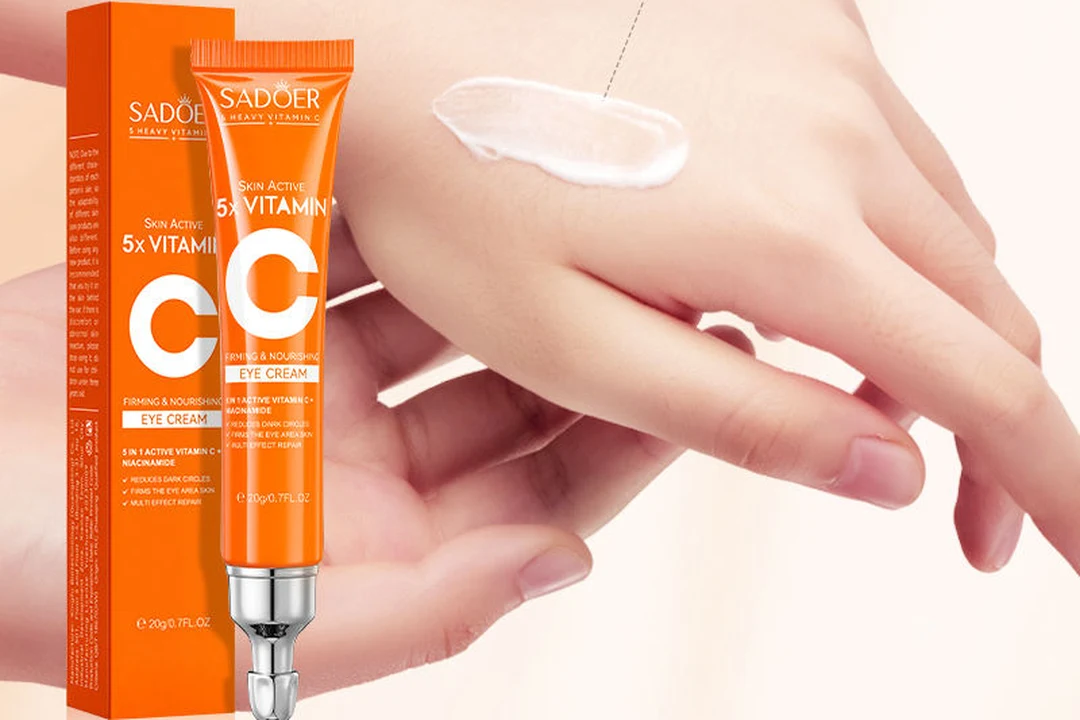
On a 20 g roller-ball Vitamin C Eye Cream, three components dominate the FOB: the metal roller-ball head, the vitamin C stabilisation system, and the printed tube. Everything else — the box, the spatula-free applicator logic, even the filling labour — is rounding error by comparison. When a buyer needs a lower price, those three lines are the only meaningful conversation, and each has a trade-off you should choose deliberately rather than discover in year two. That is lesson one: price conversations about Private Label Eye Cream are component conversations, and any supplier who answers “we will do our best” has not opened the BOM.
Seven lessons from the roller-ball line
1. The roller ball is the product. The chilled-metal applicator is why customers choose this format over a squeeze tube — de-puffing massage, cooling sensation, dose control. Cut it to a plastic ball and the FOB drops, but so does the reason anyone reorders a Vitamin C Eye Cream. We never cut it; we re-tool it (smaller head, brushed finish) when cost pressure demands.
2. Vitamin C needs a low pH home, and that costs preservative discipline. Ascorbic acid is famously unstable — degradation accelerates as pH climbs, and emulsified systems protect it better than watery ones (classic emulsion stability work, Gallarate et al., PMID 10518678). The honest cost sits in the stabilisation and preservation system, not in the vitamin itself. A supplier promising “5X vitamin C” without a pH and stability story is selling you a colour-change complaint within six months.
3. Pair vitamin C with niacinamide and the claim gets stronger, not riskier. Niacinamide has a deep clinical file: it inhibited melanosome transfer by 35–68% in coculture, and 2% niacinamide with sunscreen significantly decreased facial hyperpigmentation over four weeks in 120 subjects (Hakozaki et al., PMID 12100180). For a Brightening Eye Cream, the pair is the story — and both are cosmetic-safe claims in every market we ship to.
4. 20 g is a feature, not a compromise. Eye cream usage rates mean 15–20 g is a genuine three-month supply. Resist the urge to chase 30 g “value” — your unit economics and the customer’s perception of freshness both live happily at 20 g.
5. The tube print sells the second unit. The first unit is bought by the applicator; the second is bought by the pack shot. Foil accents on the orange tube cost cents per unit at MOQ and move the repeat rate more than any reformulation we have tested.
6. MOQ follows the fill band. At 20 g, this line sits in our 15–99 ml band — MOQ from 3,000 units, with GMPC / ISO 22716 documentation in the standard pack. Buyers testing two SKU variants (vanilla vitamin C and 5X firming) on shared tooling routinely launch both for the cost of one standalone program.
7. The sample must be from the line, not the lab. A golden sample from the actual filling line predicts your complaint rate; a lab sample predicts nothing. It is the one insistence that has saved more Vitamin C Eye Cream re-orders than any price concession ever earned.
The reference build, line by line
For a Private Label Eye Cream brief, the reference Vitamin C Eye Cream build is deliberately short:
| Element | Spec | Why it earns its place |
|---|---|---|
| Format | 20 g orange squeeze tube + metal roller-ball head | Cooling de-puffing massage; the format story in one gesture |
| Formula | 5X vitamin C + niacinamide, stabilised low-pH gel cream | Brightening with a clinical file; cosmetic-safe claims |
| 4-colour tube, foil accent, matte finish | Pack shot that sells the second unit | |
| MOQ | From 3,000 units (15–99 ml band) | Two-variant testing on shared tooling |
| Docs | GMPC / ISO 22716, COA + MSDS per batch | Customs and marketplace onboarding included |
Lesson zero: every one of these lines is negotiable except the ones that make the customer reorder. Ask us which is which before you ask us for 15 percent.
Bring the question, leave with the answer
If you are pricing a Roller Ball Eye Cream for 2026 shelves, bring us the target FOB and the market, and we will hand you the BOM map from this article applied to your case — which lines move, which never should, and what the sample will prove. As your Eye Cream Manufacturer, we would rather win the re-order than the first quote.
Send a Target FOB, Get the Component Map Back
☎ Phone / WhatsApp: +86 133 6440 1300
✉ Email: sales@moksha-bio.com
🕐 Working Hours: Monday – Saturday, 9:00 – 18:00 (GMT+8)
✉ Request the Quote — Reply Within 24h📍 Book a Factory VisitKeep reading: Anti Wrinkle Eye Cream OEM: 60g Guide · Caviar Eye Cream OEM: Anti-Aging Guide · Vitamin C Ampoule Serum OEM: Shipping Potency, Not Brown Serum · Golden Osmanthus Eye Mask vs Eye Cream: The 4-Question Decision
Frequently Asked Questions
What is the MOQ for Vitamin C Eye Cream OEM manufacturing?
For Vitamin C Eye Cream OEM projects the minimum is 3,000 pcs per SKU for standard formats and 5,000-10,000 pcs for special components. Higher volumes unlock tiered pricing, typically 15-20% lower unit cost at 10,000 pcs.
How long do sampling and bulk production take?
Stock-formula samples of Vitamin C Eye Cream ship in 7-10 working days; a fully custom brief takes 15-20 days. Bulk production runs 30-35 days after sample approval and deposit.
What should I verify before choosing a Vitamin C Eye Cream supplier?
Ask for GMPC and ISO 22716 certificates, FDA registration proof, a written MOQ ladder, sample specification sheets, and the right to audit the production line. A supplier that cannot document these adds risk to every shipment.
No Comments