


16 10 月 Urea Foot Cream OEM 2026: The 40% Formula & Export Playbook
Table of Contents
Every Urea Foot Cream program we quote starts with the same question from the buyer: how much urea, and can the label say it? The first number is a formulation decision that changes the texture, the price and the target consumer of the Urea Foot Cream. The second is a regulatory decision that changes the wording on the front of the jar — and in five export markets, the wrong word can pull a cosmetic balm into medical territory. This guide is the conversation we run through with every private-label partner before a foot cream OEM quote goes out, written from our own 2026 production files.
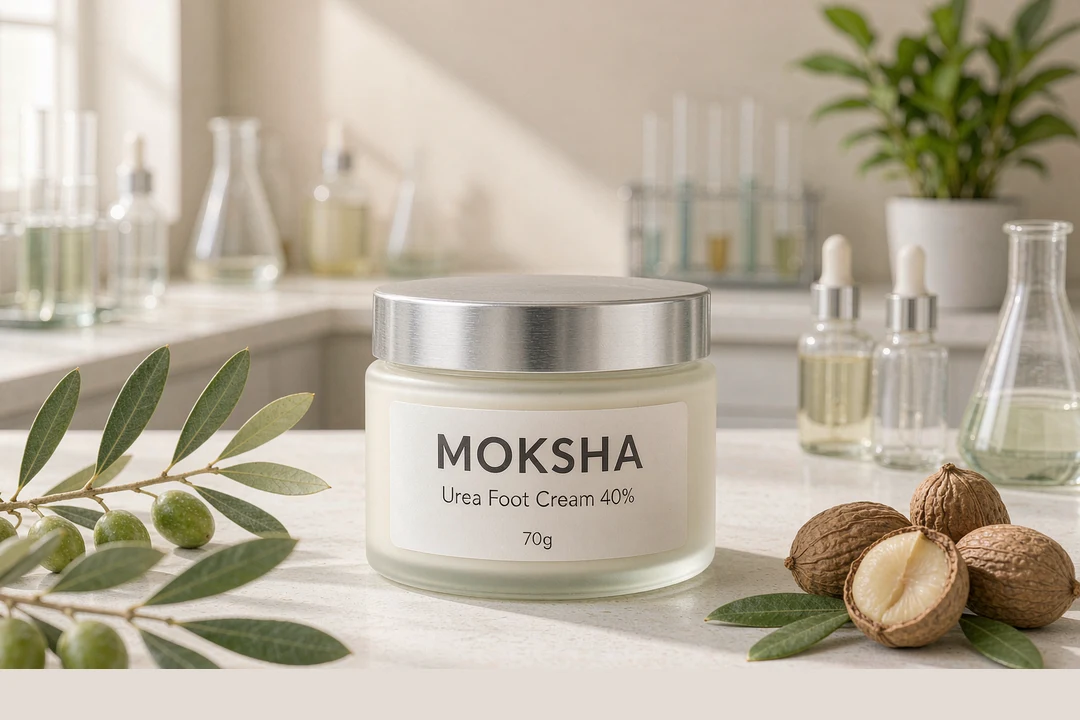
The context comes from a live program: our Urea Foot Cream OEM line — a 40% urea repair balm in a 70 g jar with olive oil, shea butter and vitamin E — running through our ISO 22716 facility at MOQ 3,000 pieces, plus the rest of the Foot Cream OEM catalog it sits on. It also links naturally to a whitening hand cream program, because the same high-urea repair logic sells to two very different aisles.
Why 40% urea is the number the category is built on
Urea is not a novel active — it is a component of the skin’s own natural moisturizing factor, which is why dermatology-grade creams have leaned on it for decades. What changes with concentration is the job the molecule does. At low levels urea is a humectant that binds water in the stratum corneum. As the percentage climbs, it becomes a keratolytic: it softens and dissolves the compacted keratin of calluses and thick heel skin, which is the mechanism behind the classic 40% strength sold in European pharmacies. That keratolytic action is the entire basis of the cracked heel repair category.
The 40%% strength matters commercially because it defines a defensible premium position. A 5%% body lotion competes on price per liter; a 40%% urea repair balm competes on performance, and performance claims are what keep unit economics healthy at bulk volumes. Our 2026 files show the split clearly:
| Strength | Primary job | Typical consumer | Where it sells |
|---|---|---|---|
| 5–10% | Daily humectant moisturization | General dry-skin aisle, gift sets | Mass retail, supermarkets |
| 10–20% | Barrier support, visible smoothing | Dry-to-very-dry skin, older consumers | Pharmacies, drugstores |
| 20–40% | Keratolytic repair of callus and cracked skin | Problem-foot buyers, diabetic foot care | Pharmacies, clinical and online |
| 40% | Intensive repair, fast visible results | Repeat buyers, medical-adjacent retail | Premium pharmacy, export tender |
One practical note buyers always raise: yes, a strong urea cream can sting on broken or freshly fissured skin. That is a formulation instruction, not a defect — the base matters (shea butter and olive oil buffer the feel), and the usage guidance on the carton matters more.
The concentration ladder: 5%, 10%, 20% and 40% do different jobs
Formulating up the ladder is not just a matter of adding more powder. Each step changes the emulsion, the jar and the claim file:
- Solubility and heat: urea needs a water phase and moderate processing temperature. The 40% cream is made with controlled cooling so the active stays intact and the base stays smooth — a process point to verify on a factory call.
- Texture: high-urea creams are richer, almost balm-like. Consumers read that richness as efficacy, which is why the 70 g jar — not a 100 ml tube — is the format that sells at premium prices.
- Stability: urea is stable, but the emulsion around it must pass real-time and accelerated protocols at 40 °C / 75% RH. Ask for the 12-week read, not the 4-week read.
- Preservation: a rich anhydrous-leaning balm can run a lighter preservative load than a light lotion — one more reason a jar program is attractive to clean-label buyers.
Our urea cream private label program standardizes on the 40%% repair balm as the hero SKU, with 10%% and 20%% variants as the line extension. That structure gives a buyer one hero claim, two supporting claims and a single jar platform — the cheapest possible way to fill a shelf.
What the foot care market actually pays for in 2026
The category is bigger than most first-time buyers assume, and it is anchored in pharmacy rather than the cosmetic aisle. Grand View Research sizes the global foot creams segment at USD 1,313.9 million in 2024, growing at a 6.5% CAGR toward USD 2,302.8 million by 2033, with North America the largest region in 2024. The parent foot care products market is projected to reach USD 38.25 billion by 2033 at a 6.8% CAGR, with foot treatments holding the largest share at 39.1% in 2024 and pharmacies and drugstores the leading channel at roughly 37.7%.
Two demand currents sit underneath those numbers. First, aging: skin thins and dries with age, and cracked heels move from a cosmetic annoyance to a comfort issue. Second, diabetes care: an NCD Risk Factor Collaboration analysis published in The Lancet in November 2024 put the global adult diabetic population at roughly 800 million — a patient group for whom daily foot moisturization is standard guidance, and for whom a 40% urea balm is the pharmacist’s usual recommendation.
For a brand owner, the read-through is simple: the premium, repeat-purchase pocket of foot care is pharmacy-channel repair, not mass-market lotion. A wholesale foot cream program built on a 40%% hero SKU lands in the channel that pays the most per jar.
Jars, liners and the component spec that survives 50,000 reorders
A 70 g jar program is a packaging-engineering decision before it is a formula decision. Four specs decide whether the reorder at 50,000 units matches the first production run:
| Component | Standard spec | Premium option | Watch-out |
|---|---|---|---|
| Jar | 70 g PP or PET jar, round, matte finish | Frosted glass jar with metallic lid | Glass raises freight cost ~12–18% per unit — budget it against the premium |
| Liner | Induction seal, foam-backed | Foil + heat-seal laminate | Urea is hygroscopic — a weak seal lets the cream dry out on shelf |
| Closure | Screw lid with ribbed grip | Brushed aluminum look | Rib pattern must be locked in the tooling drawing, not described |
| Carton | Printed 3-layer shelf box | FSC board, soft-touch finish | Humidity above 70% warps board — order with a moisture spec |
Our standard wholesale foot cream platform keeps one jar body across the line, so a second active — a hand balm, a heel sock, a foot mask — costs a label and a carton, not a new tooling.
Claims discipline: where a repair cream stops being a cosmetic
Foot care sits closer to the medical boundary than almost any other cosmetic category, because the most persuasive words — treats, heals, repairs cracked skin — are exactly the ones that move a product out of the cosmetic definition. Under the EU framework, Commission Regulation (EU) No 655/2013 requires every claim to be truthful, evidenced and honest, and national market guidance goes further: authorities such as the Swedish Medical Products Agency list “to treat wounds, cracked skin, abrasions” among the claims that must not be used for cosmetics, while “softening of dry skin” is explicitly acceptable (overview of the claims criteria).
The practical translation for a cracked heel repair program:
- Say: “softens calluses and dry, rough skin”, “smoothes heel texture”, “intensive 40% urea moisture for very dry skin”, “helps reduce the appearance of cracking”.
- Avoid: “heals cracked heels”, “treats diabetic foot”, “cures athlete’s foot” — in the EU these read as medical claims; in the US they can push the product toward OTC drug territory; in Brazil they trigger a different ANVISA notification class.
- Keep the file: whatever the carton says, the substantiation — the use test or instrumental read at the labeled concentration — lives in the product information file, per market.
This is the same discipline we run on every claim in our sunscreen OEM compliance program, where every SPF word maps to a test report.
Market-by-market entry notes for 2026
| Market | Regime | Notification / filing | The watch-out for a foot cream |
|---|---|---|---|
| EU | Regulation (EC) 1223/2009 | CPNP notification before placing on market; PIF signed by a safety assessor | Claims per 655/2013 — repair wording must stay cosmetic; German-language market expects DIN/ISO references |
| US | FD&C Act as amended by MoCRA | Facility registration + product listing; US Agent for foreign facilities | “Treats” wording can make it an OTC drug; serious adverse events reported within 15 business days — see FDA MoCRA |
| Brazil | ANVISA RDC 15/2013 | Notification filed by the local importer holding AFE | Portuguese INCI list; importer CNPJ on label; urea strength shown on carton |
| Middle East | GSO standards; Saudi SFDA | Product registration via SFDA; halal certificate expected by major retail | Arabic labelling; glycerin and any animal-derived additives need documented halal status |
| Southeast Asia | ASEAN Cosmetic Directive | National notification (BPOM for Indonesia, etc.) | Indonesia: halal certification mandatory for cosmetics from 17–18 Oct 2026 — BPJPH has rejected further delays |
Indonesia’s halal deadline lands this month, which makes halal documentation a market-entry ticket for the whole archipelago rather than a niche preference. A factory that already holds the certificate chain removes that item from your critical path entirely.
A 10-week launch playbook for a urea foot line
A real timeline from our 2026 files: a German pharmacy retailer took a two-SKU foot cream OEM program — 40%% repair balm plus a 10%% daily cream — from RFQ to first container in ten weeks. The stability read is the long pole, not bulk filling.
| Week | Milestone | Deliverable |
|---|---|---|
| 1 | RFQ + brief | Urea strength, format, claim set, target markets, carton language |
| 2–3 | Formula development | Base variants at 10 / 20 / 40% with spreadability and sting panels |
| 4 | Component lock | Jar, liner, closure and carton specs frozen; tooling order placed |
| 5–6 | Stability + claim file | Real-time and accelerated protocols launched; claim matrix drafted |
| 7 | Artwork + claim review | Market-specific wording signed off against the claim matrix |
| 8 | Notifications | CPNP / ANVISA / SFDA filings prepared |
| 9 | Pilot batch + QA | Urea assay, viscosity, pH, microbial, 30-person use panel, AQL plan |
| 10 | Bulk + shipping | Production run, pre-shipment inspection, FCL booked |
Scale economics at 3k, 10k, 50k and 100k jars
The cost curve on the urea cream private label 70 g jar program from our 2026 files — the shape big-volume buyers should hold every candidate factory to:
| Program volume | Unit FOB band (jar) | Tooling | Lead time | What changes |
|---|---|---|---|---|
| 3,000 (entry MOQ) | USD 1.30–1.70 | Stock jar platform, printed labels | 35–45 days | You validate the market; we validate the base |
| 10,000 | USD 1.05–1.35 | Dedicated jar tooling amortized | 30–40 days | Custom carton unlocked; second strength on the same jar |
| 50,000 | USD 0.85–1.10 | Multi-cavity tooling, dedicated line slot | 25–35 days | Priority scheduling; lining spec tightened for reorders |
| 100,000+ | USD 0.70–0.95 (annual contract) | Full line booking | 25–30 days + reserved capacity | DDP to EU/US/Brazil; quarterly stability reviews; halal and GSO documentation maintained on file |
Two logistics notes decide landed cost more than unit price: sea LCL works up to roughly 15 cbm, beyond which FCL typically saves 20–30%% per unit on freight; and glass jars are dense, so container planning starts with the carton dimensions, not the jar count.
How to audit a foot care factory in one call
- Ask how the 40% base is processed — controlled cooling or hot-pour. The answer predicts texture and stability.
- Ask for the 12-week stability read at 40 °C / 75% RH on the finished jar (not the bulk), plus the 45 °C read if the Gulf is a target market.
- Ask for the urea assay method on the finished product and the last three certificates of analysis.
- Ask which claim words they will put on the carton for each market — a factory that cannot produce a claim matrix per market will outsource your compliance risk to you.
- Ask for the halal certificate chain and the COA / MSDS / Free Sale certificate set now, even if Indonesia is a 2027 plan.
- Ask whether the jar platform is shared across the line — one tooling set for three strengths is the difference between a program and three projects.
Our facility is certified under ISO 22716 and GMPC, exports to 30+ countries, and runs 40%% urea bases with in-house stability testing and a per-market claim matrix across every urea cream private label program we develop. If you are building a Urea Foot Cream line for 2027 pharmacy planograms, the fastest next step is a concentration and claim review against your target markets.
Not sure whether your hero SKU should be 20% or 40%? Send us your target market and channel — we will reply with the matching base dossier, claim matrix and samples. Request the formula dossier →
Ready to Launch Your Foot Care Line? Talk to Us
☎ Phone / WhatsApp: +86 133 6440 1300
✉ 邮箱 sales@moksha-bio.com
🕐 Working Hours: Monday – Saturday, 9:00 – 18:00 (GMT+8)
✉ Inquiry This Product — Get a Free Quote
📍 Book a Factory Visit
Keep reading: Sunscreen OEM 2026: SPF Testing Costs, Regulatory Path & Private Label Playbook · BB Cushion OEM 2026: Shade Range, Puff Tech & Export Playbook · Hair Care Set OEM 2026: Formulas, Bottles & Export Playbook
暂无评论