


29 8 月 Physical vs Chemical Sunscreen OEM: [Pro Formulation Guide]
Choosing Your Defense: A B2B Guide to Physical vs Chemical Sunscreen OEM Strategy
In the rapidly evolving world of sun care, the choice between mineral and organic filters is the most critical decision a brand owner must make. Understanding the Physical vs Chemical Sunscreen OEM landscape is essential for developing a product line that meets specific consumer demands in markets like the USA, EU, and Brazil. Physical sunscreens (Mineral) rely on blockers like Zinc Oxide, while chemical sunscreens utilize absorbers to neutralize UV rays. As a leading manufacturer, we provide the technical depth and broad spectrum formulation R&D required to excel in both categories. This 2026 guide explores the scientific differences between these filters and why our facility is the preferred GMPC sunscreen factory China for professional distributors.
The Rise of the Zinc Oxide Sunscreen Manufacturer
The demand for “Clean Beauty” has led to a surge in mineral-based protection. As a specialized Zinc Oxide sunscreen manufacturer, we focus on overcoming the traditional hurdles of mineral filters—namely, the “white cast” and gritty texture. Our R&D team utilizes micronized and nano-particle Zinc Oxide to create sheer, elegant finishes. According to dermatological research on Mineral UV Filters (Dofollow Link), physical blockers are ideal for sensitive skin and post-procedure recovery. In our facility, we implement specialized dispersing technology to ensure these minerals remain stable in our mineral sunblock private label projects, providing a core advantage of the Chinese Private Label Cosmetics Advantage.
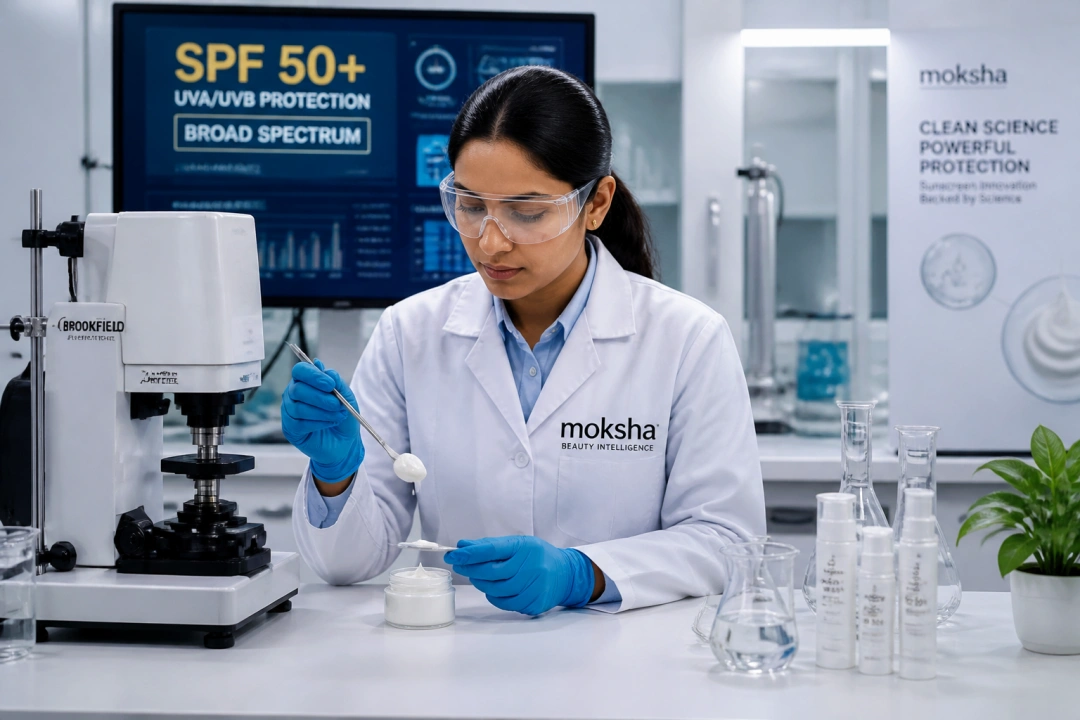
Our commitment to modernization ensures that our GMPC sunscreen factory China is equipped with advanced vacuum mixers that prevent the clumping of physical filters. We employ digital tracking systems to monitor every variable—from homogenization speed to particle distribution—ensuring that your Physical vs Chemical Sunscreen OEM project provides total consistency across millions of units. This level of technical oversight allows us to support rapid inventory turnaround for high-volume distributors who demand scientifically validated solutions that meet the highest purity benchmarks of 2026. Every batch we produce is a testament to our manufacturing excellence.
Mineral vs. Organic Sunscreen Comparison
| Feature | Physical (Mineral) | Chemical (Organic) | Moksha R&D Focus |
|---|---|---|---|
| Mechanism | UV Reflection/Scattering | UV Absorption/Conversion | Broad Spectrum Protection |
| Skin Feel | Thicker / Matte | Lightweight / Invisible | Sheer Finish Optimization |
| Wait Time | Immediate Protection | Requires 15-20 Minutes | Fast-Action Formulations |
| Stability | High (Inert) | Sensitive to UV Heat | Encapsulated VC/PE Stability |
The Versatility of Chemical Sunscreen Formulations
While mineral options are trending in the clinical space, chemical filters remains the backbone of the mass-market and e-commerce sectors due to their superior aesthetics. As a leading manufacturer, our broad spectrum formulation R&D focuses on creating high-SPF chemical sunscreens that are completely invisible on the skin. We utilize modern filters like Ethylhexyl Triazone and Tinosorb to provide stable, non-irritating protection. According to recent reports on Cosmetic Safety (Dofollow Link), the innovation in chemical filter encapsulation has solved many of the irritation and absorption issues of the past. This allows your brand to offer high-performance daily moisturizers with SPF that feel as light as a standard lotion, a critical factor for success in high-heat markets.
Our quality assurance team operates independently, conducting intensive stress testing on every Physical vs Chemical Sunscreen OEM project. We simulate extreme environmental conditions to ensure that the chemical bonds remain stable and do not degrade under intense UV radiation. This level of oversight is particularly important for high-volume wholesale distributors who need to verify the clinical provenance of their inventory before exporting to strict markets like the USA. By choosing a partner that understands the scientific nuances of filter stabilization, you minimize commercial risk and maximize your long-term return on investment in the premium sun care sector. We provide the laboratory proof needed to justify your brand’s quality claims to retailers and consumers alike.
Global Market Compliance and Purity Certification
Navigating the regulatory landscape for SPF products is meticulously handled by our team. Whether you are focused on a mineral sunblock private label line or a hybrid formula, we prepare the complete technical dossiers for CPNP notification in Europe and ANVISA registration in Brazil. Our manufacturing process ensures that every active filter concentration is verified by HPLC before mass production begins. We strictly adhere to ISO 22716:2007 (Dofollow Link) guidelines, ensuring that our 10,000-grade cleanrooms protect the bioactivity of your formulas during the sensitive vacuum emulsification and filling stages required for high-SPF products.
As your strategic partner, we provide the Certificate of Analysis (COA) and Stability Testing Reports for every batch produced. This transparency is vital for wholesale distributors who must comply with the updated MoCRA and FDA labeling standards in the USA. Our regulatory experts act as your Technical Backbone, ensuring that your product labeling is accurately translated and legally sound for all target regions. Every document leaving our GMPC sunscreen factory China facility is designed for rapid customs clearance, allowing you to scale your business across North America, Europe, and South America with total confidence. We handle the technical complexities so you can focus on building your brand’s global presence.
B2B FAQ: Sourcing Sun Care Solutions
Q1: What is the main differentiator in your Physical vs Chemical Sunscreen OEM service?
A: We focus on nano-dispersion for mineral filters (zero white cast) and encapsulation for chemical filters (low irritation), providing superior skin-feel for both.
Q2: Can your broad spectrum formulation R&D team develop “Reef Safe” options?
A: Yes, we offer formulas free from Oxybenzone and Octinoxate to meet the latest environmental standards in the EU and North American coastal regions.
Q3: Does a mineral sunblock private label project require special ANVISA testing for Brazil?
A: Yes, we provide the specific high-humidity stability tests and mineral purity analysis required by Brazilian health authorities for successful notification.
Q4: How can I request a quote from this GMPC sunscreen factory China?
A: Simply reach out through our Contact Page. We provide detailed pricing and custom lab samples for verified B2B partners within 7 business days.
📚 Strategic Sun Care Resources
Launch Your Premium Sun Care Brand Today
Partner with an expert factory that delivers clinical science, industrial scale, and global quality assurance. Let’s take your SPF brand global.
暂无评论