


20 10 月 Honey Face Mask OEM 2026: The Best 30 g Moisturizing Sheet Mask & Export Playbook
Table of Contents
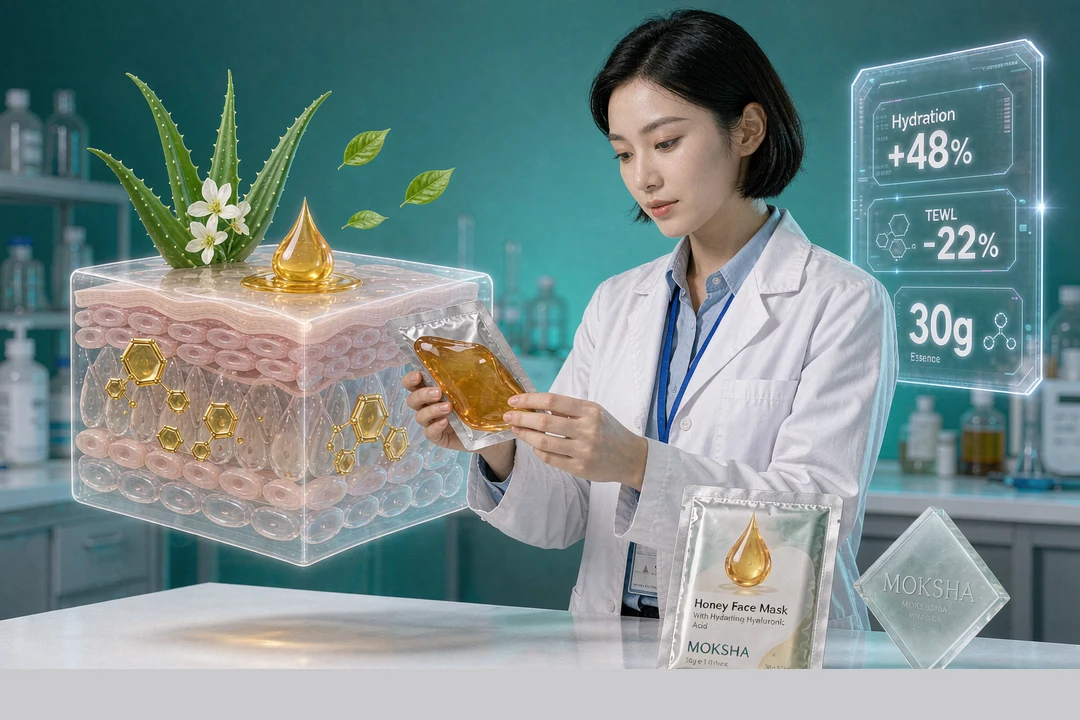
Sheet masks are the highest-frequency repeat purchase in facial care, and honey is the one moisturizing story every one of your export markets already believes. A Honey Face Mask OEM program lives or dies on three decisions: the essence system, the sheet material, and the wear-time protocol printed on the pack. This guide is the spec conversation we run with private-label partners before quoting the Honey Face Mask OEM line — 30 g of fresh honey juice essence in an ultra-soft fiber sachet — alongside the wider Face Mask OEM catalog it sits on.
Everything below comes from our 2026 production files for big-volume buyers: what the clinical record actually supports for honey in cosmetics, how the 30 g essence is built, which moisture claims survive review in your five export markets, and what the unit curve looks like from a 3,000-piece entry order to a 100,000-piece annual program.
Why honey became the default moisturizing story on the mask shelf
Honey is the rare active that needs no consumer education in any of our target regions. It carries a trusted-sweet sensory story in the Gulf and Brazil, a K-beauty-validated format story in Southeast Asia and the US, and a clean-label story in the EU — all at once.
The dermatology literature backs the cosmetic positioning: a review in the Journal of Cosmetic Dermatology describes honey as exerting emollient, humectant and soothing effects in cosmetic formulations, with typical use levels between 1 and 10 percent (Burlando & Cornara, PMID 24305429). That humectant profile is exactly what a moisturizing sheet mask needs: an ingredient that pulls water into the stratum corneum and holds it there for the whole wear session, then keeps working after the sheet comes off.
Honey also solves a formulation problem. Most sheet essences lean on glycerin alone, which hydrates but reads as “wet” rather than “cared for”. A honey-based essence at 1–5 percent adds body, a faint natural scent and a tack-free, non-greasy finish — the sensory cues consumers describe as “nourishing” in reviews. For a face mask private label program, that means the moisturizing claim and the premium feel arrive in the same sachet, without paying for a synthetic-feel polymer system.
What the 2026 honey mask market pays for
Three market frames matter for this build. Verified Market Reports sizes the global sheet face mask market at USD 3.2 billion in 2025, projected to reach USD 4.9 billion by 2034 at a 5.5% CAGR. Market Intelo sizes the honey skincare segment — led by manuka-honey positioned products — at USD 1.2 billion in 2025, heading to USD 2.2 billion by 2034 at a 7.8% CAGR, with Asia-Pacific holding 38.2% of revenue. And honey’s own cosmetic application segment is estimated at roughly USD 1.05 billion, about 12% of the global honey market. The read-throughs for a wholesale sheet mask buyer:
- Hydration is the repeat claim: the segment growth is concentrated in moisturizing and soothing masks — the everyday-use lane — rather than one-shot gimmick formats. A honey essence sits in the paying lane by default.
- Honey is the fastest-growing ingredient story in masks: honey skincare is compounding above 7.8% while the overall sheet mask category grows at 5.5% — buyers are trading up into the ingredient.
- The format travels: single-dose sachets are routine purchases in the US, the Gulf and Southeast Asia, so a full-English back label drops straight onto export shelves without re-education.
That combination — routine repeat demand, a credible natural ingredient story, and a logistics-friendly format — is what a Honey Face Mask OEM program packages for the buyer.
The honey evidence file: humectant science and the 25-minute rule
Three pieces of evidence shape how we build and instruct this product — and one hard boundary. The Journal of Cosmetic Dermatology review establishes honey’s cosmetic functions: emollient, humectant and soothing, at 1–10% use levels, with the humectant action driven by honey’s fructose-glucose matrix and amino acids (PMID 24305429). The companion systems in our 30 g essence are equally documented: a corneometer study of freeze-dried aloe vera extract at 0.10–0.50% found a measurable increase in stratum corneum water content versus vehicle after both single and two-week application, consistent with a humectant mechanism (Skin Research and Technology, PMID 17026654).
The boundary is this: honey’s strongest clinical record is medical. A Cochrane review of 26 trials with 3,011 participants found high-quality evidence that honey dressings heal partial-thickness burns faster than conventional dressings (WMD −4.68 days, 95% CI −5.09 to −4.28), and a separate dermatology review documents antimicrobial and immune-modulating activity (Cochrane, PMC9719456; PMC5661189). Those are therapeutic claims on medical-grade honey — a cosmetic sheet mask must not borrow them. Our instruction sheets keep the claim set to moisturizing, comforting and soothing-the-look-of-dry-skin wording, which is defensible everywhere we ship.
The third piece of evidence is about use, and it is the finding most brands print wrong. A 2024 randomized controlled trial in the Journal of Cosmetic Dermatology compared mask types worn for 5, 15, 25 and 40 minutes (n = 28): hydration rose and then fell, sebum climbed after 40 minutes, and adverse effects — redness (10.71%) and dryness (57.14%) — clustered in over-25-minute wear times (PMID 38951050). For any face mask private label buyer, that single study rewrites the instruction copy:
- Print the protocol on the pouch: our packs specify a 15–20 minute session — inside the clinically comfortable window and long enough for the full 30 g dose to transfer.
- Never print “overnight” or “until dry”: a mask that dries onto the face reverses the benefit and generates the complaints the trial measured.
- Keep claims cosmetic: “floods skin with moisture for a soft, comfortable finish” is defensible; wound-healing or treatment wording changes the product’s regulatory class.
The 30 g essence, system by system
A Honey Face Mask OEM build has one chance to feel right. The essence is five systems in a sachet: the honey active, the humectant phase, the soothing phase, the skin-conditioning phase and the preservative system. The spec that decides whether the reorder at 50,000 pieces matches the pilot:
| System | Typical spec | What it does | The failure mode to spec against |
|---|---|---|---|
| Honey extract | 1–5% | Humectant plus the sensory story; emollient, soothing finish | Floral source shifts color and scent — lock a sensory and color tolerance per lot |
| Aloe extract | 0.5–2% | Soothing hydration support with corneometer evidence | Polysaccharides degrade without stabilization — challenge-test the final laminate |
| Hyaluronic acid | 0.05–0.2% | The instant plumping feel consumers score in reviews | Needs pH 5–7; hydrolyzes outside the window |
| Glycerin | 3–8% | The workhorse humectant that carries the moisture claim | Under-humectant essence dries tacky before the wear time ends |
| Allantoin + panthenol | 0.2–0.5% | Soothing; offsets the redness risk over-wear creates | Skipped in cheap builds — shows up as stinging complaints |
| Preservation | Per market lists | A wet sachet is a growth medium | Preservative efficacy must be challenge-tested in the final laminate |
Our reference build is a 30 g essence: honey extract, aloe extract, hyaluronic acid, glycerin and allantoin, pH 5.5–6.0, viscosity tuned so the sheet carries the full dose without drip. A honey variant and an aloe variant share the same sheet platform, so a second SKU costs you artwork — not a new line. Every batch is validated for essence load per sheet, sheet wet-out uniformity and microbial challenge before bulk release.
Sheet, sachet and honey dipper artwork
For any sheet mask OEM program, the sheet and the sachet decide the unboxing as much as the essence decides the result. The component spec we lock before tooling:
| Component | Standard spec | Premium option | Watch-out |
|---|---|---|---|
| Sheet | Ultra-soft plant fiber cloth, 0.2–0.3 mm | Bio-cellulose or tencel-class sheet | Sheet weight must match the 30 g load or the mask drips |
| Fold | Three-fold, pre-moistened | Individually folded with mesh backing | Fold geometry decides how the mask unfolds on the face |
| Sachet | Illustrated foil with honey dipper artwork | Matte soft-touch laminate, spot UV | Laminate must be essence-compatible — some prints migrate |
| Carton | Printed 5-pc or 10-pc shelf box | FSC board, die-cut window | Box count is a channel decision: 5 for gifting, 10+ for e-commerce |
Our default is the ultra-soft plant fiber sheet in an illustrated foil sachet with a full-English back label — the configuration we recommend for a moisturizing sheet mask program: cheapest per unit at volume, retail-ready artwork included in the OEM service, and the setup our wet-out data is validated on.
Choosing between a fiber sheet and bio-cellulose for your 2027 honey line? Send us your target market and price point — we will reply with the matching essence dossier, wet-out data and samples. Request the formula dossier →
Moisture claims that survive review in every market
Moisture claims are the most scrutinized wording on any hydrating mask — and the honey evidence file cuts both ways: it supports “moisturizes” comfortably, but the moment the copy drifts toward healing language it leaves the cosmetic class. The claims that survive review:
| Market | Safe claim language | Claims that change the regulatory class |
|---|---|---|
| EU | Moisturizes; helps skin retain moisture; comforts dry skin | Any therapeutic, healing or treatment wording; structure-function claims |
| US | Moisturizes; hydrates; soothes the look of dry skin | “Heals”, “treats eczema or acne” or other drug-adjacent wording |
| Brazil | Hidratante (moisturizing cosmetic class) | Claims outside ANVISA’s cosmetic listing; therapeutic language |
| Middle East | Moisturizing, nourishing, soothing | Medical or healing wording in some GSO states |
| Southeast Asia | Moisturizing is a listed ASEAN function — register it as such | Unregistered functional wording at retail |
Two deserve emphasis. In the US, MoCRA facility registration and product listing are mandatory, and the FD&C Act wording test decides whether a moisturizing claim stays cosmetic. In Southeast Asia, moisturizing is a legitimate registered function under the ASEAN annexes — the failure mode is selling it unregistered, not selling it at all. Our claim matrix ships with every dossier.
Export entry notes: EU, US, Brazil, Gulf and SEA
| Market | Regime | Notification / filing | The watch-out for a honey sheet mask |
|---|---|---|---|
| EU | Regulation (EC) 1223/2009 | CPNP notification; PIF signed by a safety assessor | Single-use wet formats still need full preservation and challenge data |
| US | FD&C Act + MoCRA | Facility registration and product listing; US agent | Keep claims cosmetic; register the listing before import |
| Brazil | ANVISA RDC 907/2024 | Notification via local importer holding AFE | Portuguese INCI; essence identity on the technical file |
| Middle East | GSO standards; Saudi SFDA | SFDA registration; halal certificate | Arabic labelling; wet single-dose formats need documented shelf life |
| Southeast Asia | ASEAN Cosmetic Directive | National notification (BPOM etc.) | Indonesia halal mandatory from 17–18 Oct 2026 — BPJPH |
The sheet mask’s hidden regulatory trap is water activity: a pre-moistened sachet is an aqueous product regardless of how natural the story is, so the preservation file is the first thing an assessor opens. Ours is on file with the COA and MSDS set.
Scale economics at 3k, 10k, 50k and 100k pieces
The cost curve on the 30 g sheet mask OEM program from our 2026 files — the shape every wholesale sheet mask buyer should hold candidate factories to:
| Program volume | Unit FOB band (sachet) | Tooling | Lead time | What changes |
|---|---|---|---|---|
| 3,000 (entry tier) | USD 0.28–0.40 | Stock sheet, printed pouch | 15–25 days | You validate the market; free samples and full export docs included |
| 10,000 | USD 0.22–0.30 | Custom pouch artwork amortized | 14–22 days | Custom carton unlocked; the aloe variant shares the same sheet platform |
| 50,000 | USD 0.17–0.24 | Multi-lane filling, dedicated line slot | 12–20 days | Priority scheduling; bio-cellulose sheet unlocked on the same essence |
| 100,000+ | USD 0.14–0.20 (annual contract) | Full line booking | 12–18 days + reserved capacity | DDP to EU/US/Brazil; quarterly reviews; halal and GSO documentation maintained on your file |
Two logistics notes decide landed cost more than unit price: flat sachets are the most cube-efficient format in all of beauty — a 40-ft container carries millions of pieces — and because the pouch is the barrier, we burst-test the seal on every lot for e-commerce survival. The honey active itself adds only cents per unit at 1–5% loading; the money is in the sheet and the print, which is where our scale does the work.
Our facility is certified under ISO 22716 and GMPC, exports to 30+ countries, and runs the Honey Face Mask OEM program with in-house wet-out testing, per-batch challenge data and a per-market claim matrix. If you are building a hydration wall for 2027 planograms, the fastest next step is an essence-and-sheet review against your target markets — the related Grape Seed Face Mask OEM playbook covers the brightening sister format if you want both shelves.
Ready to Launch Your Honey Mask Line? Talk to Us
☎ Phone / WhatsApp: +86 133 6440 1300
✉ 邮箱 sales@moksha-bio.com
🕐 Working Hours: Monday – Saturday, 9:00 – 18:00 (GMT+8)
✉ Inquiry This Product — Get a Free Quote📍 Book a Factory VisitKeep reading: Gold Eye Mask OEM 2026: The Best 24K Collagen Crystal Patch Format & Export Playbook · Anti Wrinkle Eye Cream OEM 2026: The Best Hyaluronic Acid 60g Formula & Export Playbook · Caviar Eye Cream OEM 2026: The Best Anti-Aging Repair Tube & Export Playbook · Grape Seed Face Mask OEM 2026: The Best 25 ml Whitening Sheet Mask & Export Playbook · Castor Oil Eyelash Serum OEM 2026: The Best 15 ml Lash Conditioning Formula & Export Playbook · Mud Body Scrub OEM 2026: The Best Plant Extract Mud Gel Formula & Export Playbook
More export playbooks: Heart Bath Bomb OEM 2026: The Two-Tone Fizzy Gift Format & Export Playbook · Gem Handmade Soap OEM 2026: The Artisan Gemstone Format & Export Playbook · Bath Bomb Set OEM 2026: The Cake Home Spa Format & Export Playbook · Body Moisturizing Oil OEM 2026: The Brightening Body Oil & Export Playbook · Hand Foot Cream OEM 2026: The Shea Butter Repair Formula & Export Playbook · Candy Body Scrub OEM 2026: The Sugar Cube Exfoliating Format & Export Playbook
More from the OEM series: Vitamin C Face Cream OEM 2026: The Brightening Moisturizer & Export Playbook · Ginger Foot Mask OEM 2026: The Exfoliating Peeling Socks & Export Playbook · Avocado Foot Mask OEM 2026: The Proven 80 g Booties Formula & Export Playbook · V Line Lifting Mask OEM 2026: The Double-V Chin Format & Export Playbook · BB Cream OEM 2026: The Color-Correcting Format & Export Playbook · Whitening Hand Cream OEM 2026: The Brightening Balm & Export Playbook
Earlier guides: Urea Foot Cream OEM 2026: The 40% Formula & Export Playbook · Hair Care Set OEM 2026: Formulas, Bottles & Export Playbook · BB Cushion OEM 2026: Shade Range, Puff Tech & Export Playbook · Sunscreen OEM 2026: SPF Testing Costs, Regulatory Path & Private Label Playbook · Mud Mask OEM 2026: Clay, Set Economics & Export Compliance · Step-by-Step Eye Mask OEM Process: A Guide for Brands
暂无评论