



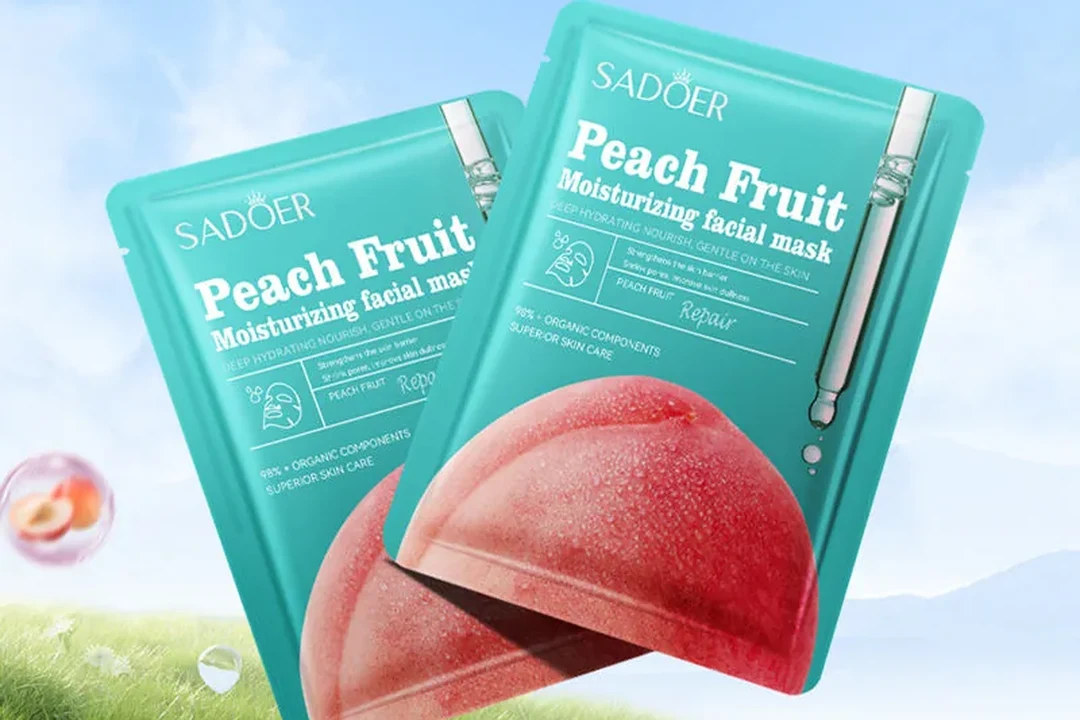
25 Oct Peach Face Mask OEM 2026: The 3 Fixes That Ended the Winter Stickiness
Table of Contents
The email arrived in the first week of January, from a private-label buyer in Toronto who had taken delivery of a 3,000-piece order two months earlier. “Your 25 g peach mask samples tested beautifully in October,” it read. “By January my customers were writing that the mask feels tight and sticky by noon. Did you change the formula?” We had not changed anything — and that was exactly the point. Every Peach Face Mask OEM buyer who ships into North America and Northern Europe meets the same physics eventually, and this article is the full answer we sent back.
Here is who should read it. If you are sourcing a Peach Face Mask OEM program for a winter market, or reordering a Wholesale Sheet Mask line that quietly underperformed between December and March, the six sections below are the diagnostic we run for Peach Face Mask OEM clients: formula architecture, usage protocol, climate spec — plus the five questions we would ask any Sheet Mask OEM factory before wiring a deposit. A Face Mask Private Label program that survives its first winter is a program that survives, and the failure mode is almost never the factory.
The Toronto Email That Started It
Here is what we knew about that order. The buyer had launched a 25 g Peach Face Mask OEM sachet — peach fruit extract, hydrolyzed collagen, niacinamide and glycerin in a gentle hydrating essence — through her own e-commerce store and two Toronto pharmacies. October and November sell-through was strong, and the reviews used words like “soft” and “glowy”. Then the buildings heated up.
By mid-December the reviews changed: “feels tight by lunch,” “sticky under moisturizer,” “dries on my face if I forget the timer.” Her first suspicion was a formula change; her second was us. Neither was correct, and walking her through why — with the data, not apologies — turned a cancellation threat into a reorder. That diagnostic is now the standard onboarding pack for every Peach Face Mask OEM order we ship to North America.
What Winter Air Does to a Peach Face Mask OEM Essence
Start with the mechanism. The essence in a Peach Face Mask OEM sachet is a humectant-led system: glycerin, hyaluronic acid and hydrolyzed collagen all hold water at the skin surface, and peach extract adds vitamins and a comforting feel. In a humid room that architecture is close to ideal — water is plentiful, the humectants keep it in place, and skin feels cushioned for hours.
In a heated Toronto apartment in January, indoor relative humidity routinely drops below 30%. A humectant applied to skin in very dry air does not stop being a humectant; it simply has less environmental water to work with, and it can pull water from the deeper layers of the skin toward the surface instead. If that surface water then evaporates — faster, in dry air — the net effect can feel like tightness rather than hydration. Nothing in the formula failed. The room changed.
The second half of the complaint — “sticky” — is a film problem, and it is a design choice. Glycerin and collagen at generous loads leave a slightly tacky film that consumers notice the moment they layer moisturizer on top. In October nobody noticed; in January, with a cold-stressed barrier and dry air, the same film feels like glue. A Peach Face Mask OEM spec is therefore a climate spec, not just an ingredient list — the most useful thing a Sheet Mask OEM buyer can internalize before the first reorder of any Wholesale Sheet Mask program.
| Variable | October (sampling season) | January (complaint season) | Consequence |
|---|---|---|---|
| Indoor relative humidity | 45–60% | Under 30% | Humectant has less environmental water; surface evaporation accelerates |
| Skin barrier state | Post-summer, resilient | Cold-stressed, compromised | The same film is felt as tightness instead of comfort |
| Layering behavior | Light gel moisturizer | Heavier cream plus makeup | Tacky film pills and reads as “sticky” |
| Consumer protocol | Timed, rinsed on schedule | Often over-worn while indoors | Past dryness a mask works against hydration (PMID 38951050) |
Read the table as a failure-mode map: four variables, all of them outside the sachet. The formula that sampled beautifully in a humid October was the same formula that disappointed in a dry January — which is why we now sign off every Peach Face Mask OEM spec against the climate it will be used in, not the climate it was sampled in.
What the Clinical Data Says
The literature supports the fix we shipped, and it also draws the honest boundaries of what this format can claim. Four references are worth your time before you lock a Peach Face Mask OEM essence spec.
First, the reference dose for hyaluronic acid is a fraction of one percent: Pavicic and colleagues measured significant improvements in hydration and elasticity with a 0.1% hyaluronic acid cream in 76 women over 60 days (PMID 22052267). Note the word cream — the benchmark formula carried emollients and occlusives alongside the humectant, which is precisely the architecture winter air punishes when it is missing.
Second, usage protocol is not decoration: wear-time sessions found benefits peaked mid-window and reversed with over-wear, with adverse effects clustering past 25 minutes (PMID 38951050) — which is why we print 15–20 minutes and “rinse before dry” on pack. Third, hydrolyzed collagen is a surface film-former and humectant: the 500-Dalton rule (Bos & Meinardi, Experimental Dermatology 2000, PMID 10787704) tells us intact stratum corneum barely passes molecules above ~500 Da, so the honest claim is a smoother, cushioned feel — not rebuilt collagen.
Fourth, the niacinamide in the essence has real support: 2% niacinamide with sunscreen significantly reduced facial pigmentation over four weeks in a 120-person study (PMID 12100180). Those four references are the whole claims file for a Peach Face Mask OEM program — and for any Peach Sheet Mask variant built on the same essence base. A Sheet Mask OEM factory that cannot point to the same four is guessing with your label.
The 3 Fixes We Shipped for Every Peach Face Mask OEM Program
We did not redesign the product; we rebalanced it, and we put the protocol where the consumer can see it. Three fixes, in the order we would apply them to any Wholesale Sheet Mask line heading into a dry season — and all three now ship as standard on every Peach Face Mask OEM order above 3,000 pieces.
| Fix | What changed | What it costs | Why it works |
|---|---|---|---|
| 1. Essence architecture | Rebalanced the humectant-to-emollient ratio and added a light emollient ester plus a breathable film-former; total sodium hyaluronate stays at 0.1–0.2% multi-weight | About USD 0.01 per sachet (illustrative 2026 range) | The film stops tacking under moisturizer, and the humectants keep a partner that slows evaporation in dry air |
| 2. Protocol on pack | “15–20 minutes, rinse before dry, follow with your cream” printed on the sachet back plus an insert card | Plate change only | The wear-time data shows masks past dryness work against hydration — the printed timer is free efficacy |
| 3. Climate spec | Viscosity specification at 4°C and 35°C, 45°C / 75% RH stability file, and batch seal-integrity (leak) testing | Test plan, not formula | Winter shipping and Gulf summers are the two ends of one spec; a sachet that survives both never generates a leak claim |
None of the three fixes required a new registration, and together they cost about a cent per sachet — the kind of number that matters when a reorder is 10,000 pieces. The lesson from Toronto is not “add more actives”; it is that the cheapest fix in a Peach Face Mask OEM program is usually architecture and instructions, not a higher percentage on the front label.
Five Questions to Ask Any Sheet Mask OEM Factory
If you remember nothing else from this article, remember these five questions. They take one email, and they separate factories that have shipped through a winter from factories that have only shipped through a catalogue — ask them before you reorder any Peach Face Mask OEM line, or any Peach Sheet Mask program built on the same essence base.
One: what is the humectant-to-emollient architecture of the essence — not the percentages, which every factory guards, but the functional roles on the INCI list? Two: is the usage protocol printed on the sachet, and can you send the artwork proof before the plates are cut? Three: is there a viscosity specification at both 4°C and 35°C, plus 45°C / 75% RH stability data on the exact formula? Four: what is the sachet seal specification, and do you run a leak test on every batch? Five: will you send a sample batch with a COA before payment, early enough for your own market to test it?
A Sheet Mask OEM partner who answers all five in writing has almost certainly rescued a winter order before — and a Peach Face Mask OEM reorder placed with that partner is the one that still has five-star reviews in February. A Wholesale Sheet Mask supplier who answers two of five is quoting you a summer product — and the Face Mask Private Label brand pays for it in January.
The Demand Backdrop
None of this matters if the category is not moving, and it is. The global patch and sheet mask market is tracked at USD 2.8 billion in 2025 heading to USD 5.3 billion by 2035, with “natural” the largest claim segment at 54% and the US alone at USD 659.1 million. Hydrating masks are the winter peak in North America and Northern Europe — the exact season that broke the Toronto order — which means a Peach Face Mask OEM program launched with a climate-proof spec is timed for the quarter when the category sells hardest.
The peach positioning fits that lane honestly: peach fruit extract and glycerin for comfort, niacinamide for tone, hydrolyzed collagen for the cushioned feel, and an essence spec that behaves in dry air. A Peach Face Mask OEM program built on this essence architecture is timed for the quarter when the category sells hardest. If your 2026 roadmap includes a Peach Sheet Mask line for a winter market, send us the market and the essence brief — we will return the same diagnostic we sent Toronto, filled in with your numbers, within 24 hours.
Get your Peach Face Mask OEM sample pack and winter-climate essence review — MOQ 3000, free samples, 24-hour quote.
☎ Phone / WhatsApp: +86 133 6440 1300
✉ Email: sales@moksha-bio.com
🕐 Working Hours: Monday – Saturday, 9:00 – 18:00 (GMT+8)
✉ Request the Quote — Reply Within 24h📍 Book a Factory VisitKeep reading: Honey Face Mask OEM Guide · Grape Seed Face Mask OEM Guide · Avocado Facial Mask Cost Breakdown · Collagen Sleep Mask OEM Guide · Peach Bubble Clay Mask OEM Guide
Sources: Pavicic 2011 (PMID 22052267); sheet-mask wear-time study (PMID 38951050); Bos & Meinardi 2000, 500-Dalton rule; Hakozaki 2002 niacinamide study; Global Market Insights patch & sheet mask outlook (USD 2.8B→5.3B). Climate figures are illustrative ranges from our shipment files, not a laboratory report.
Frequently Asked Questions
What is your sample policy for Peach Face Mask 3?
Samples of Peach Face Mask 3 are prepared in 7-10 working days for existing formulas and ship with a specification sheet so the tested batch matches production. Sample cost is credited against the first bulk order.
Do you support small trial orders before scaling Peach Face Mask 3 production?
Yes. Start at the 3,000-5,000 pcs MOQ to test your market, then scale. The same production line and QC standard apply from the first trial run to full volume.
How do you protect my Peach Face Mask 3 formula and artwork?
Custom formulas and packaging artwork are used exclusively for your orders. NDAs are signed before technical exchange, and masters stay in your control.
No Comments