


16 Nov Glycolic Acid Toner OEM: 6 AHA Label Checks That Pass
An aha toner manufacturer can put “7% glycolic acid” on a bottle in an afternoon. Passing the label through a US retailer’s compliance review and an EU import inspection takes longer — and it is where most acid toner projects stall. The six checks below are the ones we run on every glycolic acid toner oem artwork before it goes to print, and they are the difference between a launch and a relabel.
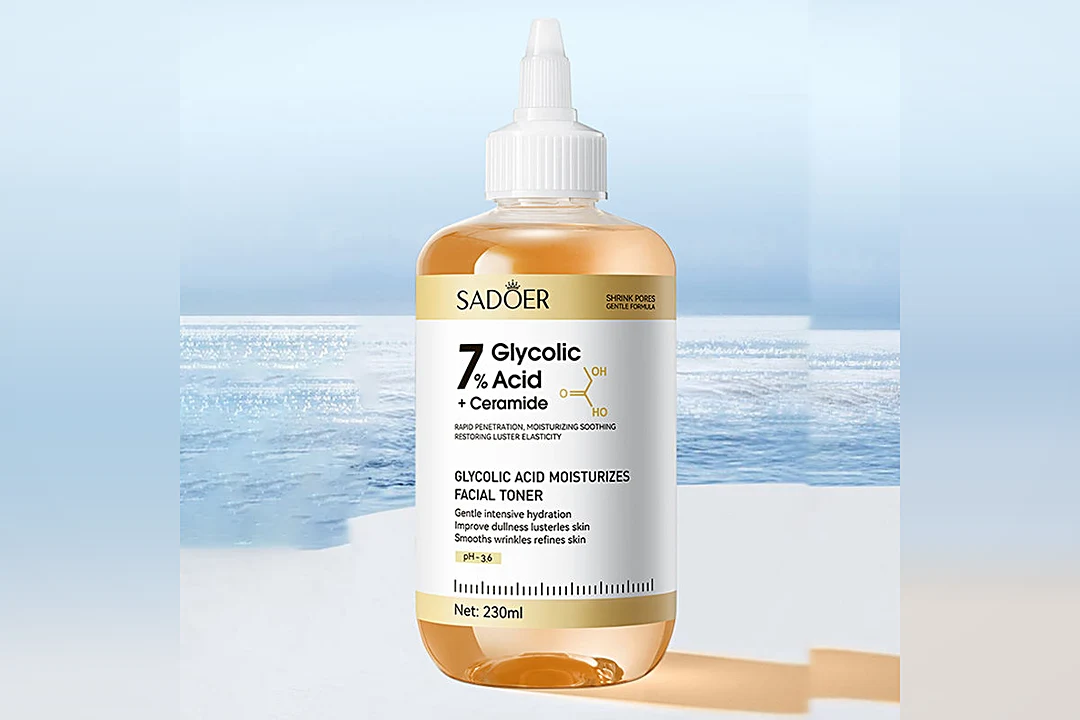
The reference product is our glycolic acid toner: a 7% AHA essence water buffered with ceramides, held at pH 3.8–4.2, filled into a 230 ml pump bottle. The formula is the easy part; the six checks decide what the label is allowed to say.
Table of Contents
Check 1–2: Dose by Destination and pH
Check 1: the same acid dose does not pass everywhere. US guidance for cosmetic AHA products lands around 10% with a pH of 3.5 or higher plus sun-protection wording, while the EU review path is stricter — roughly 4% free acid at pH 3.8 for leave-on products (PMC11268769, AHA efficacy and regulatory review). We quote the 7% version for US, Middle East and Southeast Asia programs and dial an EU-bound run off the same line at the EU dose; the base, the bottle and the pump do not change, only the fill and the panel.
Check 2: the pH belongs on the spec sheet, not just in the lab book. Glycolic acid works by freeing the acid, and effectiveness tracks pH, concentration and exposure time — the dermatology literature is consistent on that triple (PMC3047947, hydroxy acids: mechanisms and photoactivity). A glycolic acid toner oem quote without a pH window is a quote for something else. Ours runs pH 3.8–4.2, verified per batch.
Ask any exfoliating toner supplier for the dose and pH per destination in one email. If the answer is a brochure, keep shopping; if it is a spec sheet, you have found a factory.
Check 3–4: Sunburn Alert and Claims Line
Check 3: the sunburn alert. AHAs increase sensitivity to UV, and the US label convention is explicit about it — AHA products carry sunburn-alert wording and a direction to use sunscreen (FDA, Alpha Hydroxy Acids). It is a small panel block that saves an entire retailer-compliance cycle, and skipping it is the most common reason a US-bound acid toner gets pulled from listing.
Check 4: the claims line. “Exfoliates and smooths the look of skin texture” is cosmetic; “treats acne”, “repairs skin” or any percentage-efficacy promise drifts toward the drug line in both markets. We keep the copy on texture, tone appearance and smoothness, backed by the pH and dose data rather than by invented percentages — the gap between label and file is exactly what both regulators audit.
Check 5–6: Barrier Support and Documents
Check 5: what sits under the acid. An AHA opens the barrier; the formula should close it again. Our 230 ml toner pairs the acid with a ceramide complex and a hydrating glycerin-plus-sodium-hyaluronate base, which is also the retail story: exfoliation with comfort, not the tight-sting finish that fills review sections. Any chemical exfoliant toner moq conversation should ask for the buffer system before it asks for the price.
Check 6: the document pack. Batch COA and MSDS, INCI dossier, ISO 22716 and GMPC certificates, CPNP-ready files for the EU under Regulation (EC) 1223/2009 and MoCRA facility registration with a US agent (EUR-Lex, EC 1223/2009). Acid products get inspected more closely than moisturizers; the pack should already exist when the inspector asks.
| Check | US program | EU program |
|---|---|---|
| Free acid dose | Up to ~10% (7% typical) | ~4% leave-on, same line re-dosed |
| pH window | ≥3.5, ours 3.8–4.2 | ≥3.8, ours 3.8–4.2 |
| Sun wording | Sunburn alert + SPF direction | Sun avoidance wording |
| Claims | Texture / tone appearance | Same, claims file per 655/2013 |
| Documents | MoCRA listing + US agent | CPNP + PIF, EC 1223/2009 |
| Buffer system | Ceramide + HA base | Same formula, dose re-set |
Six Checks Before a Glycolic Acid Toner OEM Print Run
Run the six in order and the artwork goes to print once, not three times. Every glycolic acid toner oem project we run now gates the print on this list, because the cheapest failure is the one caught in the PDF stage — a relabel at the port costs the margin the acid was supposed to earn. A glycolic acid private label program that passes all six is also the one retailers onboard fastest, which is where the sell-through actually happens.
Send your destination market and dose preference — we will return a glycolic acid toner quote with the pH data, label checks, MOQ ladder and free samples within 24 hours.
☎ Phone / WhatsApp: +86 133 6440 1300
✉ Email: [email protected]
🕐 Working Hours: Monday – Saturday, 9:00 – 18:00 (GMT+8)
✉ Request the Quote — Reply Within 24h📍 Book a Factory VisitFrequently Asked Questions
What is the MOQ for a glycolic acid toner?
1,000 pcs on the 230 ml pump bottle with your printed label. The US-dose and EU-dose versions run on the same line and share the bottle, so a two-market launch does not double the tooling.
Why is pH 3.8–4.2 the window?
It keeps enough free acid for documented turnover while staying above the EU leave-on floor of about 3.8. We verify pH per batch and the curve travels with the COA, so the file matches the panel.
How long from artwork to delivery?
Samples in 7–10 days, bulk 15–25 days after artwork lock with components in house, 30–35 days door to door. Every aha toner manufacturer shipment leaves with COA, MSDS, INCI and ISO 22716 certificates per batch.
Keep reading: Glycolic Acid Toner OEM 7% 230 ml · Centella Asiatica Face Toner OEM 120 ml · Vitamin C Face Toner OEM: Landed Cost · Get a Custom Quote
No Comments