


17 Oct Vitamin C Face Cream OEM 2026: The Brightening Moisturizer & Export Playbook
Table of Contents
Every Vitamin C Face Cream program we quote starts with the same two questions from the buyer: which form of vitamin C, and how do we keep it alive to the last gram? The first is a formulation decision — pure L-ascorbic acid or a stabilized derivative — that sets the pH, the claim and the price. The second is a packaging decision that decides whether the label claim still means anything when the consumer scrapes the bottom of the jar. This guide is the spec conversation we run through with private-label partners before a quote goes out.
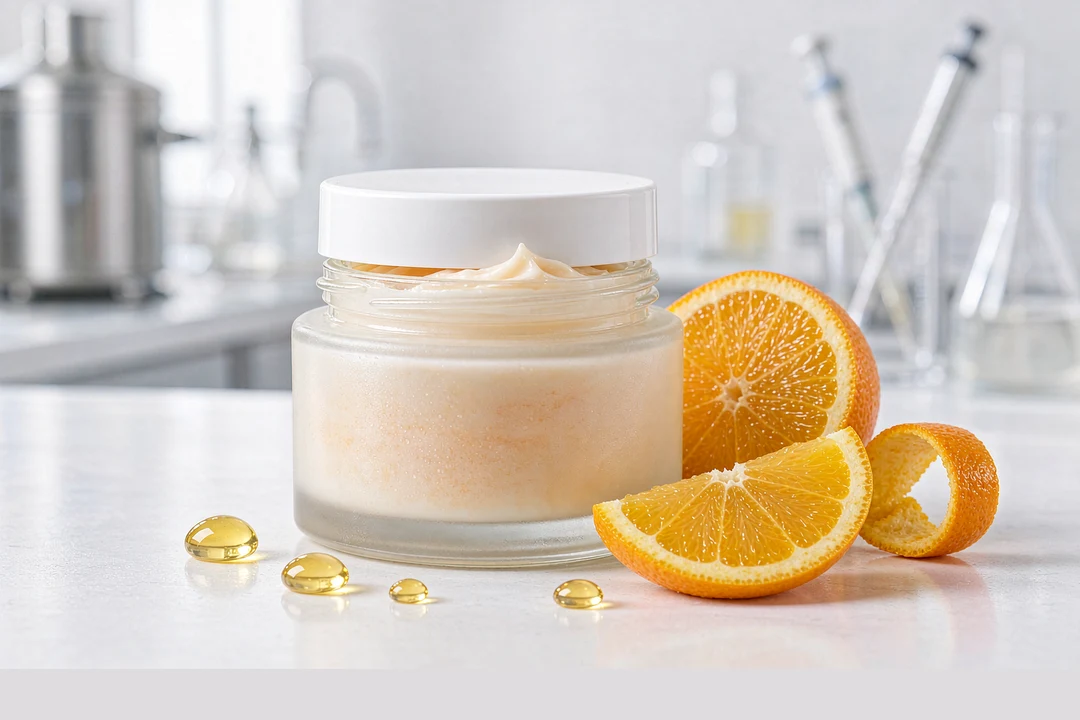
The live program behind it: our Vitamin C Face Cream OEM line — a 50 g brightening moisturizer with fresh orange essence that doubles as a makeup base, running at MOQ 3,000 pieces in our ISO 22716 facility — plus the wider Face Cream OEM catalog it sits on and the vitamin C cleanser that shares the same actives deck.
Why brightening is the most defensible claim in face care
Brightening sits at the intersection of everything the 2026 skincare market rewards: an active with decades of dermatology use, a visible benefit consumers can actually see, and a claim family that survives regulatory scrutiny when worded properly. Global Market Insights sizes the vitamin C based skincare products market at USD 4.7 billion in 2025, projected to reach USD 12.4 billion by 2035 at a 10.3% CAGR — with North America the largest region and Asia-Pacific the fastest-growing.
Two structural currents sit underneath that growth. First, dermocosmetic credibility: consumers increasingly evaluate actives through an efficacy-and-tolerability lens rather than as marketing add-ons, and vitamin C is one of the few actives with clinical recommendations behind it. Second, the tone-evening habit: the skin brightening application segment alone accounted for USD 2,170.45 million of the skin cosmeceutical vitamins market in 2025 — roughly a third of the category — which is the demand pool a Vitamin C Face Cream program draws from.
L-ascorbic acid vs derivatives: the stability trade-off
The single most consequential decision in the program is which form of the active goes in the jar, because each form carries a different pH window, a different stability profile and a different claim file:
| Form | Typical use level | pH window | Stability profile | Program fit |
|---|---|---|---|---|
| L-ascorbic acid (pure) | 8–20% | Below ~3.5 | Oxidizes on air and light exposure; yellows as it degrades | Prestige serums and clinical lines; needs airless, opaque packaging |
| 3-O-ethyl ascorbic acid | 1–5% | Near-neutral | Stable, oil-soluble derivative | Creams and emulsion formats where pure L-AA cannot survive |
| Ascorbyl glucoside (AA2G) | 1–3% | Near-neutral | Water-soluble, highly stable | Mass and mid-tier brightening creams |
| Ascorbyl palmitate (AA-PAL) | 0.1–1% | Flexible | Oil-soluble antioxidant | Barrier-support and hybrid formats |
Two engineering notes buyers should verify on any vitamin C cream OEM factory call. First, the concentration claim on the carton must match the assay on the finished product — “contains vitamin C” is an INCI-list statement, not a potency claim. Second, anhydrous and low-water systems have demonstrated long-term stability for L-ascorbic acid in clinical assessments, which is why our 50 g cream format can carry the pure form where a light lotion could not.
What vitamin C does in skin: three documented mechanisms
Vitamin C earns its position through three mechanisms that are documented in the dermatological literature, and each maps to a different claim family:
- Antioxidant defense: ascorbic acid quenches free radicals generated by UV and pollution exposure — the environmental-protection story that anchors daytime positioning.
- Collagen synthesis support: vitamin C is an essential cofactor for the enzymes that hydroxylate proline and lysine during collagen formation — the firmness and texture story behind anti-aging positioning.
- Melanogenesis modulation: the active inhibits tyrosinase, the rate-limiting enzyme in melanin production — the biochemical basis of the tone-evening and brightening story, and the reason the category skews toward visible-results claims.
For a vitamin C cream OEM program the practical consequence is that the claim file needs a substantiation per mechanism: an antioxidant claim rests on the formulation, a firmness claim rests on a use test, and a brightening claim rests on an instrumental read at the labeled concentration. A factory that cannot produce that file per market will outsource your compliance risk to you.
What the 2026 vitamin C market pays for
The numbers a buyer should hold in mind when sizing a brightening program:
| Metric | Value | Source |
|---|---|---|
| Vitamin C based skincare products, 2025 | USD 4.7 billion | Global Market Insights |
| Vitamin C based skincare products, 2035 | USD 12.4 billion (10.3% CAGR) | Global Market Insights |
| Vitamin C face cream market, 2025 | USD 980.5 million | PW Consulting |
| Vitamin C face cream market, 2032 | USD 1,590.19 million (~7.15% CAGR) | PW Consulting |
| L-ascorbic acid cream share, 2025 | 46.1% of face cream segment | PW Consulting |
| Vitamin C cosmetic market, 2034 | USD 5.00 billion from USD 2.30 billion in 2025 (9.0% CAGR) | TrendX Insights |
For a wholesale face cream buyer the read-through is that vitamin C is the largest single vitamin in the skin cosmeceutical segment, the face cream format is growing at high single digits, and L-ascorbic acid still holds the largest share of the cream segment. A vitamin C private label program built on a stabilized 50 g brightening face cream sits at the intersection of all three.
Jar engineering: keeping the active alive to the last gram
A 50 g Vitamin C Face Cream program is an actives-stability decision before it is a design decision. Four specs decide whether the consumer’s last gram works like the first:
| Component | Standard spec | Premium option | Watch-out |
|---|---|---|---|
| Jar | 50 g opaque PP or glass jar | Airless pump jar | Airless is the default for pure L-AA programs — an open jar oxidizes the active on shelf |
| Liner / seal | Induction seal | Foil + heat-seal laminate | Seal integrity is part of the stability file, not just a hygiene item |
| Actives support | Vitamin E + ferulic in the base | Encapsulated L-AA | The antioxidant support system is what lets the claim survive 24 months |
| Carton | Printed shelf box | FSC board, soft-touch finish | Storage wording (“keep away from direct sunlight”) must match the stability data |
One platform note: the same jar body runs the vitamin C cleanser and the plain moisturizer, so a second SKU costs a label and a carton, not a new tooling.
Claim discipline for a brightening cream
Brightening is a claim family with a long history of regulatory trouble, because the strongest words — whitens, treats pigmentation, removes dark spots — slide easily into medical territory. Under the EU framework, Commission Regulation (EU) No 655/2013 requires every claim to be truthful, evidenced and honest, and the same discipline applies in every market we export to:
- Say: “brightens the look of dull skin”, “helps even the appearance of skin tone”, “antioxidant protection against environmental stress”, “with 10%% vitamin C” (when the assay supports it).
- Avoid: “treats melasma”, “removes dark spots”, “bleaches pigmentation” — in the EU these read as medical claims; in the US they can push the product toward OTC drug territory; in Brazil they change the ANVISA notification class.
- Keep the file: whatever the carton says, the substantiation — the use test or instrumental read at the labeled concentration — lives in the product information file, per market.
Not sure whether your claim set is cosmetic or medical in your target market? Send us the wording and market list — we will reply with a claim matrix and samples for the matching base. Request the claim matrix →
Market entry notes: EU, US, Brazil, Gulf and SEA
| Market | Regime | Notification / filing | The watch-out for a brightening cream |
|---|---|---|---|
| EU | Regulation (EC) 1223/2009 | CPNP notification; PIF signed by a safety assessor | Claims per 655/2013 — brightening wording must stay cosmetic; concentration claims need the assay on file |
| US | FD&C Act as amended by MoCRA | Facility registration + product listing; US Agent for foreign facilities | “Treats” wording can make it an OTC drug; serious adverse events reported within 15 business days — see FDA MoCRA |
| Brazil | ANVISA RDC 15/2013 | Notification filed by the local importer holding AFE | Portuguese INCI list; importer CNPJ on label; brightening claims reviewed against local rules |
| Middle East | GSO standards; Saudi SFDA | SFDA registration; halal certificate expected by major retail | Arabic labelling; glycerin and any animal-derived additives need documented halal status |
| Southeast Asia | ASEAN Cosmetic Directive | National notification (BPOM for Indonesia, etc.) | Indonesia: halal certification mandatory for cosmetics from 17–18 Oct 2026 — BPJPH |
Scale economics at 3k, 10k, 50k and 100k jars
The cost curve on the 50 g Vitamin C Face Cream program from our 2026 files:
| Program volume | Unit FOB band (jar) | Tooling | Lead time | What changes |
|---|---|---|---|---|
| 3,000 (entry MOQ) | USD 1.60–2.05 | Stock airless jar, printed labels | 35–45 days | You validate the claim; we validate the actives deck |
| 10,000 | USD 1.30–1.65 | Dedicated jar tooling amortized | 30–40 days | Custom carton unlocked; second actives deck on the same jar |
| 50,000 | USD 1.05–1.35 | Multi-cavity tooling, dedicated line slot | 25–35 days | Priority scheduling; seal spec tightened for reorder matching |
| 100,000+ | USD 0.90–1.15 (annual contract) | Full line booking | 25–30 days + reserved capacity | DDP to EU/US/Brazil; quarterly stability reviews; halal and GSO documentation maintained on file |
Two logistics notes: airless jars are light but fragile in drop tests — specify board weight on the shipper for e-commerce channels, a real constraint for a brightening face cream program shipping to Amazon FBA; and sea LCL works up to roughly 15 cbm, beyond which FCL typically saves 20–30%% per unit on freight.
How to audit a vitamin C program in one call
- Ask which form of vitamin C is in the base and at what assay on the finished product — the carton claim must match the certificate of analysis.
- Ask for the 12-week stability read on the finished jar at 40 °C / 75% RH, plus the 45 °C read if the Gulf is a target market — and ask whether the read was run in the retail jar or the bulk.
- Ask how the antioxidant support system is built (vitamin E, ferulic, encapsulation) — it is the difference between a 24-month claim and a 6-month one.
- Ask which claim words they will print per market — a factory that cannot produce a claim matrix per market will outsource your compliance risk to you.
- Ask whether the vitamin C cream OEM jar platform is shared across the line — one tooling set for a cream, a cleanser and a moisturizer is the difference between a program and three projects.
Our facility is certified under ISO 22716 and GMPC, exports to 30+ countries, and runs vitamin C cream OEM programs with in-house stability testing, airless filling and a per-market claim matrix. If you are building a brightening face cream line for 2027 planograms, the fastest next step for a wholesale face cream program is a forms-and-claims review against your target markets — the vitamin C private label dossier is ready when you are.
Ready to Launch Your Brightening Line? Talk to Us
☎ Phone / WhatsApp: +86 133 6440 1300
✉ Mail sales@moksha-bio.com
🕐 Working Hours: Monday – Saturday, 9:00 – 18:00 (GMT+8)
✉ Inquiry This Product — Get a Free Quote 📍 Book a Factory VisitKeep reading: Peach Squalane Stick OEM 2026: The Best 4-in-1 Repair Balm & Export Playbook · Ginger Foot Mask OEM 2026: The Best Exfoliating Peeling Socks & Export Playbook · Urea Foot Cream OEM 2026: The 40% Formula & Export Playbook · Whitening Hand Cream OEM 2026: The Brightening Balm & Export Playbook · BB Cream OEM 2026: The Color-Correcting Format & Export Playbook · Avocado Foot Mask OEM 2026: The Proven 80 g Booties Formula & Export Playbook · V Line Lifting Mask OEM 2026: The Ultimate Double V Chin Mask & Export Playbook · BB Cushion OEM 2026: Shade Range, Puff Tech & Export Playbook · Hair Care Set OEM 2026: Formulas, Bottles & Export Playbook · Sunscreen OEM 2026: SPF Testing Costs, Regulatory Path & Private Label Playbook · Mud Mask OEM 2026: Clay, Set Economics & Export Compliance
Sans commentaires