

16 Oct Hair Care Set OEM 2026: Formulas, Bottles & Export Playbook
Table of Contents
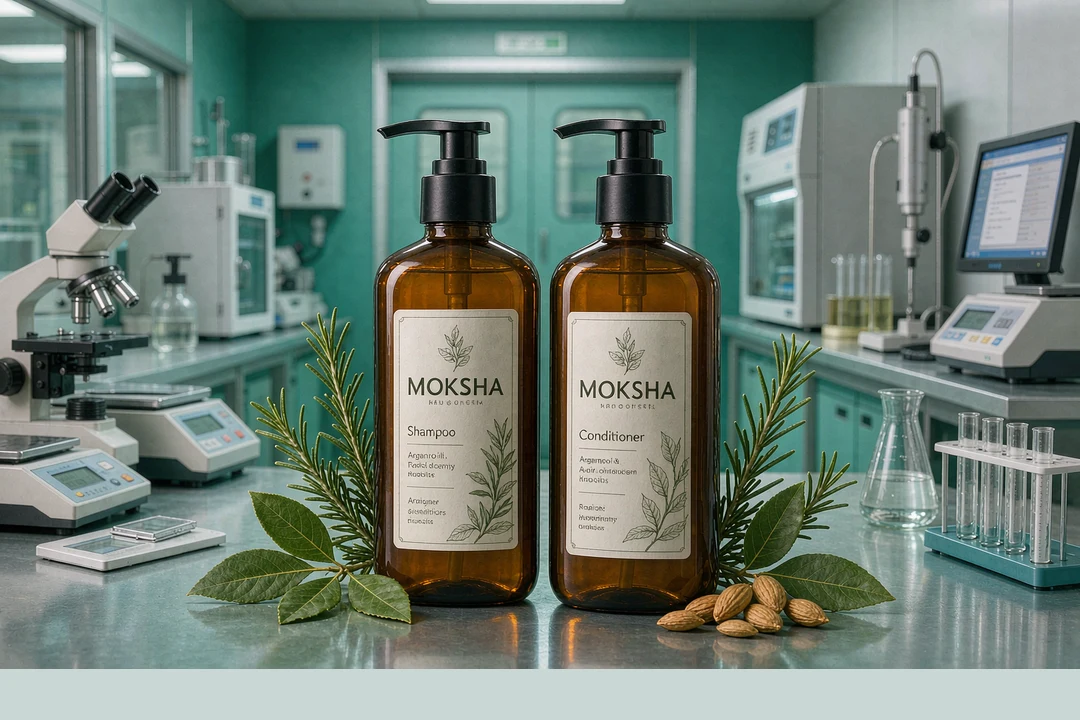
Every Hair Care Set OEM conversation with a big-B buyer eventually turns into the same realization: the shampoo is the easy part. What decides whether your set program makes money is the pairing logic between wash and condition, the claim language your packaging can actually defend in five export markets, and whether the bottle-and-pump tooling survives a 100,000-unit reorder cycle without a color drift. This guide is the spec conversation we run through with every private-label partner before a set quote goes out.
It is written from our own 2026 production files: five Hair Care Set OEM programs running through our ISO 22716 facility every week — a biotin repair set, a caffeine and biotin growth set, a rosemary scalp set, a keratin smoothing set and an argan and rice water set — plus the rest of the Hair Care Set OEM catalog those platforms sit on. The numbers below come from those programs, and the regulatory framing from what our compliance team files every month for EU, US, Brazilian, Gulf and Southeast Asian clients.
Why sets beat singles in the hair aisle
The shampoo-plus-conditioner format is the default purchase in every mature hair care market, and for a brand owner the set is the better product for three commercial reasons that have nothing to do with formulation:
- Basket size and margin: a 300 ml shampoo plus a 250 ml conditioner set prices 30–45% above the shampoo alone while costing barely more to produce — the conditioner formula is cheaper per ml than the wash.
- Routine lock-in: a consumer who finishes both bottles together reorders together. Single-SKU buyers comparison-shop on the next purchase; set users re-buy the routine.
- Seasonality: gift sets carry Q4. A set platform with a dedicated carton can be re-skinned for holiday, Mother’s Day and Eid without touching a formula or a tooling.
The engineering cost of that commercial advantage is real, though: a set is two formulas, two bottles, two closures and one carton, each with its own failure mode. A shampoo and conditioner set OEM program that treats the pair as one system — one development cycle, one stability program, one artwork approval — lands on shelf in ten weeks. A program that develops them separately lands in sixteen. A Hair Care Set OEM planned as one system avoids both delays.
Shampoo and conditioner are one formula, not two
Most first-time buyers spec the shampoo first and treat the conditioner as an afterthought. In production the two are matched on three axes, and a mismatch on any of them shows up as a complaint within six weeks of launch:
| Axis | Shampoo side | Conditioner side | The mismatch that fails |
|---|---|---|---|
| Surfactant system | SLES + betaine (standard), APG/sulfate-free (premium), or acyl glutamate (gentle) | No surfactants — the conditioner is a cationic emulsion | A strong sulfate wash strips the cuticle that a light conditioner cannot re-seal → “dry, squeaky” reviews |
| Conditioning load | Light: 0.3–0.8% guar hydroxypropyltrimonium chloride or polyquaternium-10 | Heavy: 1–2% behentrimonium methosulfate or cetrimonium chloride | Under-conditioned shampoo plus weak conditioner = tangling on fine hair |
| Silicone choice | Sulfate-free bases pair with amodimethone (amine-functional) | Dimethicone for slip, amodimethone for damaged/color-treated hair | Dimethicone build-up with an SLES wash = weighed-down roots by week four |
The practical rule we give every hair care private label client: pick the hair type first, then derive both formulas from the same matrix. Fine and oily hair wants a light sulfate/APG wash with a low-dose cationic conditioner. Coarse, curly or color-treated hair wants a sulfate-free or mild wash with behentrimonium and amodimethone. Keratin-treated hair is its own case — the set must be sulfate-free and sodium-chloride-free, or the treatment washes out in eight washes and the reviews say your conditioner “does not work”.
The five hero actives buyers ask for in 2026
Our 2026 RFQ data shows five actives driving shampoo and conditioner set OEM programs, and each carries a different evidence story. Being straight about the evidence is not just honesty — it is claim compliance, because the wording your label can defend follows the literature:
| Active | Typical use level | What the evidence supports | Defensible claim language |
|---|---|---|---|
| Caffeine (caffeine complex) | 0.05–0.2% | In-vitro work (Fischer et al., International Journal of Dermatology, 2007) showed caffeine counteracts testosterone-induced growth suppression in cultured follicles; a 210-man randomized trial (Dhurat et al., Skin Pharmacology and Physiology, 2017) found a 0.2% caffeine liquid non-inferior to minoxidil 5% on anagen ratio after six months | “Energizes the scalp”, “supports the appearance of fuller hair” — never “treats hair loss” |
| Biotin (vitamin B7) | 0.1–0.5% in-wash | Oral biotin deficiency links to hair thinning; topical biotin evidence in healthy scalps is weak — the honest position | “Nourishes”, “supports hair strength” — not “regrows” |
| Rosemary extract/oil | 0.2–1% | Traditional use plus modern scalp-comfort positioning; pairs well with caffeine in growth sets | “Invigorates the scalp”, “botanical freshness” |
| Hydrolyzed keratin | 0.5–2% | Hydrolyzed protein deposits on the shaft and improves combability and shine in instrumental tests | “Repairs visible damage”, “smooths and shines” |
| Argan + rice water | 1–3% argan oil; rice water filtrate | Argan’s fatty acid profile supports emolliency and shine; rice water is the heritage inositol story behind the K-beauty rinse tradition | “Deeply nourishes”, “softness and shine” |
These five actives are exactly the platforms behind the sets in our catalog: the biotin repair and caffeine-biotin growth sets, the rosemary and keratin smoothing sets, and the argan and rice water nourishment set. Because every Hair Care Set OEM we build shares one bottle-and-carton platform, extending your line with a second active costs a stability panel, not a new tooling.
Picking the hair type, the active and the claim wording before tooling is 80% of the work. Send us your target market and active — we will reply with the matching formula dossier, claim matrix and samples. Request the formula dossier →
Bottle, pump and cap engineering
Every Hair Care Set OEM lives or dies on its components. Three specs decide whether the shelf presence works and whether the reorder at 50,000 units matches the first production run:
| Component | Standard spec | Premium option | Watch-out |
|---|---|---|---|
| Shampoo bottle | 300 ml PET, round or oval, flip-top | 300 ml PETG or PCR-PET, soft-touch label area | PCR content changes resin shade — lock a color tolerance in writing |
| Conditioner bottle | 250 ml PET, matching silhouette | 250 ml airless-pump or tube | Airless pump adds USD 0.18–0.35/unit but cuts preservative load |
| Pump / closure | Disc-top or pump 2.0 cc | Metal-collar pump, ribbed cap | Pump spring corrosion in sulfate systems — specify coated springs |
| Carton | Printed 3-piece set box, matte lamination | FSC board, soft-touch + spot UV | Carton dimension drift at humidity >70% — order board with moisture spec |
The wholesale shampoo set economics favor a shared bottle platform across the whole line: one blow-mold tooling set, per-SKU labels and cartons. A hair product manufacturer quoting you a different bottle per active is quoting you five toolings.
Claims and paperwork: where cosmetics stop
Hair care sits closer to the drug boundary than any other cosmetic category, because growth and anti-hair-loss claims are the easiest sales pitch and the fastest route to a regulatory rejection. The line is simple:
- Cosmetic claims are about appearance and maintenance: cleanses, conditions, strengthens, shines, reduces breakage, supports the scalp. These need substantiation you can keep on file — but not a drug license.
- Drug claims treat or prevent disease: “stops hair loss”, “treats alopecia”, “regrows hair”. In the US these put the product under the OTC monograph or an NDA; in the EU they fail the common criteria outright. The UK’s Advertising Standards Authority has already ruled against caffeine-shampoo advertising that outran the evidence — the substantiation file is part of the claim.
- “Sulfate-free”, “vegan”, “halal”: each is documentable. Sulfate-free needs an SLES/SLS-free formula sheet; vegan needs supplier declarations on every animal-derived material; halal needs the certificate chain — and in Indonesia it becomes mandatory this month.
Our compliance team files the claim matrix per market before artwork is approved, so the label never promises what the dossier cannot support. The same discipline we apply in our sunscreen OEM compliance guide — where every claim maps to a test — runs through every hair program.
What each export market will ask you for in 2026
| Market | Regime | Notification / filing | The watch-out for a hair set |
|---|---|---|---|
| EU | Regulation (EC) 1223/2009 | CPNP notification before placing on market; PIF signed by a safety assessor | Quaternium and cationic actives have concentration limits; claim wording follows the 2013 common criteria — growth claims fail |
| US | FD&C Act as amended by MoCRA | Facility registration + product listing via Cosmetics Direct; US Agent for foreign facilities; first biennial renewals ran through July 1, 2026 | Anti-hair-loss positioning can make it an OTC drug; serious adverse events reported within 15 business days |
| Brazil | ANVISA RDC 15/2013 | Cosmetic notification filed by the local importer holding AFE | Portuguese INCI list, importer CNPJ on label, restricted preservative lists |
| Middle East | GSO standards; Saudi SFDA | Product registration via SFDA; halal certificate expected by major retail | Arabic labelling; glycerin and any animal-derived additives need documented halal status |
| Southeast Asia | ASEAN Cosmetic Directive | National notification (BPOM for Indonesia, etc.) | Indonesia: halal certification mandatory for cosmetics from 17–18 Oct 2026 under Gov. Reg. 42/2024 — BPJPH has rejected further delays |
Two of these deserve emphasis for Q4 2026 planning. Indonesia’s halal deadline lands this month — uncertified cosmetics face withdrawal from circulation, which makes halal documentation a market-entry ticket rather than a niche. And in the US, MoCRA moved cosmetics from voluntary registration to mandatory facility registration and product listing; a factory that already supports that paperwork removes it from your critical path.
A 10-week launch playbook for a hair set line
A real timeline from our 2026 files: a French botanical brand took a wholesale shampoo set program from RFQ to first container in ten weeks. The pairing loop — wash and conditioner matched on all three axes — is the long pole, not bulk filling.
| Week | Milestone | Deliverable |
|---|---|---|
| 1 | RFQ + brief | Hair type, active, claim set, sulfate-free yes/no, carton format |
| 2–3 | Pairing development | Matched wash + conditioner variants with combability and feel panels |
| 4 | Component lock | Bottle, pump and carton specs frozen; tooling order placed |
| 5–6 | Stability + claim file | Real-time and accelerated protocols launched; claim matrix drafted |
| 7 | Artwork + claim review | Market-specific label wording signed off |
| 8 | Notifications | CPNP / ANVISA / SFDA filings prepared |
| 9 | Pilot batch + QA | Viscosity, pH, microbial, 30-person feel panel, AQL plan |
| 10 | Bulk + shipping | Production run, pre-shipment inspection, FCL booked |
Scale economics: 3k, 10k, 50k and 100k sets
The cost curve on a shampoo and conditioner set OEM program from our 2026 files — the shape big-B buyers should hold every candidate factory to:
| Program volume | Unit FOB band (set) | Tooling | Lead time | What changes |
|---|---|---|---|---|
| 3,000 (entry MOQ) | USD 2.10–2.80 | Shared bottle platform, stock closures | 35–45 days | You validate the market; we validate the pairing |
| 10,000 | USD 1.70–2.15 | Dedicated bottle tooling amortized | 30–40 days | Custom carton unlocked; per-SKU labels spread across the run |
| 50,000 | USD 1.40–1.75 | Multi-cavity tooling, dedicated line slot | 25–35 days | Priority scheduling; second active on the same platform |
| 100,000+ | USD 1.20–1.55 (annual contract) | Full line booking | 25–30 days + reserved capacity | DDP to EU/US/Brazil; quarterly formula reviews; halal and GSO documentation maintained on your file |
Two logistics notes decide landed cost more than unit price: sea LCL is fine up to roughly 15 cbm, beyond which FCL typically saves 20–30% per unit on freight; and air freight for launch quantities should be treated as marketing spend — plan the first container by sea.
How to audit a Hair Care Set OEM factory in one call
- Ask any hair care private label factory how the shampoo and conditioner are developed — as a matched pair with a shared matrix, or separately. The answer predicts your timeline.
- Ask for the claim substantiation file behind every growth-adjacent word on the label, including the caffeine studies they rely on and at what concentration.
- Ask for the 12-week stability read on the set (not the shampoo alone) at 40 °C / 75% RH, plus the 45 °C read if the Gulf is a target market.
- Ask which preservative system they use and at what level — a set with an airless conditioner can run lower, and the wash cannot.
- Ask for the halal certificate chain and the vegan supplier declarations now, even if you are not selling to Indonesia yet.
- Ask any hair product manufacturer whether the bottle platform is shared across the line — one tooling set for five SKUs is the difference between a hair care private label platform and five separate projects.
Our facility is certified under ISO 22716 and GMPC, exports to 30+ countries, and develops wash and conditioner as matched pairs with in-house stability testing and a per-market claim matrix. If you are building a Hair Care Set OEM line for 2027 planograms, the fastest next step is a pairing review against your target hair types.
Need Help? Contact Us
☎ Phone / WhatsApp: +86 133 6440 1300
✉ Mail sales@moksha-bio.com
🕐 Working Hours: Monday – Saturday, 9:00 – 18:00 (GMT+8)
✉ Inquiry This Product — Get a Free Quote
📍 Book a Factory Visit
Keep reading: Sunscreen OEM 2026: SPF Testing Costs, Regulatory Path & Private Label Playbook · BB Cushion OEM 2026: Shade Range, Puff Tech & Export Playbook
Sans commentaires