


17 Avr Cosmetic Contract Manufacturing: Benefits & Checklist for Global Brands
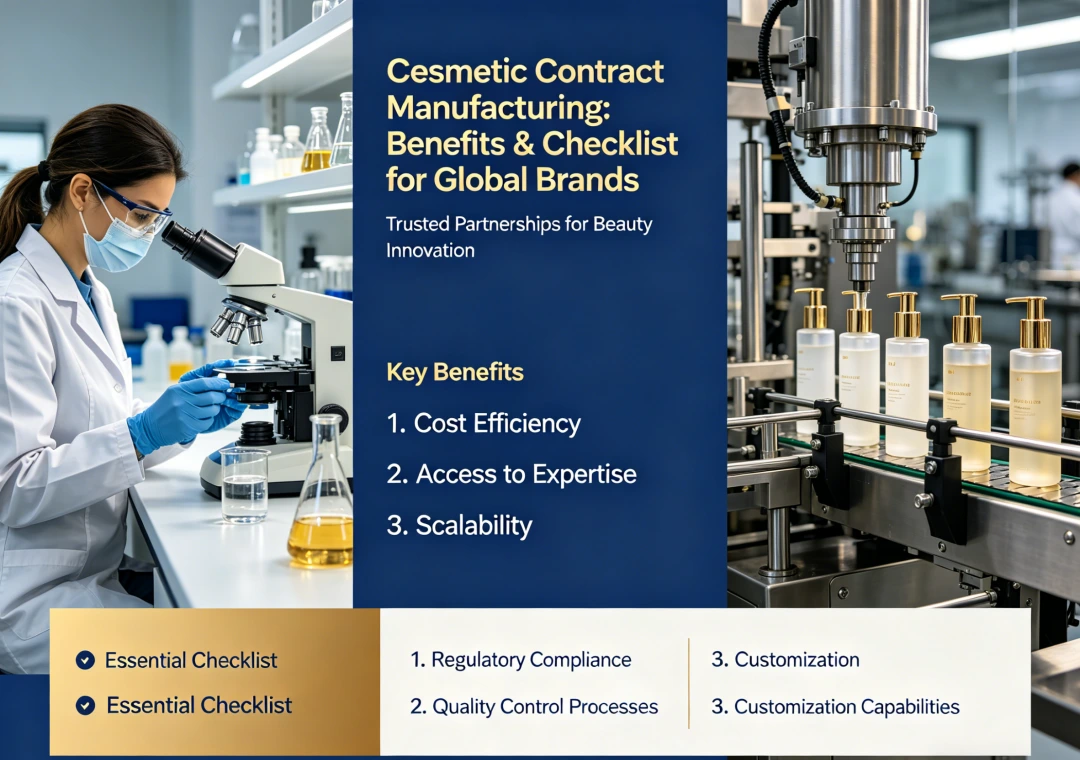
Cosmetic Contract Manufacturing: Benefits & Checklist for Global Brands
In the $580 billion global beauty market, brands of all sizes face crippling risks from the wrong production partner: product quality failures, customs detention, missed market windows, and irreversible damage to your hard-earned brand reputation. Most global brands still don’t fully grasp the strategic value of professional cosmetic contract manufacturing, and lack a standardized framework to screen reliable long-term partners. This guide breaks down the 8 core benefits of cosmetic contract manufacturing for global brands, delivers a comprehensive, actionable partner verification checklist, and reveals the most common pitfalls to avoid. Read on to build a stable, growth-aligned supply chain for your beauty business.
What Is Cosmetic Contract Manufacturing?
Cosmetic contract manufacturing is a full-service, end-to-end outsourcing model that covers both OEM (Original Equipment Manufacturing) and ODM (Original Design Manufacturing) services, tailored to your brand’s unique needs. For brands with proprietary formulas and designs, it delivers standardized mass production, QC, and packaging services; for brands seeking full customization, it provides a one-stop solution from formula R&D and packaging design to regulatory compliance and export logistics.
Unlike simple white-label production, professional cosmetic contract manufacturing is a strategic partnership, not a one-time transaction. Your manufacturer acts as an extension of your team, delivering technical, compliance, and production support to drive sustainable global growth for your brand.
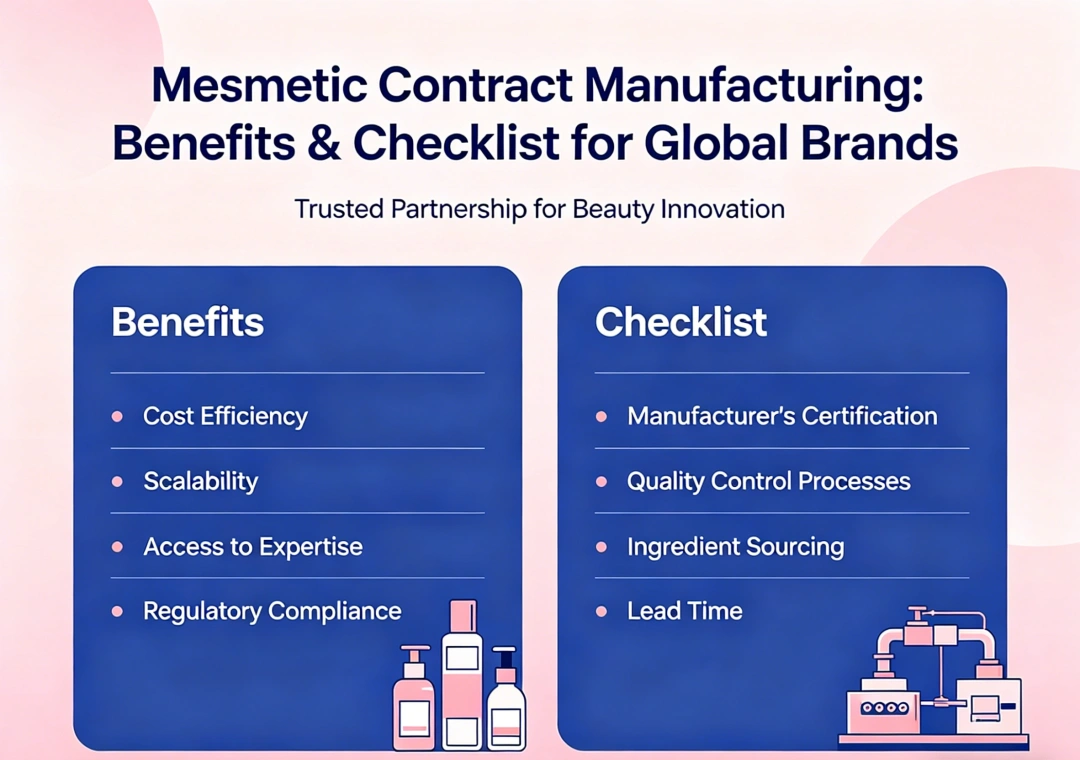
8 Core Benefits of Cosmetic Contract Manufacturing for Global Brands
1. Zero Upfront Capital Investment in Production Infrastructure
Building an in-house cosmetic factory requires massive upfront investment in GMP workshops, production equipment, and full-time teams. Cosmetic contract manufacturing eliminates all these fixed costs, converting heavy capital expenditure into flexible variable costs tied to your order volume. For startups, this drastically lowers market entry risk; for established brands, it frees up capital to invest in marketing and channel expansion.
2. Access to Top-Tier R&D & Formulation Expertise
Formula innovation is the core of cosmetic competitiveness, and professional cosmetic contract manufacturing gives your brand access to independent R&D labs, senior formulators with 5-10+ years of experience, and a mature formula library covering all major product categories. You’ll get the same R&D capabilities as top multinational beauty brands, without the ongoing high investment.
3. Full-Process Global Regulatory Compliance Support
Regulatory non-compliance is the #1 risk for cross-border beauty brands. Professional cosmetic contract manufacturing partners have dedicated regulatory teams proficient in EU, US, ASEAN, and Middle East cosmetic rules. They deliver end-to-end support: pre-production formula review, label compliance checks, product registration assistance, and a full set of export documents (PIF, SDS, COA), with real-time tracking of global regulatory updates.
4. Flexible Production Capacity & Scalability
Fixed in-house capacity leads to wasted costs in off-peak seasons and stockouts during peak sales. Cosmetic contract manufacturing offers fully flexible capacity: startup-friendly low MOQs of 1000-3000 units per SKU for market testing, plus large-scale automated lines that handle monthly mass production of 500,000+ units for global promotions and offline channels.
5. Unmatched Cost Efficiency & Profit Margin Optimization
Leading cosmetic contract manufacturing providers (especially in Guangzhou, China’s global cosmetic industrial cluster) leverage bulk procurement to secure high-quality raw materials and packaging at 30-50% lower costs than individual brands. This directly improves your profit margins, or lets you offer more competitive pricing to gain market share.
6. Ultra-Fast Time-to-Market & Trend Adaptability
In the fast-changing beauty industry, launch speed determines first-mover advantage. Professional cosmetic contract manufacturing completes the full process from formula confirmation to delivery in 4-6 weeks — 2-3x faster than in-house production. This lets you capitalize on emerging trends, seasonal demand, and promotional opportunities ahead of competitors.
7. Comprehensive Risk Mitigation & Quality Assurance
Reliable cosmetic contract manufacturing partners operate 100,000-level GMP clean workshops, with a full-process IQC-IPQC-FQC quality control system and complete batch traceability. This transfers production-related quality risks to the manufacturer, protecting your brand from financial and reputational losses caused by product failures.
8. Focus on Your Core Brand Growth & Competitive Advantage
For most beauty brands, your core strengths are brand positioning, marketing, channel resources, and consumer insight — not production management. Cosmetic contract manufacturing frees up your time, energy, and resources from day-to-day production operations, letting you focus on the work that drives brand growth and revenue.
The Ultimate Checklist for Selecting a Reliable Cosmetic Contract Manufacturer
| Verification Category | Core Checklist Items |
|---|---|
| Legal Qualification & International Certification (Non-Negotiable Threshold) | ✅ Valid, up-to-date official Cosmetic Production License ✅ Valid GMPC and ISO 22716 international certifications ✅ US FDA establishment registration and EU CPNP notification qualification ✅ No history of regulatory violations or major product quality incidents ✅ Business license fully covering cosmetic production and OEM/ODM services |
| R&D & Customization Capability Verification | ✅ Independent R&D laboratory and full-time senior formulator team ✅ Mature, market-verified formula library matching your product categories ✅ Full formula testing capabilities (stability, microbial, skin irritation testing) ✅ Successful product launch cases for overseas brands in your target market |
| Full-Process Quality Control System Audit | ✅ 100,000-level dust-free GMP clean workshop ✅ Standardized IQC-IPQC-FQC three-stage quality control system ✅ Complete digital batch traceability system for all products ✅ Detailed Certificate of Analysis (COA) for every batch ✅ Strict raw material supplier management and incoming inspection |
| Global Regulatory Compliance Expertise | ✅ Dedicated full-time regulatory team for your target export market ✅ Rich practical export experience and successful customs clearance cases ✅ Full-process compliance support for formula, label, and product registration ✅ Full set of export compliance documents (PIF, SDS, COA, Certificate of Origin) ✅ Real-time tracking of global cosmetic regulatory updates |
| Supply Chain & Production Service Capability | ✅ Transparent, stable upstream supply chain with high-quality suppliers ✅ Flexible MOQ options for both small-batch trials and large-scale mass production ✅ 98%+ on-time delivery rate with clear, fixed production cycles ✅ One-stop full-link services from R&D to logistics and customs clearance ✅ Dedicated account manager and 24-hour rapid response after-sales system |
| Contract & Intellectual Property Protection | ✅ Willing to sign a comprehensive Non-Disclosure Agreement (NDA) before cooperation ✅ Clear intellectual property ownership definition in the formal contract ✅ Contract specifies quality standards, delivery timelines, and liability for breach of contract ✅ Detailed, itemized quotation with no hidden fees ✅ Long-term pricing and production capacity guarantees for brand growth |
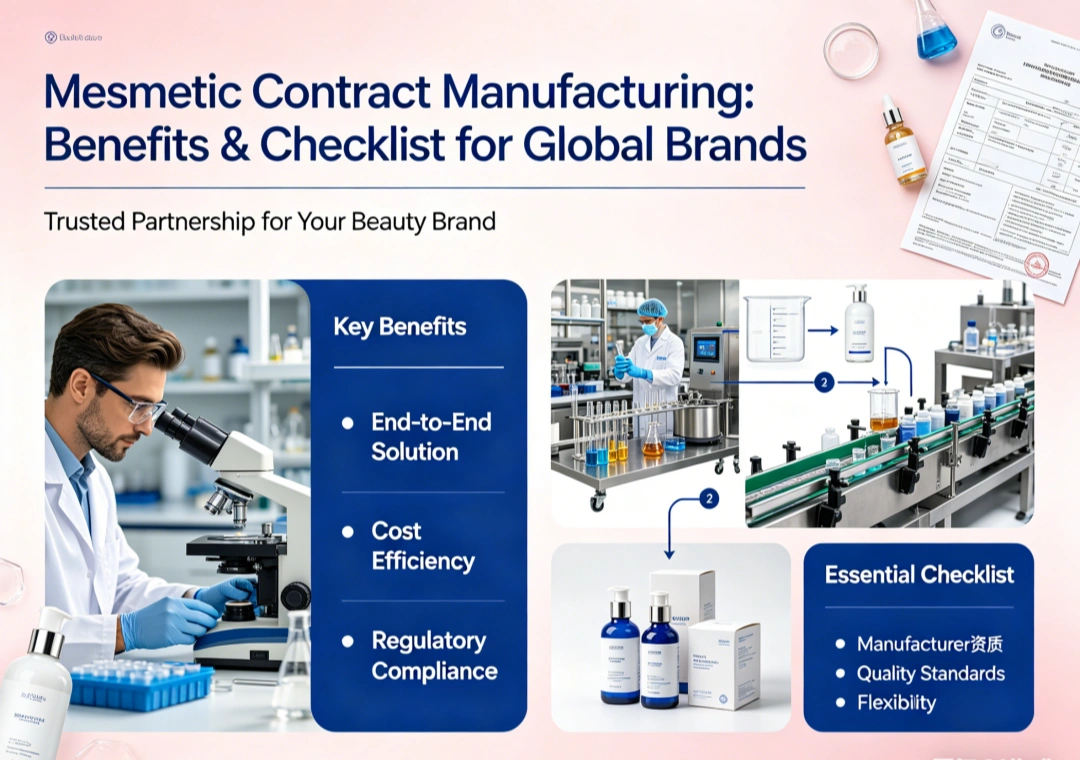
Common Pitfalls to Avoid in Cosmetic Contract Manufacturing
- Choosing solely based on the lowest price: Ultra-low quotations almost always mean compromised raw material quality, production standards, and compliance support, leading to irreversible brand damage that far outweighs short-term cost savings.
- Skipping factory verification: Always request a live video tour of the workshop, lab, and QC room, or arrange a third-party on-site audit to confirm the manufacturer’s actual capabilities, not just online claims.
- Failing to sign a formal NDA and detailed contract: Never disclose your brand’s formula, packaging design, or business plans without a signed NDA. A detailed contract is your only legal protection for quality, delivery, and IP ownership.
- Ignoring target market export experience: A manufacturer with strong domestic experience may have no expertise in your target export market’s regulations. Always confirm successful export cases in your target region.
- Overlooking long-term scalability: Confirm the manufacturer can scale production capacity as your sales grow, and provide ongoing formula iteration, new product development, and regulatory support, not just one-time production.
FAQ: Cosmetic Contract Manufacturing for Global Brands
Q1: What’s the difference between cosmetic contract manufacturing, OEM and ODM?
A1: Cosmetic contract manufacturing is an umbrella term covering both OEM and ODM services. OEM (Original Equipment Manufacturing) means your brand provides the formula, design, and specifications, and the manufacturer handles mass production. ODM (Original Design Manufacturing) means the manufacturer delivers a full end-to-end solution from formula R&D to mass production, based on your brand’s needs. Professional contract manufacturers offer both services, tailored to your requirements.
Q2: What is the typical MOQ for cosmetic contract manufacturing?
A2: For standard skincare products (cleansers, moisturizers, serums), professional manufacturers in Guangzhou, China offer a startup-friendly MOQ of 1000-3000 units per SKU, with some categories supporting trial runs as low as 500 units. For large-scale mass production, the MOQ can be flexibly adjusted to match your sales volume, with discounted pricing for larger batches.
Q3: How long does the full cosmetic contract manufacturing process take?
A3: The standard full cycle is 4-8 weeks. For mature formulas and conventional packaging, the process can be completed in 4-6 weeks. For fully customized formulas and custom mold-opening packaging, the cycle is typically 6-8 weeks. A reliable manufacturer will provide a clear, fixed timeline at the start of the project.
Q4: Can a cosmetic contract manufacturer help with product registration in our target market?
A4: Yes. Professional cosmetic contract manufacturing partners with rich export experience provide comprehensive registration support, including all required formula information, test reports, and compliance documents. They can also connect you with local regulatory agencies to complete EU CPNP notification, US FDA VCRP filing, and other market registration processes.
Q5: How can we verify a cosmetic contract manufacturer’s reliability remotely?
A5: Effective remote verification steps include: 1) Request a live video tour of the factory’s workshop, lab, and QC room; 2) Verify the authenticity of all qualifications and certifications via issuing institutions; 3) Request and contact references from overseas cooperative brands; 4) Test sample products to verify quality and consistency; 5) Review the detailed quotation and contract to evaluate professionalism and transparency.
Sans commentaires