

30 Oct Bamboo Charcoal Nose Patch OEM: Why Strips Curl at 80% RH
A distributor in Jakarta sent us a photo last month that we have seen a dozen times: a five-pack of charcoal nose strips, still sealed, with the strip curled off the backing paper before it ever reached a nose. His warehouse reads 80% relative humidity in the wet season and his returns were running at a fifth of orders. The question was whether a bamboo charcoal nose patch OEM program could be built to survive that, or whether pore strips simply do not work in tropical Southeast Asia.
They work — but only when the adhesive coat, the backing paper and the pack seal are specified for humidity instead of for a European test lab. Here is the failure analysis, the three fixes, and what a tropical-ready nose patch manufacturer order looks like from the factory side.
Table of Contents
Why Southeast Asia Is the Nose Patch Market to Win
The global pore strips market was valued at USD 1.75 billion in 2025 and is projected to reach USD 2.81 billion by 2034 at 5.4% a year, with Asia-Pacific already the largest region at 38.4% share (Straits Research). Charcoal is one of the two ingredient segments the category is measured on, alongside tea tree.
The demand driver is regional, not global. Blackhead search interest peaks in late summer, K-beauty routines are embedded in Vietnam, Indonesia and the Philippines, and men’s grooming is the fastest-growing sub-segment in every one of those markets. A charcoal nose strips wholesale program aimed at tropical Southeast Asia is therefore competing on one thing the big brands handle badly: pack stability in heat and humidity.
What a Bamboo Charcoal Nose Patch OEM Formula Actually Does
Charcoal in a strip is an adsorbent, not a vacuum. The strip works because the adhesive lifts the top layer of keratin and sebum plugs when it is peeled, and the charcoal contributes porous carbon that adsorbs surface oil and odour during the ten minutes the strip is wet. That distinction matters for what you may print on the pack.
Keep the claims at appearance level: removes blackheads and excess oil, purifies the look of pores, controls shine. Do not claim pore shrinking, acne treatment or permanent removal — those cross into drug territory in the EU and the US, and they are the claims that get a pore strips oem shipment held at the border. Our own strip pairs charcoal with aloe barbadensis extract for comfort and melaleuca alternifolia oil for the purifying story, so the formula supports the copy without overselling it.
Three Reasons Nose Strips Curl at 80% Relative Humidity
We run a humidity chamber test on every tropical-bound batch. Nearly every blackhead nose strip private label failure traces to one of three causes, and all three are decided before the first sample is approved.
| Root cause | What the buyer sees | Where it was decided |
|---|---|---|
| Adhesive coat weight | Strip lifts at the edges before the ten minutes are up; leaves residue on the nose | Adhesive specification at quoting stage |
| Backing paper | Strip curls off the liner in the sachet, or tears when peeled | Release liner and slit direction |
| Pack seal | Strip feels damp on opening; powder bloom on the surface; mould smell after three months | Three-layer foil and seal temperature |
Cause two is the one that catches exporters. A liner that releases cleanly at 45% RH grabs at 80%: the silicone coat absorbs moisture, the release value climbs, and the strip either curls or tears in the customer’s hand. Most nose patch manufacturer failures start here, in the liner spec, not in the formula. The fix costs almost nothing at specification stage and cannot be retrofitted into stock already on the water.
Test worth asking for: 40°C / 80% RH for 30 days, strips still in the sachet, then open and apply. A supplier who has run it will send the report; a supplier who has not will send a photo of a strip on a nose.
Formula and Pack Fixes That Hold in the Tropics
Three changes took our Jakarta customer from a fifth of orders returned to under three percent, and none of them raised unit cost by more than a cent or two.
| Fix | Specification | Effect |
|---|---|---|
| Adhesive | Synthetic rubber-acrylic blend at 26–30 gsm, tack tuned for 30–34°C skin | Holds ten minutes without residue; no edge lift |
| Liner | Moisture-resistant PET liner, 75–90 g release force | No curl in the sachet, clean peel at 80% RH |
| Pack | Three-layer foil (PET/AL/PE), seal at 150–170°C, residual oxygen checked | Strip stays dry through a wet season, 24-month shelf life |
Two smaller items complete the pore strips oem program. First, print the 10-minute protocol on the pack and stop there: leaving a strip on until it is bone dry is what lifts the top layer of skin and drives the irritation reviews. Second, keep the essence load light — charcoal strip formulas do not need a heavy humectant base, and a wetter strip is a strip that milks moisture from the air inside its own pack.
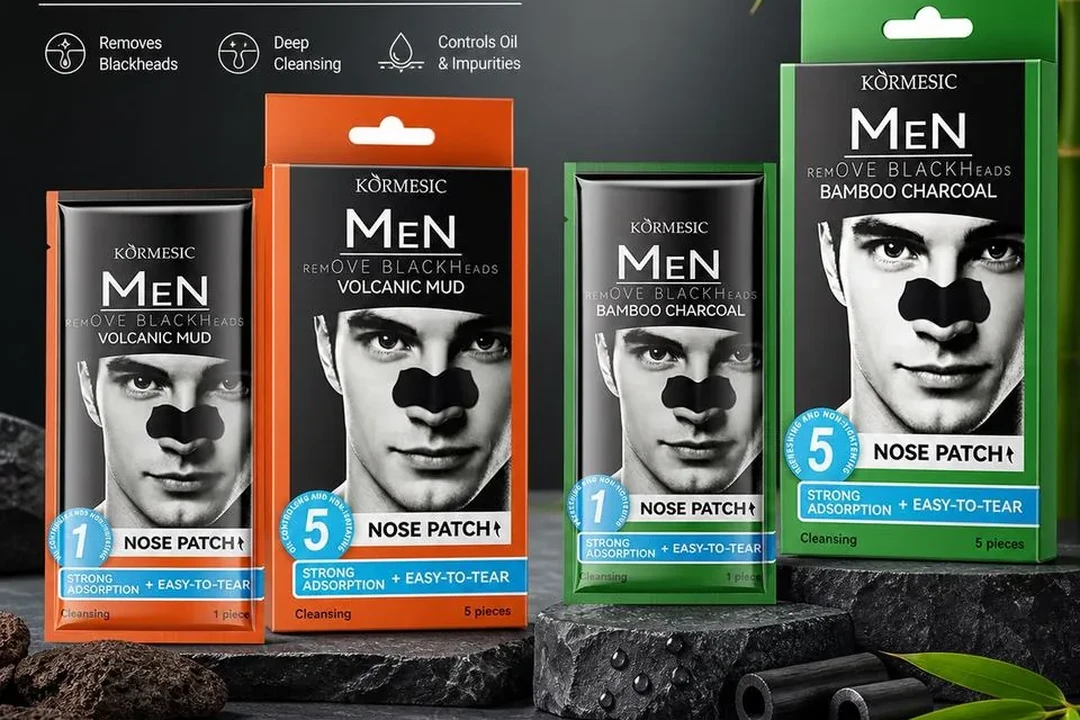
Format follows market. A five-piece retail pack is the volume seller in Indonesia and the Philippines; a single-piece sachet is what convenience retail and men’s grooming displays want. Our bamboo charcoal nose patch OEM line runs the five-piece pack as standard, and the same charcoal-plus-aloe base carries into a fuller routine through the bamboo charcoal skin care set OEM if you want the T-zone story as a set.
MOQ, Sampling and Lead Time for a Tropical Run
A bamboo charcoal nose patch oem order opens at 1,000 pcs per SKU on the five-piece retail pack, with price breaks at 3,000, 5,000 and 10,000. The liner and foil upgrades above are stock options for us, so they do not move the MOQ; a custom sachet print does.
Sampling runs 7–10 working days including the humidity chamber, and bulk production 30–35 days after approval and deposit. Certificates that ship with every order: ISO 22716, GMPC, FDA facility registration, MSDS and a batch COA; add CPNP support for the EU, halal-capable filling for Indonesia and the Gulf, and Arabic or Bahasa labelling review if those are your shelves. For a deeper look at the ingredient side, the bamboo charcoal skin care set OEM detox guide covers how charcoal claims are documented across a full routine.
One scheduling note for the region: wet season stocking starts earlier than buyers expect, because freight from South China to Jakarta or Manila adds one to two weeks and humidity testing adds another. A nose patch manufacturer that quotes 30–35 days of production without counting transit is quoting you a late arrival.
FAQ: MOQ, Claims and Documents
What MOQ applies to a charcoal nose strip order?
1,000 pcs per SKU on the five-piece retail pack, with breaks at 3,000, 5,000 and 10,000. Humidity-grade liner and foil are stock options, so they do not raise the entry point.
Can we claim the strip removes blackheads permanently?
No. Keep it at appearance level — removes blackheads and excess oil, purifies the look of pores. Permanent or acne-treatment language reclassifies the product as a drug in the EU and US, and that is a blackhead nose strip private label problem no factory can fix after the fact.
How do we know the strips will survive our climate?
Ask for the 40°C / 80% RH, 30-day in-sachet report before you approve the sample. If a supplier cannot produce it, that is the answer: your charcoal nose strips wholesale order is being specified for a European warehouse, not yours.
Send your market, pack count and humidity conditions — we will return a tropical-ready spec sheet, an MOQ ladder and free samples within 24 hours.
☎ Phone / WhatsApp: +86 133 6440 1300
✉ Email: sales@moksha-bio.com
🕐 Working Hours: Monday – Saturday, 9:00 – 18:00 (GMT+8)
✉ Request the Quote — Reply Within 24h📍 Book a Factory VisitKeep reading: Bamboo Charcoal Nose Patch OEM 5-Pc · Bamboo Charcoal Skin Care Set OEM 460g · Turmeric Clay Face Mask OEM 120g
No Comments