


06 Nov Chamomile Facial Mask OEM: Top 5 Specs Buyers Miss
Chamomile sells itself on the shelf: the flower photography does the marketing and the soothing story writes itself. That is exactly why the specification work gets skipped. A chamomile facial mask oem brief that names the botanical but not the dose, the heat history or the allergen file will sample beautifully and fail on shelf — usually as a brown-tinted essence or a claims complaint, and both are spec failures, not formula failures.
We fill botanical sheet-mask programs for European, Gulf and Southeast Asian buyers every month, and the same five specification lines decide whether a chamomile sheet mask manufacturer delivers a reorder or a refund. Here they are, in the order they cost you money when missed.
Table of Contents
Spec 1: Extract Dose and Form, Not Just the INCI Name
“Chamomile” on an INCI list can mean flower water, flower extract, or bisabolol — and they are not interchangeable. The functional data cluster around alpha-bisabolol and chamomile flower water: bisabolol shows anti-inflammatory action with effective ranges reported around 0.1–1% in cosmetic use, and a flower-water HRIPT at 0.2% across 105 subjects recorded zero irritation or sensitization (evidence summary). Trace-level dusting below 0.1% is the industry’s quiet habit — enough for the front of the pack, not enough for the skin. A bisabolol face mask private label brief should state the INCI, the dose and the extract supplier in one line, because that single line is what separates a functional mask from a perfumed wet wipe.
Spec 2: Heat and pH Limits the Botanical Actually Has
Chamomile’s signature blue compound, chamazulene, photo-oxidizes — the essence drifts from blue-tinted toward muddy brown under light and air exposure — and the flavonoid fraction degrades above pH 7 and at sustained heat over roughly 40°C. The process consequence is mechanical, not mystical: botanical premixes dose into the cool-down phase, tanks run nitrogen-blanketed where the format allows, and the finished essence holds pH in the 4–6.5 band. A soothing sheet mask oem line that fills at 60°C to save line time is manufacturing its own complaint statistics, and the first place it shows is the lot photo six weeks later.
The 90-second test: ask the factory at what temperature the chamomile premix enters the batch, and what the pH window of the finished essence is. A real chamomile facial mask oem partner answers with numbers; a brochure answers with the flower.
Spec 3: Substrate and Essence Load, Declared
| Spec line | What to require | Why it decides the reorder |
|---|---|---|
| Essence weight | 25 g per 25 g mask, verified by sampling weight check | Under-dosing reads as dry-on-face reviews |
| Substrate | Natural fiber or tencel blend, burst strength stated, fit curve tested | Tears at the eye slit = returns, not reviews |
| Preservative system | Challenge-tested (ISO 11930) for a water-rich botanical base | The most common silent failure in botanical masks |
| Scent load | Fragrance declared separately from the botanical | Allergen labelling and sensitive-skin positioning |
The preservative row is the one buyers skip and auditors do not. A water-rich, botanical-loaded essence is a growth medium first and a cosmetic second; without a challenge test on the actual finished essence — not the base — the file is decorative. This is also where a serious facial mask oem moq conversation overlaps with compliance: the test is per formula, so changing the botanical dose after approval re-triggers it.
Spec 4: The Safety File Behind the Flower
Chamomile is an Asteraceae botanical, which means a documented — though small — cross-allergy population: patch-test data put contact allergy to bisabolol below roughly 0.5%, and reactions cluster around the ragweed-sensitive. The file a buyer should receive therefore has four layers: the HRIPT on the finished essence, the botanical supplier’s COA, the EU fragrance-allergen disclosure where a fragrance is used, and the market-specific registration — CPNP for the EU, MoCRA listing for the US. A chamomile sheet mask manufacturer that cannot produce all four is selling a photograph of a flower, not a documented cosmetic.
Spec 5: The Claims Line the Evidence Actually Supports
The honest evidence ceiling for chamomile and bisabolol in a mask: soothing and visible-redness support at functional doses, plus a modest brightening signal — a 4-week Mexameter study on 15 women found 1.0% alpha-bisabolol significantly reduced melanin index (about 28.6 points on the normal-skin group), and a separate 8-week 0.5% study in 28 women reported roughly 24% pigmentation reduction. Read those as supporting-actor numbers.
The safe label copy for a chamomile facial mask oem program is “calms the look of redness,” “soothes stressed skin,” and “supports a brighter, even-toned appearance” — cosmetic wording, not treatment claims. The moment the copy says “treats eczema” or “repairs skin,” the product changes regulatory category in the EU and the US, and the certificate file becomes fiction — a line no soothing sheet mask oem program can afford to cross.
Chamomile Facial Mask OEM MOQ and Lead Times
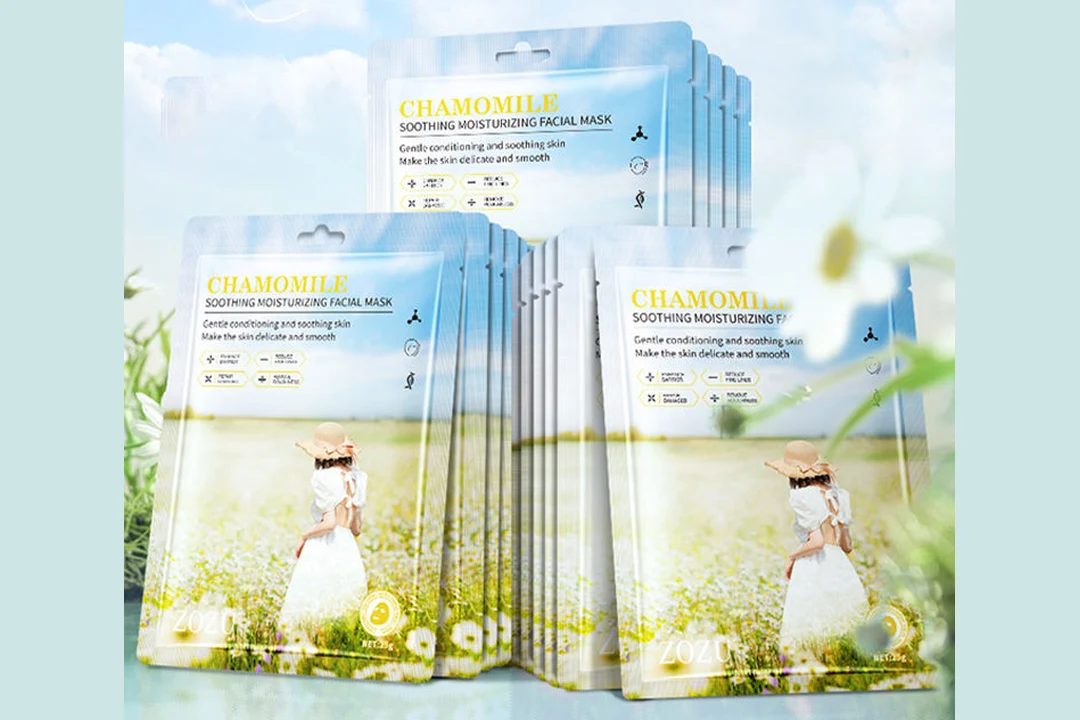
Our facial mask oem moq opens at 3,000 pcs per SKU on the stock 25 g chamomile sachet and stock essence, with breaks at 5,000 and 10,000 where printed sachets and a dedicated filling slot bring the unit index down. Sampling runs 7–10 working days on the stock base, 15–20 with a custom botanical level; bulk follows 30–35 days after approval and deposit.
| Tier | Unit price index | What changes |
|---|---|---|
| 3,000 pcs | 100 (reference) | Stock 25 g sachet, stock essence, shared filling slot, standard stability protocol |
| 5,000 pcs | 92–95 | Printed sachet break, dedicated slot, custom bisabolol level, challenge test on file |
| 10,000 pcs | 82–88 | Reserved substrate stock, custom carton, priority slot, lower freight per unit |
Documents ship as standard: batch COA, MSDS, botanical spec and supplier COA, the HRIPT and challenge-test summaries, ISO 22716 and GMPC certificates, and CPNP or MoCRA support. The platform SKU is on the chamomile facial mask OEM 25 g product page; for format decisions across mask types, the hyaluronic acid face mask format matrix and the peach face mask winter essence guide cover the adjacent programs.
FAQ: Dose, Safety and MOQ
What bisabolol or extract level should we specify?
Functional ranges for bisabolol sit around 0.1–1% in cosmetic use, with soothing data at functional doses and brightening signals at 0.5–1%. Below 0.1% the ingredient is a label decoration. A bisabolol face mask private label brief should name the INCI, the dose and the supplier COA in one line.
Is chamomile safe for sensitive skin positioning?
With the file, yes: HRIPT data on chamomile flower water at 0.2% showed zero reactions in 105 subjects, and bisabolol patch-test allergy sits below roughly 0.5%. The caveat is the Asteraceae cross-allergy population — the label carries the standard botanical caution, and the claims file avoids treatment language entirely.
What MOQ and lead time apply to a chamomile mask order?
3,000 pcs per SKU on stock sachet and essence, breaks at 5,000 and 10,000, samples in 7–10 working days, bulk 30–35 days. Changing the botanical level after sampling re-triggers the challenge test, so lock the dose before the sample approval — that discipline is what keeps a chamomile facial mask oem launch on its calendar.
Send your market, botanical brief and launch window — we will return a chamomile facial mask quote with the full spec sheet, an MOQ ladder and free samples within 24 hours.
☎ Phone / WhatsApp: +86 133 6440 1300
✉ Email: sales@moksha-bio.com
🕐 Working Hours: Monday – Saturday, 9:00 – 18:00 (GMT+8)
✉ Request the Quote — Reply Within 24h📍 Book a Factory VisitKeep reading: Chamomile Facial Mask OEM 25 g · Hyaluronic Acid Face Mask: Format Matrix · Peach Face Mask OEM: Winter Essence Guide · Private Label Skin Care Manufacturer: 7-Point Audit
No Comments