


17 Oct V Line Lifting Mask OEM 2026: The Ultimate Double V Chin Mask & Export Playbook
Table of Contents
Ask a volume buyer why the V Line Lifting Mask OEM category still grows while classic sheet mask shelves flatten, and the answer is mechanical: the ear-hanging V panel physically holds the jawline under tension for the treatment window, which gives the consumer something to see in the mirror. That visible geometry — not the peptide list — is what made the double V chin mask a retail-proof format, and it is the spec conversation we run with private-label partners before a quote goes out.
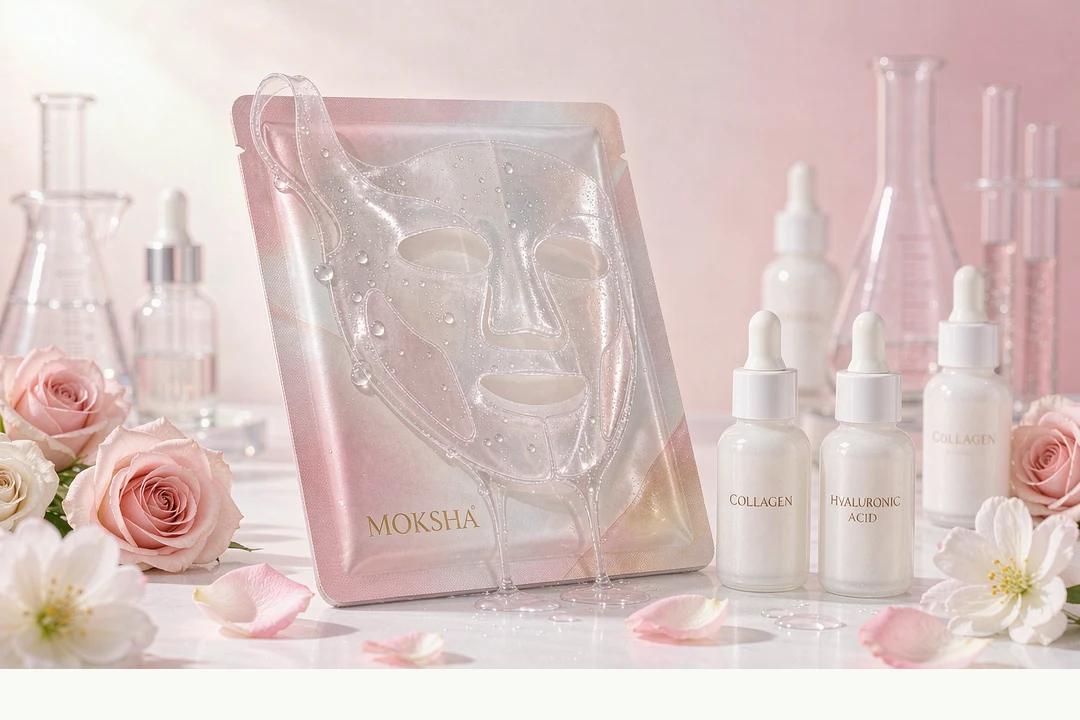
The live program behind it: our V line lifting mask — an ear-hanging double V chin mask infused with hexapeptide-9, collagen and hyaluronic acid in 15 g of essence, private label from MOQ 3,000 pcs — plus the wider face mask OEM catalog and the BB cushion line that shares the same complexion-adjacent shelf.
The K-beauty contour trend that built the V mask category
The V-line concept came out of the Korean contouring wave, where “small face” positioning turned a sheet mask into a shaping tool. The export data shows how deep that runway is: Korean cosmetics exports broke US$10.2 billion in 2024, up 20.6% year on year, with basic skincare categories — sheet masks included — accounting for over US$7.67 billion of the total, according to Global Market Insights. Korean consumers also remain the world’s highest per-capita beauty spenders at roughly US$493 a year, which is why the format keeps iterating faster in Seoul than anywhere else.
For an overseas buyer the practical read is different: the format has finished its novelty phase and is now a mainstream SKU in the US, EU, Gulf and SEA beauty aisles. A private label face mask buyer in 2026 is not selling a Korean trend — they are selling a jawline-care category that Western and Middle Eastern consumers already understand, which shortens the education cycle at retail.
Anatomy of the double V ear-hanging mask
A double V chin mask has three engineered parts. The ear hooks create the upward pull; the V panel — narrower at the chin, wider at the cheekbone — concentrates the 15 g essence load along the jawline rather than spreading it across the whole face; and the mask material controls how long that load stays in contact. Usage runs 15–20 minutes, two to three times a week, which is the cadence the retail copy and the pack count both have to respect.
Material choice is where the tiering happens. Cotton and cupra are the workhorses, tencel adds drape for the premium tier, and hydrogel or bio-cellulose positions the product at the top of the range — Global Market Insights notes exactly this migration from traditional cotton toward hydrogel and bio-cellulose, with hydrogel marketed as the premium substitute for better adherence and active delivery. A firming sheet mask on a hydrogel base can carry a 30–50% price premium over the same formula on cupra.
Hexapeptide-9, collagen and the firming claim stack
Our V line lifting mask platform is built on a four-part stack. Hexapeptide-9 is the firming signal peptide — the peptide family that cosmetic science uses for conditioning and elasticity support. Collagen and hyaluronic acid carry the moisture and plumping role, and glycerin locks it in during the treatment window. The result is a firming sheet mask that reads as a treatment product at retail while remaining a cosmetic at the regulatory level.
On evidence: our internal panel scored the formula at 95.7% approval for nourishment, firming and lifting attributes, and that is the number we share with private-label partners as internal test data — not as a clinical claim. Buyers planning their own substantiation should budget for a 30-person consumer panel plus instrumental elasticity measurement if they want on-pack percentages in the EU, where Regulation 655/2013 requires every efficacy statement to be backed by evidence.
What the facial mask market pays for in 2026
The parent category is large and compounding steadily. Global Market Insights values the global facial mask market at US$6.9 billion in 2025, growing at a 5.4% CAGR to US$11.6 billion by 2035, with sheet masks alone contributing US$2.7 billion of the 2025 base. The sheet face mask segment specifically is forecast to grow from US$2.8 billion in 2025 to US$5.3 billion by 2035 at a 6.6% CAGR — faster than the parent, because the format keeps taking share from paste masks in the convenience-driven aisle.
| Data point | Value | Source |
|---|---|---|
| Facial mask market, 2025 | US$6.9 B → US$11.6 B by 2035 (5.4% CAGR) | Global Market Insights |
| Sheet mask segment, 2025 | US$2.7 B of the facial mask total | Global Market Insights |
| Sheet face mask market | US$2.8 B in 2025 → US$5.3 B by 2035 (6.6% CAGR) | Global Market Insights |
| Supplier concentration | Top 5 players ≈ 12% share (2025) | Global Market Insights |
That last row is the buyer’s opportunity: with the top five manufacturers holding only about 12% of the sheet mask market, the category is structurally open to private label. A private label face mask program competes on fabric tier and claim discipline rather than brand spend — the same reason the ear-hanging format entered retail through regional brands first.
Firming claims and the anti-aging rulebook
Firming language is the highest-risk copy in the category. In the US, a claim that the product alters the structure or function of skin — “reduces wrinkles” is the textbook example — crosses from cosmetic into drug territory, while conditioning and appearance claims stay cosmetic. In the EU the product stays a cosmetic under Regulation (EC) No 1223/2009, but every firming statement needs substantiation under the common claims principles, and the CPNP notification plus a signed Product Information File must precede market entry.
Brazil deserves a specific note: ANVISA scrutinizes anti-aging and functional claims closely under RDC 907/2024, and the notification must be held by a local company with an AFE licence. The safe global wording set that travels across all five markets is appearance-based — “looks firmer,” “contoured,” “smoothed” — which is exactly how our standard pack copy is written for the V Line Lifting Mask OEM export program.
Market entry notes: EU, US, Brazil, Gulf and SEA
| Market | Regime | What the buyer files | Watch-out |
|---|---|---|---|
| EU | Regulation (EC) 1223/2009 | CPNP notification, PIF, safety assessment | Firming claims need documented substantiation |
| US | MoCRA cosmetics regime | Facility registration, product listing | Structure/function wording becomes a drug claim |
| Brazil | ANVISA RDC 907/2024 | Notification via a local holder with AFE | Anti-aging claims attract extra review |
| Gulf | GSO standards, Saudi SFDA | Product listing, halal certificate if claimed | Arabic label panels; premium gift-pack demand |
| SEA | ASEAN-aligned national regimes | BPOM notification (Indonesia) and equivalents | Local-language ingredient lists |
Our facility runs ISO 22716 and GMPC manufacturing, exports to 30+ countries, and keeps CPNP, ANVISA and SFDA filing packages current — a new V line lifting mask program normally inherits the existing dossier instead of rebuilding one.
Sachets, cartons and the component spec
The functional unit is a single ear-hanging firming sheet mask saturated with 15 g of essence, sealed in an aluminum-plastic sachet; the retail unit is a printed carton, most commonly 5 or 10 masks for the mass tier and 5 for the premium tier. Fabric tier drives the cost stack more than the essence does, and the sachet’s aluminum layer is what makes a 24–36 month export shelf life achievable without preservatives doing the heavy lifting.
Two details decide retail reviews. First, essence load: a mask that feels dry at minute 15 reads as under-filled, so we spec the load against the fabric’s retention curve rather than a flat gram number. Second, the ear-hook geometry: hooks that are 5 mm too short pull the V panel off the jawline, so hook length is locked to the fabric’s stretch spec during tooling, not adjusted afterwards.
Scale economics at 3k, 10k, 50k and 100k masks
Entry orders start at 3,000 masks with a 15–25 day lead time and free samples before artwork freeze. As with every mask category, the first 10,000 units absorb the artwork and tooling amortization; after that, fabric tier and sachet print method dominate the unit cost curve.
| Order size | Unit economics | Packaging | Lead time |
|---|---|---|---|
| 3,000 | Test order; artwork amortized across fewer units | Digital-print sachets, stock cartons | 15–25 days |
| 10,000 | First real step down in unit cost | Digital-print sachets, custom cartons | 20–30 days |
| 50,000 | Plate-print sachets amortize; fabric lot control pays off | Plate-print sachets, shipper cartons | 30–40 days |
| 100,000+ | Annual contract pricing; reserved line capacity | Full plate-print program, DDP shipping | 35–45 days + reservation |
Scoping a jawline-care line for 2027? Request a V line lifting mask quote — or WhatsApp +86 133 6440 1300 for samples, fabric specs and lead times within 24 hours.
One planning note for multi-SKU buyers: masks are lightweight but carton-cube heavy, so sea freight is usually quoted per cbm rather than per unit — combining a V mask line with a mud mask or BB cushion line on the same container is the cheapest way to fill one. Our V Line Lifting Mask OEM team can quote a combined facial-care program against a single artwork calendar and one filing package.
If you are scoping a contour or jawline line, the fastest next step is a fabric-and-claims review against your target markets: material tier, essence load, claim wording and the substantiation file your retail partners will ask to see.
Ready to Launch Your V Line Mask Line? Talk to Us
☎ Phone / WhatsApp: +86 133 6440 1300
✉ Email: sales@moksha-bio.com
🕐 Working Hours: Monday – Saturday, 9:00 – 18:00 (GMT+8)
✉ Inquiry This Product — Get a Free Quote
📍 Book a Factory Visit
Keep reading: Mud Mask OEM 2026: Clay, Set Economics & Export Compliance · Urea Foot Cream OEM 2026: The 40% Formula & Export Playbook · BB Cushion OEM 2026: Shade Range, Puff Tech & Export Playbook · BB Cream OEM 2026: The Color-Correcting Format & Export Playbook · Whitening Hand Cream OEM 2026: The Brightening Balm & Export Playbook · Hair Care Set OEM 2026: Formulas, Bottles & Export Playbook · Sunscreen OEM 2026: SPF Testing Costs, Regulatory Path & Private Label Playbook
No Comments