


12 Sep Skincare Sourcing Trends 2026: Top 10 Global Insights
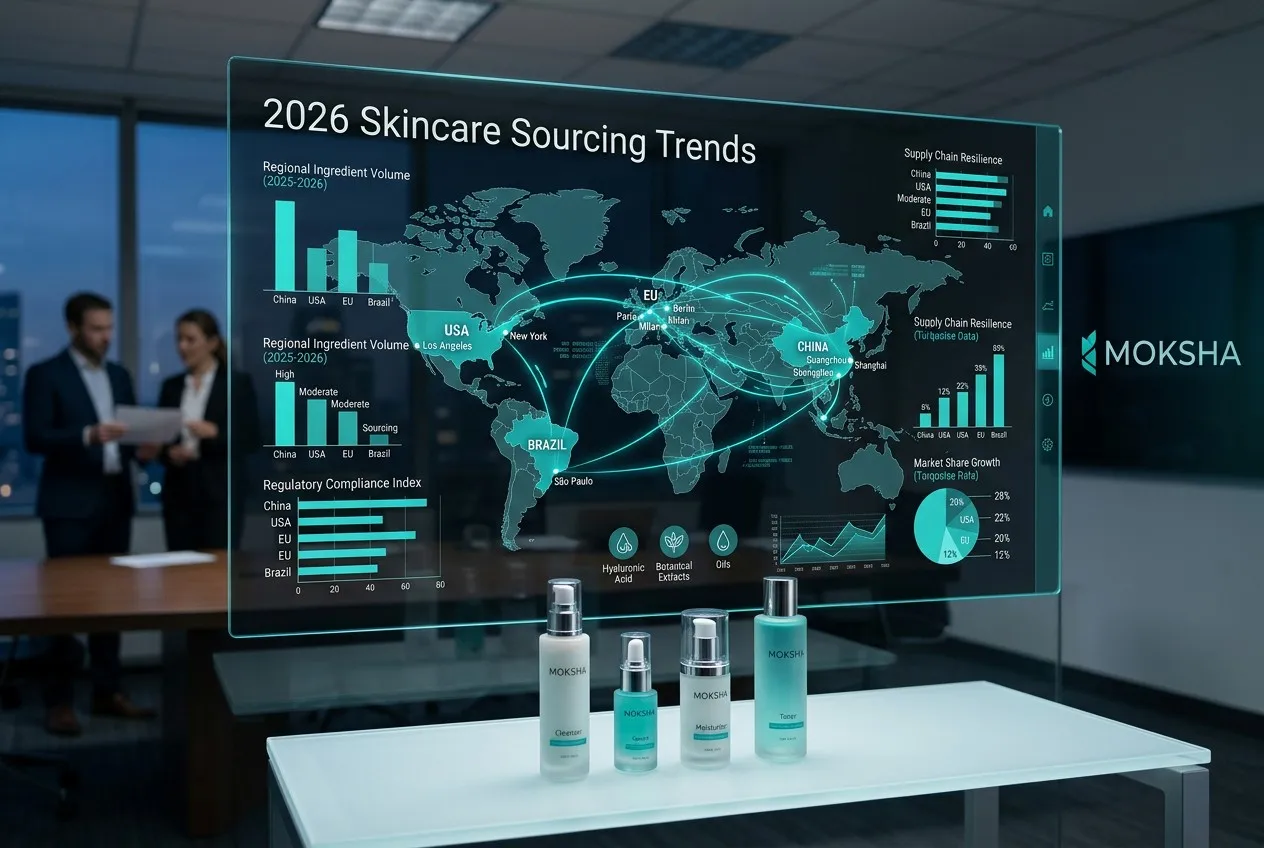
Skincare Sourcing Trends 2026: A Comprehensive Review of Global Manufacturing Innovations
As we navigate the final quarter of the fiscal year, the global beauty industry is undergoing a structural shift toward technical transparency and logistical resilience. For brand owners and wholesale distributors currently auditing their supply chains, staying informed on the latest Skincare Sourcing Trends 2026 is the definitive factor in securing long-term market dominance. This week, we have deconstructed the critical pillars of procurement—ranging from clinical formulation science to regional compliance hacks—to help our partners in the USA, EU, and Brazil optimize their inventory for the upcoming consumer cycle.
According to recent industry audits from Statista (2026), the demand for high-performance active ingredients is now intrinsically linked to regulatory agility. As a scientific-led GMPC facility, MOKSHA prioritizes this intersection of data and manufacturing. This report summarizes the top five trends that are redefining global beauty manufacturing insights this year, providing the technical evidence needed for high-ROI procurement decisions.
Trend 1: The Rise of Evidence-Based Formulation
The foremost of the Skincare Sourcing Trends 2026 is the transition from marketing-led to science-led development. Professional B2B buyers are increasingly demanding skincare formulation science dossiers that include bio-availability data and clinical efficacy results. By prioritizing stability research over simple concentration percentages, brands can justify premium retail price points and build lasting consumer trust in competitive markets like North America and Europe.
Trend 2: Radical Transparency in OEM Cost Breakdown
Budgeting for 2026 requires a precise OEM cost breakdown that accounts for raw material volatility and sustainable packaging surcharges. Modern manufacturing budget frameworks are moving away from flat per-unit quotes toward line-item transparency. This allows brands to identify “hidden markups” and reinvest those savings into higher active concentrations or bespoke bottle molding, directly boosting their overall Cosmetic Manufacturing ROI.
| Sourcing Pillar | 2026 Technical Shift | Wholesaler Strategic Advice |
|---|---|---|
| R&D Cycle | From 6 months to 7-10 day rapid prototyping. | Accelerate market testing with pilot batches. |
| Compliance | Integration of MoCRA and ANVISA pre-audits. | Prioritize factories with FEIs and ISO certificates. |
| Logistics | Temperature-controlled UN packaging. | Ensure MSDS accuracy for Class 3 shipments. |
(Source: MOKSHA Global Sourcing Performance Audit, 2026)
Analyzing your 2026 procurement plan? Get a free global market entry audit and a customized factory-direct quote within 48 hours. Request Your 2026 Quote →
Trend 3: Logistical Resilience and Lead-Time Optimization
In a seasonal industry, speed is a financial lever. Reducing skincare lead time to a 15-25 day production window has become the benchmark for high-growth brands. By utilizing vertically integrated manufacturing models—where raw materials and packaging components are pre-stocked—factories can eliminate the 4-week supply chain delays that once plagued the industry. This agility is a core component of modern Skincare Sourcing Trends 2026, allowing wholesalers to operate with leaner inventory and higher cash-flow velocity.
Trend 4: Sustainable Luxury as a Primary Value Driver
One of the most persistent Skincare Sourcing Trends 2026 is the demand for eco-conscious luxury. Brands are no longer choosing between “green” and “premium.” B2B buyers in the USA and EU are seeking bespoke glass packaging and FSC-certified secondary components as a standard requirement. This trend is driven by consumer demand for refillable systems and PCR (Post-Consumer Recycled) materials, which now command a 15-20% higher retail margin compared to traditional plastic packaging.
Trend 5: Digital-First Compliance Ecosystems
The regulatory landscape has transitioned into a purely digital environment. Navigating cosmetic export compliance trends now requires proficiency in the FDA’s Direct Cosmetics portal and the EU’s CPNP interface. Successful wholesalers are prioritizing manufacturing partners that provide “API-ready” technical dossiers, allowing for seamless integration with national health databases in Brazil (ANVISA) and North America. This digitalization reduces the administrative lead time of a global launch by up to 45%.
Trend 6: The “Mini-Batch” Scaling Strategy
Risk mitigation is redefining the Skincare OEM Scaling Strategy. Instead of committing to 50,000 units upfront, brands are utilizing 1,000-unit pilot batches to validate market demand. This “Agile Manufacturing” model depends on a factory’s ability to switch production lines rapidly without increasing the unit cost. By leveraging tiered pricing models, wholesalers can secure long-term profitability while maintaining the flexibility to pivot based on real-time retail data.
Factory Snapshot: MOKSHA operates a vertically integrated manufacturing ecosystem in Guangzhou, China. With a 180,000+ daily production capacity and a team of 30+ international regulatory experts, we have facilitated over 500 successful global product launches in 2026 alone. Our facility is GMPC, ISO 22716, and FDA registered, ensuring that your B2B skincare market review always leads back to a certified, industrial-scale partner. Download our factory credentials →
Strategic FAQ: Consolidating Your 2026 Sourcing Knowledge
Q1: What is the single biggest threat to procurement margins in 2026?
A: Regulatory delays. A shipment held at customs in Brazil or the USA for 30 days can erode 15% of your seasonal profit margin. Compliance-by-design is mandatory.
Q2: How does the current Skincare Sourcing Trends 2026 impact small-scale wholesalers?
A: It provides an opportunity to compete with giants. By utilizing high-active clinical formulas and bespoke packaging, smaller brands can occupy the “Masstige” tier where margins are highest.
Q3: Is factory-direct sourcing better than using a sourcing agent?
A: Yes. Removing the 15-30% middleman markup allows you to invest more in active bioavailability and sustainable packaging, which are the primary retail drivers this year.
Q4: How do I ensure logistics safety for concentrated serums and perfumes?
A: Always demand UN-certified export crates and a Class 3 MSDS. This eliminates the risk of shipment seizures and hazardous material cleanup fines during global transit.
Q5: What is the average ROI of switching to a GMPC-certified factory in China?
A: Brands typically report a 22-28% reduction in COGS (Cost of Goods Sold) and a 40% reduction in quality-related returns within the first 12 months.
Conclusion: Securing Your Future in the Global Beauty Market
The Skincare Sourcing Trends 2026 reveal a clear roadmap for success: prioritize scientific precision, master regional compliance, and demand absolute supply chain transparency. By partnering with a factory that provides industrial scale and technical data, you transform your procurement process into a strategic growth engine. Secure your brand’s future in the USA, EU, and Brazil by making data-backed sourcing decisions today.
Complete Your 2026 Procurement Audit
Ready to implement these global trends into your brand? Request a comprehensive supply chain audit and a factory-direct quote within 48 hours.
Official WhatsApp: +86-1336-440-1300
🔗 Weekly Sourcing Review: Core Insights Hub
Dive deeper into this week’s technical breakthroughs and compliance guides:
- Strategy: Comprehensive Skincare OEM Pricing Strategy & Cost Breakdown
- Lead Time: Logistics Focus: How We Deliver Global Orders in 15-25 Days
- Sampling: Technical Insight: Skincare Sample R&D Timeline & Process
- Brazil: Market Entry: Brazil Skincare Market Guide & ANVISA Secrets
- USA: Legal Guide: Navigating USA MoCRA & FDA Compliance Standards
- EU: Compliance Hub: EU CPNP Notification & PIF Documentation Hacks
- Safety: Logistics Guide: Ensuring Safety for Fragrance & Serum Export
- Case Study: Growth Case: How a Private Label Brand Scaled to 1M Units
- Science: Clinical Focus: The Data-Driven Path to Skincare Formulation Science
- Professional: SPA Focus: Why Professional Channels Trust Our GMPC Facility
- Production: Pillar Page: High-Volume Bulk Skincare Manufacturing Solutions
No Comments