


16 10 月 BB Cushion OEM 2026: Shade Range, Puff Tech & Export Playbook
Table of Contents
Sourcing a BB Cushion OEM partner in 2026 is not a packaging question — it is a shade-engineering, applicator-tooling and claims-compliance question wearing a compact shell. The category has outgrown its K-beauty origins: independent trackers size the global BB cushion market at USD 2.02 billion in 2026, growing at a 7.1% CAGR toward USD 3.47 billion by 2034, with Asia-Pacific still holding more than 60% of demand and North America and Europe growing fastest through premium launches. Yet the same research flags the two problems that actually kill cushion programs: shade mismatch (the top consumer complaint across the category) and formula drying inside the sponge over a product’s life cycle.
This guide is the spec conversation we walk through with every private-label partner before a compact quote: how shade architectures are built and what each one costs in tooling, how the puff and refill system are engineered as components, what an SPF-in-cushion claim obliges you to file in five export markets, and what MOQ, lead time and landed cost look like at 3,000 units versus 100,000.
The BB cream format itself started as a post-treatment tint and evolved into the hybrid makeup-skincare category that cushions industrialized — buildable coverage with a dewy or satin finish, skincare actives in the base, and a hygienic airless-style application that never touches the formula with fingers. Our 2026 production files for the BB Cushion OEM line and the rest of our BB cream and cushion catalog are the basis for every number below.
Why the cushion beat the bottle
The compact did not win on coverage — it won on dose control and hygiene. A pump bottle dispenses whatever the consumer presses; a cushion with a sealed membrane releases a fixed amount of formula per press of the puff, and the applicator never re-enters the jar. For big-B buyers that translates into three commercial advantages worth pricing into the program:
- Repeat purchase mechanics: the refill pod is the consumable. A consumer who keeps the compact and rebuys pods generates 2–3× the unit revenue of a one-off bottle at a fraction of the packaging cost per reorder.
- Skincare-makeup hybrid pricing: niacinamide, centella asiatica and hyalur acid bases let a cushion sit in the skincare aisle, not the makeup aisle — different shelf, different margin.
- Channel fit: travel retail, duty-free and e-commerce all reward the format. A cushion survives cabin pressure in a way a glass bottle does not, and the compact doubles as the on-screen hero in short-video content.
The counterweight is engineering complexity. A cushion is a three-component system — formula, container with applicator, and refill architecture — and each component carries its own tooling, its own failure mode and its own patent landscape. A cushion foundation OEM program that treats all three as one decision is quoting you a price, not a product. That is where sourcing decisions are won or lost.
The shade matrix is the real engineering problem
Ask any factory for a BB Cushion Private Label quote and you will get a single-shade or three-shade answer within a day. The shade range is where the real money sits, because shade architecture determines tooling cost, artwork versions, MOQ per shade and the market channels you can enter. Industry research repeatedly identifies shade mismatch as the number-one reason consumers abandon cushion products — for a brand, a five-shade line that misses the local market’s undertone distribution does more brand damage than no line at all.
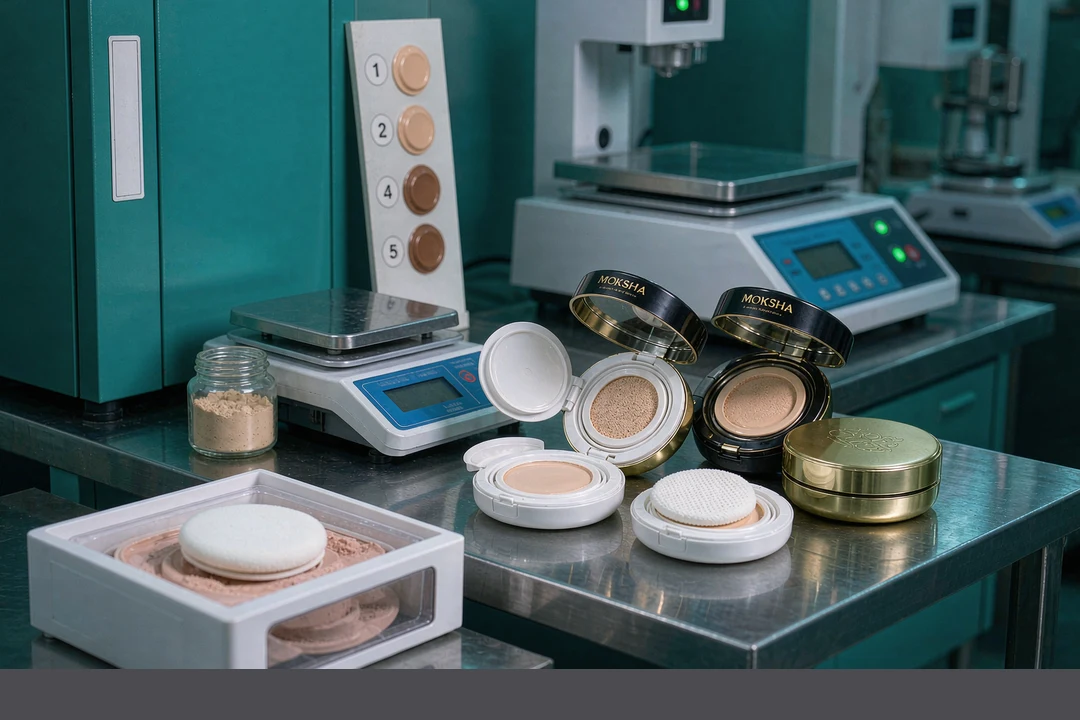
The undertone logic is the part buyers skip. Depth alone (light / medium / tan / deep) is not a range; each depth needs cool, neutral and warm undertone variants, and the pigment load must stay low enough to keep the “second-skin” finish the format is bought for. That constraint — full coverage with minimal pigment — is the actual formulation challenge of a cushion foundation OEM program, and it is why shade development, not filling capacity, sets your critical path — the reason every serious BB Cushion OEM program starts with a shade review.
| Architecture | Shades | Tooling sets | Entry MOQ | Best channel | Watch-out |
|---|---|---|---|---|---|
| Single shade | 1 (universal / adaptive) | 1 case + 1 inner tray | 3,000 | Test markets, subscription boxes | Adaptive claims need substantiation in the EU |
| Trio | 3 (light / medium / tan) | 1 case, 3 printed lids | 3,000 per shade | Masstige retail, pharmacy | Gaps at the ends of the depth curve |
| Five-shade core | 5 (2 light, 2 medium, 1 deep) | 1 case, 5 printed lids | 5,000 total program | National retail, Amazon FBA | Undertone variants deferred — review risk |
| Twelve-shade pro | 12 (4 depths × 3 undertones) | 1 case, 12 lid prints | 12,000+ program | Professional beauty, US mass | Artwork versioning and COA per shade |
| Full inclusive | 21+ (7 depths × 3 undertones) | 1 case, full print library | 30,000+ program | Global masstige, Middle East deep tones | Stability data must cover every pigment load |
Tooling sets assume a shared case platform with per-shade lid artwork; dedicated case tooling is quoted separately at lower total cost above 50,000 units.
Our recommendation to every BB Cushion Private Label client: enter with the five-shade core, then extend depth and undertone on the same case platform once the velocity data tells you which end of the curve is actually selling. Extending shades on a shared case costs artwork and a stability panel; changing case platform after launch costs the tooling.
The puff is a component, not an accessory
The puff is the most under-specified item in a cushion RFQ and the most common source of returns. Three specs decide whether the application feels premium: the substrate, the pore density, and the membrane system that keeps the formula from drying out between presses.
| Puff type | Substrate | Feel | Cost band* | Notes |
|---|---|---|---|---|
| Non-woven (standard) | 100% cotton, single layer | Soft, absorbent | Lowest | Fine for entry price points; soaks up formula fast |
| Tex (velvet-latex) | Polyurethane foam with velvet face | Dense, bouncy, zero absorption | Medium | The K-beauty standard; releases dose evenly, cleans with water |
| Silicone-tip hybrid | Tex puff + silicone applicator edge | Precise edges | Medium–high | Popular for contouring cushions in the Middle East |
| Antimicrobial tex | Tex + silver-ion treatment | Dense, hygienic positioning | High | Supports “hygienic application” claims in retail QA |
*Indicative bands from our 2026 component files at 10,000+ unit volumes.
The membrane matters as much as the puff. A cushion case with a sealed foil membrane under the formula loses under 1% weight in 12 weeks of accelerated stability, while an open-cell sponge reservoir can dry to a crust in a São Paulo summer warehouse. For any wholesale cushion compact program, ask for the 12-week weight-loss data and the 45 °C stability read before you sign — not after the first container arrives.
Refill architecture is the margin engine. A refill pod — the formula in a drop-in tray that reuses the consumer’s case — cuts packaging cost per unit by roughly 40% and supports the sustainability positioning that moves the category in the EU. It also protects you: a consumer locked into your refill system is a consumer not re-shopping the shelf.
SPF in a cushion: claims, tests and paperwork
More than half of cushion launches now carry an SPF claim, and an air cushion manufacturer that shrugs at the paperwork is outsourcing your compliance risk to you. The rules are the sunscreen rules — there is no cushion exemption:
- EU: every UV filter must be on Regulation (EC) 1223/2009 Annex VI at or below its listed maximum, the SPF value must be substantiated by an in-vivo method such as ISO 24444, and the claim language follows the 2013 common criteria — “SPF 50+” and “broad spectrum” are testable; “prevents ageing” is not a cosmetic claim.
- US: an SPF claim puts the product under the OTC sunscreen monograph and MoCRA registration; foreign facilities need a US Agent and product listing, and the first biennial renewal cycle closed in July 2026.
- Water-resistance claims (“80 minutes”) are tested claims, not adjectives — and cushion textures make the water-resistance test harder, not easier, because the film is thinner.
Practically: budget the in-vivo SPF slot early. The test books weeks ahead at accredited labs, and running it in parallel with stability — not after — is what keeps a cushion launch inside a 10-week timeline. Our sunscreen OEM compliance guide covers the test matrix and costs in detail, and the same dossier structure applies to a cushion base with SPF.
What each export market will ask you for in 2026
| Market | Regime | Notification / filing | The watch-out for a cushion |
|---|---|---|---|
| EU | Regulation (EC) 1223/2009 | CPNP notification before placing on market; PIF signed by a safety assessor | Colorants must be on Annex IV; SPF filters on Annex VI; claim wording follows the common criteria |
| US | FD&C Act as amended by MoCRA | Facility registration + product listing via Cosmetics Direct; US Agent for foreign facilities | Color additives need FDA approval; SPF claim pulls the product into the OTC monograph; adverse events reported within 15 business days |
| Brazil | ANVISA RDC 15/2013 | Cosmetic notification filed by the local importer holding AFE | Portuguese INCI list, importer CNPJ on label, colorant list restricted to ANVISA positive lists |
| Middle East | GSO standards; Saudi SFDA | Product registration via SFDA; halal certificate expected by major retail | Arabic labelling; deep-tone shade range expected; glycerin and additives need documented halal status |
| Southeast Asia | ASEAN Cosmetic Directive | National notification (BPOM for Indonesia, etc.) | Indonesia: halal certification mandatory for cosmetics from 17–18 Oct 2026 under Gov. Reg. 42/2024 — BPJPH has rejected further delays |
Two of these deserve emphasis for Q4 2026 planning. Indonesia’s halal deadline lands this month — uncertified cosmetics face withdrawal from circulation, which makes a factory with halal documentation in place a market-entry ticket rather than a nice-to-have. And in the US, MoCRA moved cosmetics from voluntary registration to mandatory facility registration and product listing — a factory that already supports that paperwork removes it from your critical path.
A 10-week launch playbook for a cushion line
This is a real timeline from our 2026 files: a Benelux beauty brand took a five-shade cushion foundation OEM line from RFQ to first container in ten weeks. Note that the shade development loop — not bulk filling — is the long pole.
| Week | Milestone | Deliverable |
|---|---|---|
| 1 | RFQ + brief | Target price band, shade architecture, refill decision, SPF yes/no |
| 2–3 | Shade development | First-round base shades with drawdown and wear panels |
| 4 | Component lock | Case, puff and membrane specs frozen; tooling order placed |
| 5–6 | Stability + SPF start | Real-time and accelerated protocols launched; in-vivo SPF slot booked |
| 7 | Artwork + claim review | Lid prints, market-specific claim matrix signed off |
| 8 | Notifications | CPNP / ANVISA / SFDA filings prepared |
| 9 | Pilot batch + QA | Shade consistency against masters, weight-loss read, AQL plan |
| 10 | Bulk + shipping | Production run, pre-shipment inspection, FCL booked |
Scale economics: 3k, 10k, 50k and 100k units
Big-B buyers do not need the lowest unit price — they need the steepest cost curve as volume grows. The shape of that curve on a five-shade BB Cushion OEM program from our 2026 files:
| Program volume | Unit FOB band | Tooling | Lead time | What changes |
|---|---|---|---|---|
| 3,000 (entry MOQ) | USD 1.60–2.10 | Shared case platform, pilot tooling | 40–50 days | You validate the market; we validate the shade curve |
| 10,000 | USD 1.30–1.65 | Dedicated case tooling amortized | 30–40 days | Refill pods unlocked; per-shade artwork costs spread |
| 50,000 | USD 1.05–1.35 | Multi-cavity tooling, dedicated line slot | 25–35 days | Priority scheduling; shade extension on same platform |
| 100,000+ | USD 0.90–1.20 (annual contract) | Full line booking | 25–30 days + reserved capacity | DDP to EU/US/Brazil; quarterly shade QC reviews; halal and GSO documentation maintained on your file |
Two logistics notes decide landed cost more than unit price: sea LCL is fine up to roughly 15 cbm, beyond which FCL typically saves 20–30% per unit on freight; and air freight for launch quantities should be treated as marketing spend — plan the first container by sea.
How to audit a BB Cushion OEM factory in one call
- Ask how many shades they have shipped in production — not sampled — and ask to see the shade masters and the QC method against them (spectrophotometer or by eye).
- Ask for the puff spec: substrate, pore density, and whether the latex tex puffs are sourced with documented low-nitrosamine processing.
- Ask for the 12-week weight-loss and 45 °C stability reads on a cushion base — not a jar base. The two behave nothing alike.
- If SPF is on the label: ask which lab runs the in-vivo SPF test, the booking lead time, and who signs the safety assessment.
- Ask for the refill pod architecture and the packaging cost per reorder — this is where your repeat revenue lives.
- Ask about puff and case patents: cushion applicator designs are heavily patented, and your factory should be able to say which designs it can and cannot replicate.
Our facility is certified under ISO 22716 and GMPC, exports to 30+ countries, and runs shade development, component tooling and stability testing in-house — For a BB Cushion OEM program of any size, that means one partner from drawdown to container. If you are planning a BB Cushion OEM line for 2027 planograms, the fastest next step is a shade architecture review against your target markets.
Need Help? Contact Us
☎ Phone / WhatsApp: +86 133 6440 1300
✉ 邮箱 sales@moksha-bio.com
🕐 Working Hours: Monday – Saturday, 9:00 – 18:00 (GMT+8)
✉ Inquiry This Product — Get a Free Quote
📍 Book a Factory Visit
Keep reading: Sunscreen OEM 2026: SPF Testing Costs, Regulatory Path & Private Label Playbook · Mud Mask OEM 2026: Clay, Set Economics & Export Compliance · Foundation Liquid Contract Manufacturing Services
暂无评论