

15 10 月 Sunscreen OEM 2026: SPF Testing Costs, Regulatory Path & Private Label Playbook
The Sunscreen OEM category is unusual among skincare segments: here, regulations — not marketing trends — decide whether your product ever reaches a shelf. Under the EU Cosmetics Regulation 1223/2009, every UV filter must come from the Annex VI positive list at its approved concentration; in the US, sunscreen sits inside the OTC drug monograph; and in China it is registered as a special cosmetic. A wrong filter choice does not just weaken your SPF claim — it blocks customs clearance and retail listing.
This guide is written for brand owners and category buyers sourcing an Sunscreen OEM partner for 2026 volume programs. It covers what SPF testing actually costs, how the EU, US and China paths differ, what a realistic 14-week launch looks like, and how wholesale sunscreen production scales from a 3,000-piece entry run to container quantities for the EU, US, Brazil, Middle East and Southeast Asia.
Table of Contents
What SPF testing really costs (and where buyers get surprised)
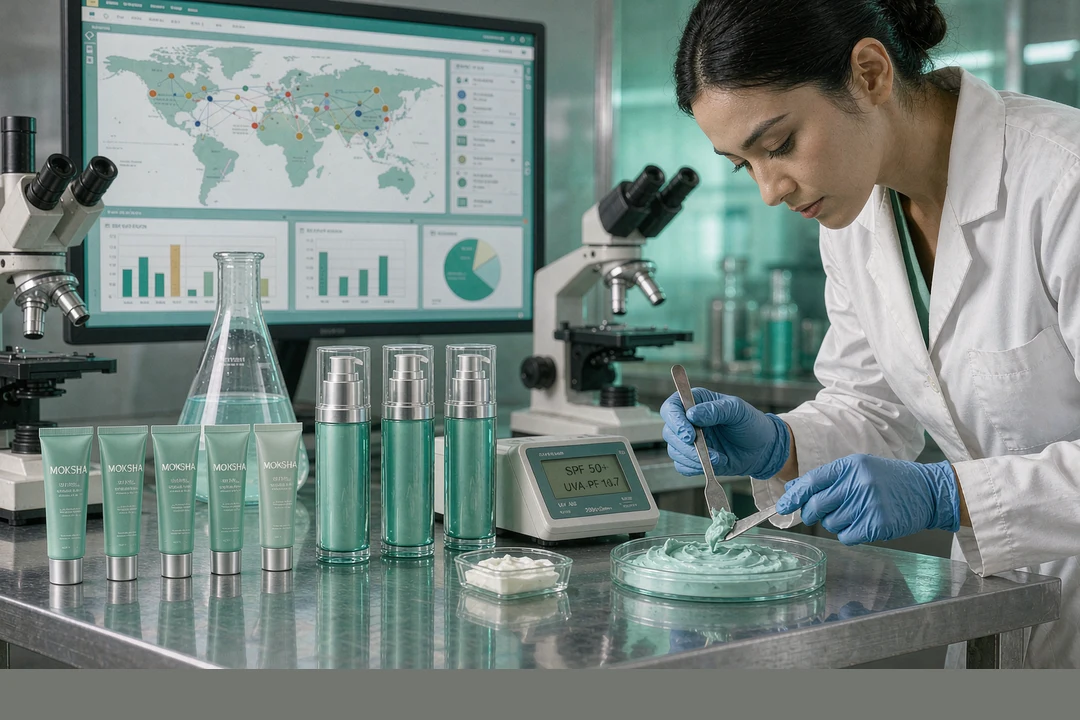
In-vivo SPF testing under ISO 24444:2019 is the single largest compliance line item in any SPF project. The numbers below are market-typical CRO ranges we see across labs in China, Korea and Europe — quotes vary by subject count and lab, but they are the honest planning band:
| Test | Standard | What it proves | Market-typical cost |
|---|---|---|---|
| In vivo SPF | ISO 24444:2019 | The SPF number itself, measured on 10+ volunteers | $3,000 – $6,000 |
| In vivo UVA-PF | ISO 24442 | UVA protection, required for most EU UVA claims | $2,500 – $5,000 |
| Critical wavelength | ISO 24443 | Broad-spectrum eligibility (≥ 370 nm) | $300 – $900 |
| Photostability | Adapted from ICH Q1B | Formula survives its own UV exposure | $1,000 – $2,000 |
| Accelerated stability | 45 °C / 40% RH, 3 months | Shelf-life and packaging compatibility | $1,500 – $3,000 |
Budget $9,000 – $17,000 for a full EU-grade SPF 50 test program. Two practical notes from the sunscreen manufacturer’s production floor. First, run cheap in-vitro screening (critical wavelength and photostability) before booking the in-vivo slot — a formula that fails critical wavelength wastes the most expensive test on the list. Second, ask who owns the test report: if the CRO issues it to the factory, you may not be able to reuse it if you ever add a second supplier.
Three regulatory paths compared: EU, US and China
The same formula faces three different rulebooks. The differences that matter most for launch timing are the filter source and the registration route:
| Requirement | EU | USA | China |
|---|---|---|---|
| UV filter source | Annex VI positive list, max concentrations per filter | FDA OTC Monograph M020 (GRASE status per filter) | NMPA-approved filter list (special cosmetic) |
| SPF label cap | SPF 50+ | SPF 50+ | Per registration dossier |
| Broad spectrum | UVA-PF ≥ 1/3 of SPF; critical wavelength ≥ 370 nm (Commission Recommendation 2006/647/EC) | Critical wavelength ≥ 370 nm required for the claim | UVA-PF ≥ 1/3 of SPF per GB standards |
| Water resistance | 40 / 80 min voluntary claim test | 40 / 80 min claim must be tested and stated | Per dossier testing |
| Go-to-market route | CPNP notification + Product Information File (PIF) | OTC drug facility compliance + label conformance | NMPA special-cosmetic registration, typically 6–12 months |
Two details wholesale sunscreen buyers routinely miss. In the EU, a UVA claim requires UVA-PF of at least one third of the SPF — an SPF 50 product therefore needs UVA-PF ≥ 16.7, which is a formulation target, not a labeling choice. In the US, “broad spectrum” is legally defined by critical wavelength ≥ 370 nm, and the claim must be tested, not asserted.
A 14-week SPF 50 launch, week by week
To stay honest: the timeline below is a composite of typical mid-size private label sunscreen projects we run, not one named client. It assumes a stock-formula base with custom packaging — fully bespoke formulation development adds 4–6 weeks for stability cycling. The same setup sits behind our own SPF 50 Sunscreen OEM and tinted sunscreen lines.
| Weeks | Milestone |
|---|---|
| 1 – 2 | Briefing, filter-system selection against the Annex VI list, sample agreement signed |
| 3 – 4 | Lab batches and in-vitro screening (critical wavelength, photostability) before any expensive in-vivo slot is booked |
| 5 – 6 | Pilot batch released; in-vivo SPF and UVA-PF testing runs at an external CRO |
| 7 – 9 | Stability program kick-off, packaging artwork, PIF / CPSR drafting in parallel |
| 10 – 11 | Pilot filling, QA release, CPNP notification or registration filing |
| 12 – 14 | Mass production, final inspection, DDP shipment to your 3PL |
The critical path is in-vivo testing. CRO booking slots are the usual bottleneck — secure the slot the week your pilot batch is mixed, not the week it ships.
Planning an SPF launch this quarter?
Send us your target market and volume, and we will return the matching regulatory checklist, filter options and a test-cost estimate within 24 hours.
Get the SPF launch checklistBuilt for volume: capacity, pricing tiers and where we ship
Big-B private label sunscreen programs need more than a good formula — they need guaranteed line time and predictable unit economics as quantities grow. Our sunscreen production is organized around that reality:
- Minimum order 3,000+ pcs per SKU for stock-formula runs, with tiered pricing that improves as volume scales — larger runs get dedicated filling-line slots, not queue time.
- Dedicated SPF lines with controlled-fill accuracy and inline QA checks, sized for runs from 3,000 pieces up to full container loads.
- Export experience across five regions: the EU (CPNP notification, PIF/CPSR documentation), the US (OTC monograph label conformance), Brazil (ANVISA-oriented documentation support), the Middle East (GCC/GSO markets) and Southeast Asia (ASEAN-harmonized documentation).
- DDP shipping and documentation — MSDS, COA, stability summaries and photostability reports shipped with the goods, so your importer clears customs without chasing paperwork.
| Order size | What it unlocks |
|---|---|
| 3,000 – 10,000 pcs | Entry run per SKU — stock formulas, your logo and packaging, full test dossier included |
| 10,000 – 50,000 pcs | Dedicated filling-line slot, tiered unit pricing, priority artwork turnaround |
| 50,000 – 100,000 pcs | Scheduled production windows, component cost-down program, buffer stock for your market |
| 100,000+ pcs / container loads | Container-scale scheduling, on-site QC resident, quarterly capacity reservation |
Volume also protects your margin on testing: at 50,000+ pieces the per-unit compliance cost of the in-vivo program drops to a rounding error, which is why we recommend booking the test slot and the first large run together.
Five questions to ask your sunscreen OEM before you sign
- Are your UV filters on the EU Annex VI positive list, and at what maximum concentration? A sunscreen manufacturer that quotes “SPF 50” without naming the filter system is guessing with your compliance budget.
- Do you run in-vitro critical wavelength screening before committing to in-vivo tests? If not, you pay $3,000–$6,000 to learn what a $500 test could have told you.
- Can you deliver the PIF, CPSR and stability data — or only bulk product? Some factories sell liquid and leave the dossier to you. For EU market entry that is a 6–10 week detour.
- Which external lab do you subcontract in-vivo testing to, and what is the booking lead time? Subcontracting is normal; not knowing the answer is not.
- What is your water-resistance validation history? “Water resistant 80 minutes” is a tested claim under both the FDA monograph and EU guidelines, not a marketing adjective.
Sunscreen OEM FAQ
Q: Can we launch SPF 50 in the EU without in-vivo testing? A: No. The SPF value on your label must be substantiated by an in-vivo method such as ISO 24444. In-vitro methods can pre-screen and support broad-spectrum arguments, but they cannot replace the in-vivo SPF determination.
Q: Mineral or chemical filters for a 2026 launch? A: Both are viable. Inorganic (zinc oxide / titanium dioxide) systems simplify the EU dossier and support “reef-conscious” positioning, while modern organic filters deliver lighter textures. The right answer depends on your claim set and target price — we map this in week 1–2 of every project.
Q: What is the minimum order quantity? A: 3,000+ pieces per SKU for private label sunscreen runs, with tiered pricing from 10,000 pieces upward. Fully custom developments start higher to amortize the testing program.
Q: How long does China NMPA registration take? A: Sunscreen is a special cosmetic in China; registration typically runs 6–12 months including domestic testing. If China is a target market, start the dossier in parallel with your EU program.
Q: Do you support reef-safe and Hawaii-compliant claims? A: Yes — oxybenzone- and octinoxate-free mineral systems are standard options, and we can document the absence of the filters restricted by Hawaii Act 104 and similar regional rules.
The bottom line
An Sunscreen OEM partnership is really a compliance partnership. The sunscreen manufacturer that wins your 2026 volume program is the one that books the in-vivo slot early, owns the dossier, quotes MOQ and tiered pricing honestly, and tells you the real test budget before you sign — not the one with the cheapest unit price. If you are comparing partners right now, start with the five questions above; the answers separate factories that have shipped SPF 50 into the EU from those that have only quoted it. Related reading: Skincare OEM pricing: full cost breakdown | Our SPF 50 Sunscreen OEM product line | wholesale sunscreen catalog. Background on how sunscreens are evaluated: sunscreen science overview and the FDA OTC medicines program.
Need Help? Contact Us
☎ Phone / WhatsApp: +86 133 6440 1300
✉ 邮箱 sales@moksha-bio.com
🕐 Working Hours: Monday – Saturday, 9:00 – 18:00 (GMT+8)
✉ Inquiry This Product — Get a Free Quote📍 Book a Factory Visit
暂无评论