

Skincare Sample Development: From Brief to Approved Sample
Most launch delays are not production problems — they are sample rounds that should never have been needed. This is the process we run, the timeline you can plan against, and what your brief must contain.
Table of Contents
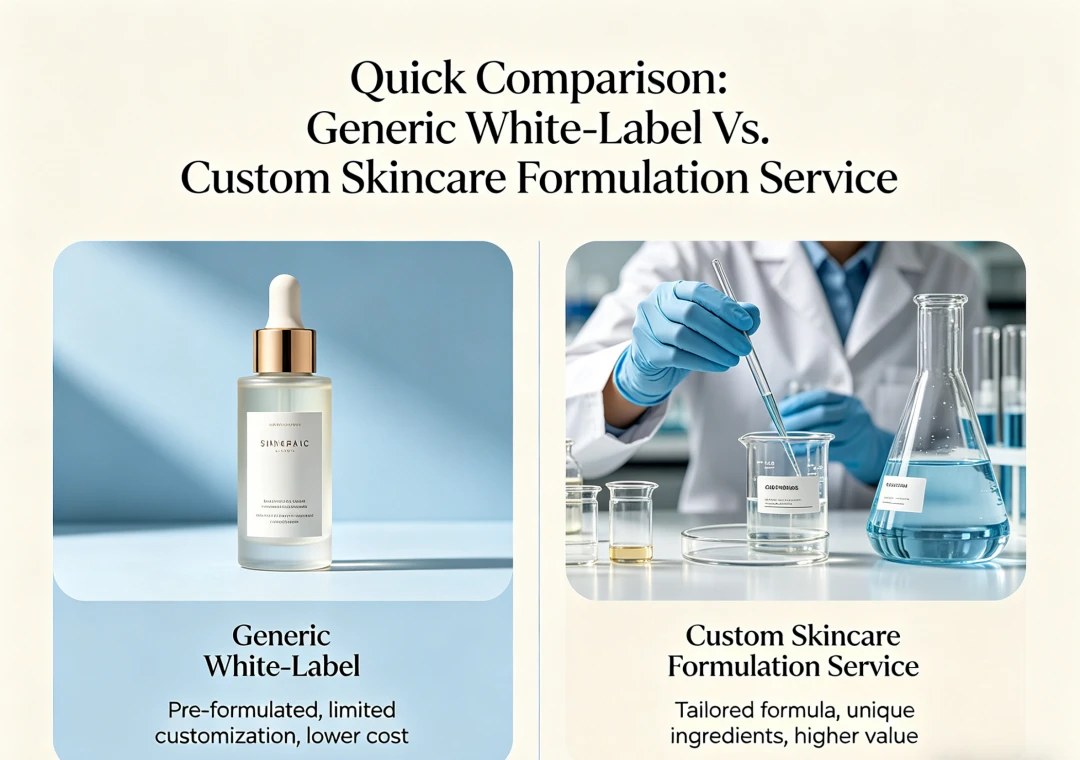
The five stages
1. Brief and feasibility (day 0–2). We check whether the formula, the claim and the packaging are compatible, and whether anything in the brief is restricted in your target market.
2. Formula match or development (day 2–10 stock / day 2–20 custom). Stock formulas are matched from our library; custom formulas are built on the bench by the formulation team.
3. Filled prototype (day 7–15). The sample is filled into the actual pack, so pump torque, dropper pickup and tube flow are tested, not assumed.
4. Stability and micro check (day 15 onward, runs in parallel). Accelerated stability and microbiological testing run while you evaluate the sample.
5. Approval and scale-up (day 30–60). You sign the retained sample, we lock the specification, and the bulk run is scheduled.
Timeline at a glance
| Stage | Stock formula | Custom formula |
|---|---|---|
| Bench sample | 5–7 days | 10–20 days |
| Filled prototype in your pack | 7–10 days | 15–25 days |
| Stability study | 4–12 weeks, parallel | 4–12 weeks, parallel |
| Bulk production after approval | 15–25 days* | 15–25 days* |
*Bulk run time counts from sample approval, deposit and components in house. If tooling or component production is still running, plan 30–35 days end to end. Clock starts when brief, packaging and artwork are confirmed.
What your brief must contain
Product category and the claim you intend to make (for example a brightening serum, without hydroquinone).
Target market and registration route — EU CPNP, US MoCRA, ASEAN notification or Brazil ANVISA.
Key actives and the percentage range you want, plus anything that must stay out of the formula.
Texture and sensory target: gel, cream, lotion; fast-absorbing or occlusive; fragrance or fragrance-free.
Packaging format and fill volume, or the reference product you are benchmarking against.
Target MOQ per SKU and your launch date. A price ceiling per unit also helps, because it tells us where to spend and where to save.
Sample cost and credit
Stock formulas: samples are free, you cover the courier. Each one ships with its specification sheet.
Custom development: a development and sampling fee applies and is credited against your first bulk order.
Revisions: two adjustment rounds are included in a development project. Further rounds are charged per iteration.
Why samples get rejected
Sensory mismatch — viscosity or absorption speed does not match the reference product.
Fragrance or colour that reads wrong for the market the product is sold in.
Packaging incompatibility — a pump that clogs, a formula that separates in an airless chamber.
Stability failure — discolouration, phase separation or weight loss over the study window.
A claim that cannot legally be made in the target market. This one is caught at the brief stage if the brief names the market.
Send Your Brief — Samples in 7–10 Days
Related capability pages
Where skincare sample development usually stalls
Most delays in skincare sample development come from an incomplete brief: no target texture, no benchmark product, or packaging chosen after the formula is locked. Each gap sends the sample back to the lab.
Our brief template closes those gaps in one sample development brief — fill it once and the lab runs the first trial without a follow-up call.
What each sample round includes
Every approved round ends with a graded package: the sample itself, a specification sheet listing ingredients and filling parameters, and photos of the sample filled in your chosen component.
Keep every graded round in one folder — when the pre-production sample ships, the lab compares it against round one so texture drift is caught before the bulk run, not after.
- >