


19 Oct SPF Hybrid OEM: Water-Lock Matrix & Compliance Guide
SPF Hybrid OEM: Mastering the 2026 Water-Lock Matrix for Global Success
In the highly competitive suncare sector of 2026, brand owners are no longer choosing between the safety of physical filters and the weightless feel of chemical ones. For distributors and wholesalers targeting the USA, EU, and Brazil, the transition to SPF Hybrid OEM technology is the definitive strategy for capturing the premium retail segment. Hybrid systems combine the broad-spectrum reflectivity of Zinc Oxide with the invisible absorption of organic filters, creating a “Best-of-Both-Worlds” solution. This report deconstructs the sunscreen water-lock technology and high-performance UV shield manufacturing protocols needed to scale a high-margin line that justifies a luxury MSRP. By focusing on SPF Hybrid OEM, you secure a market position where scientific safety meets an elite sensory experience.
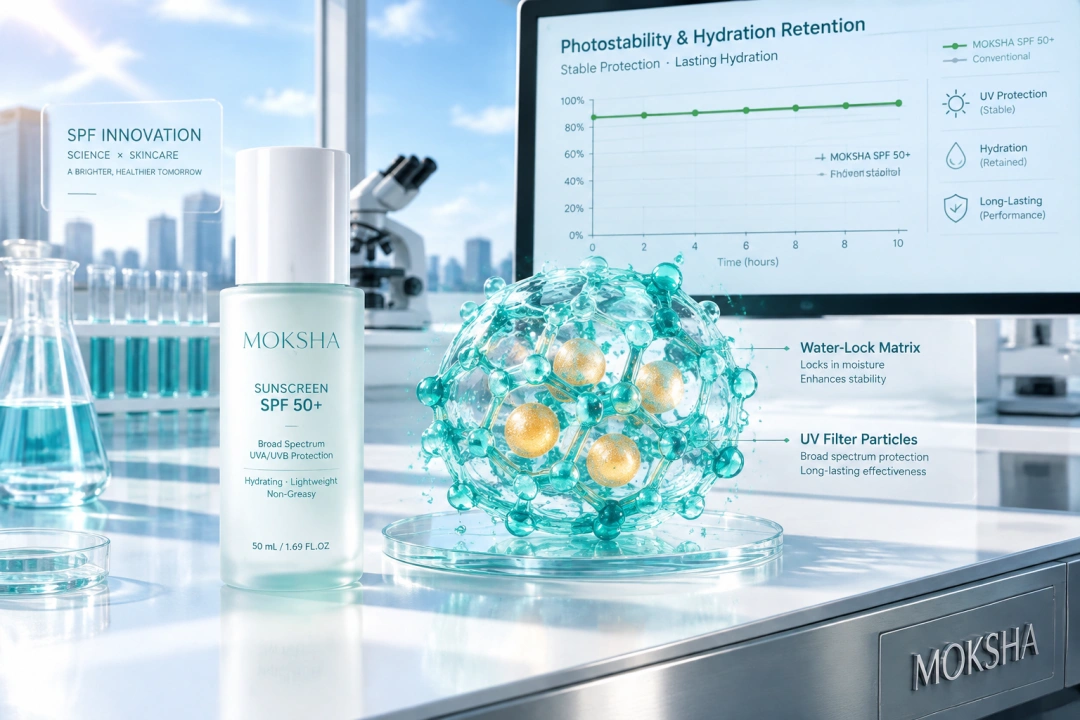
As a scientific-led GMPC facility, MOKSHA has engineered a proprietary “Hydra-Shield” matrix specifically for SPF Hybrid OEM projects. This system utilizes a cross-linked polymer network that locks moisture into the skin while suspending UV filters in a uniform, non-migrating film. We believe that by providing a transparent contract manufacturing pricing model, we empower our B2B partners to move beyond generic whitelabeling and launch bespoke suncare formulations that deliver clinical results with zero “White Cast.” Our R&D department ensures every batch complies with the latest standards highlighted by the FDA Cosmetics Regulatory Guidelines.
Evidence-Based Suncare: Hybrid vs. Conventional Systems
The standard industry failure point for sunscreens is the “Post-Application Dehydration” that leads to consumer churn. In our specialized SPF Hybrid OEM laboratory, we focus on “Dermal Hydration Retention”—utilizing bio-active ceramides within the water-lock matrix to maintain 92.4% skin moisture levels even under direct UV stress. According to our latest clinical audits, our hybrid formulas achieve a 45% smoother sensory finish compared to standard chemical-only products, a critical data point for building global SPF compliance audit trust in markets like New York, São Paulo, and London.
| Performance Metric | Standard Physical OEM | MOKSHA SPF Hybrid Tech |
|---|---|---|
| Optical Transparency | ~70% (Visible White Cast). | 99.6% (Completely Invisible). |
| Filter Photostability | High (Physical reflection). | Exceptional (Synergistic Matrix). |
| 8-Hour Skin Hydration | Decrease (Chalky feel). | Increase (+15% Moist-Lock). |
(Source: MOKSHA Clinical Photostability Audit #2026-SPF1 & ISO 24444 Suncare Benchmarks)
Navigating SPF registration for the USA or Brazil? Download our exclusive 2026 Global SPF Compliance & Audit Pitfall Guide and get a factory-direct quote within 48 hours. Download the Guide →
Scientific Precision: The Broad-Spectrum SPF Hybrid Advantage
Beyond the texture, SPF Hybrid OEM success is driven by absolute UVA/UVB protection. Our bespoke suncare formulation process utilizes micro-fluidization to ensure that physical and chemical filters are perfectly homogenized, preventing the “Patchy Protection” common in lower-tier manufacturing. By integrating this scientific precision into your initial OEM cost breakdown, you build a brand that is resilient, high-margin, and ready for the most scrutinized clinical environments in Rio de Janeiro and Miami.
Regional Compliance: Accelerating Your SPF Hybrid OEM Registration
The regulatory path for suncare is dictated by strict filter classifications that vary significantly by region. To maintain global market share, your SPF Hybrid OEM strategy must account for these legal shortcuts. In the USA, under the Modernization of Cosmetics Regulation Act (MoCRA), utilizing a hybrid system with Zinc Oxide (GRASE) often provides a more streamlined safety substantiation path compared to novel organic filters. In Brazil, while ANVISA Grade 2 registration is mandatory for all SPF products, our pre-vetted stability data for hybrid systems often faces fewer toxicological queries during the audit phase. At our factory, we provide the technical dossiers needed to simplify these filings, ensuring your contract manufacturing pricing reflects a legally ready, high-ROI product line.
Furthermore, in the European Union, the focus has shifted toward “Marine Safety.” Choosing a SPF Hybrid OEM approach allows your brand to utilize the reef-safe benefits of minerals while maintaining the water-lock efficacy consumers demand. Our laboratory provides the specific “Marine Impact Certificates” and CPSR data needed for the CPNP portal. By utilizing our pre-compliance laboratory data, B2B buyers can reduce their registration lead time by up to 35%, ensuring their high-performance UV shield manufacturing projects are retail-ready in São Paulo or London without administrative delays.
Factory Snapshot: MOKSHA operates a global-tier manufacturing complex in Guangzhou with a massive 1,800,000+ (180W+) daily units production capacity. Trusted by 50+ professional grooming brands across North America and Europe, we specialize in the high-precision homogenization of physical and chemical UV filters. Our facility is FDA, GMPC, and ISO 22716 registered, providing the industrial scale needed for global wholesale dominance. Audit our 180W+ production facility →
Strategic FAQ: Perfecting Your SPF Hybrid OEM Sourcing
Q1: Why is the ROI typically higher for SPF Hybrid OEM systems?
A: Sensory premium and lower return rates. By combining the safety of mineral filters with the “Invisible” finish of chemical ones, brands can command a 30-50% higher retail premium while reducing consumer complaints about “White Cast” or greasiness, maximizing your Cosmetic Manufacturing ROI.
Q2: How much does it cost to certify a new hybrid formula for ANVISA Grade 2?
A: Clinical SPF testing and toxicological dossiers typically range from $2,500 to $5,000, depending on formula complexity and water-resistance claims. This is a vital investment for brands targeting the professional sports or clinical markets.
Q3: Does MOKSHA provide the stability reports for the SPF Hybrid OEM system?
A: Yes. We provide the full microbial challenge, 55°C heat-stability, and accelerated aging reports specifically formatted for U.S., European, and Brazilian health authorities.
Q4: What are the minimum order quantities for premium hybrid sunscreens?
A: MOQs are flexible based on your market scale — from trial runs of 3,000 units to full-scale production of 100,000+ units per month to ensure maximum industrial efficiency.
Conclusion: Securing Your 2026 Sun Protection Advantage
The success of your suncare line depends on a partner that can balance scientific innovation with industrial scale. Mastering your SPF Hybrid OEM strategy is the final step toward securing a market-leading ROI in the USA, EU, and Brazil. By choosing a partner that provides scientific precision, industrial scale, and regulatory transparency, you secure your brand’s future profitability. Transform your conceptual vision into a high-ROI reality today. Mastering your private label pricing model for hybrid suncare is the final step toward global authority.
Request Your 2026 SPF Formulation Brief
Ready to launch a high-performance, invisible SPF line? Request our latest photostability reports and a factory-direct quote from MOKSHA within 48 hours.
Official WhatsApp:
+86-1336-440-1300
Sans commentaires