


16 Oct BB Cream OEM 2026: The Color-Correcting Format & Export Playbook
Table of Contents
Every BB Cream OEM conversation with a volume buyer eventually lands on the same two questions: how many shades, and can the label say SPF? The first is a pigment and tooling decision that sets your retail price point. The second is a regulatory decision that can quietly turn a cosmetic into an OTC drug in the United States. This guide is the spec conversation we run through with private-label partners before a BB Cream OEM quote goes out, written from our own 2026 production files.
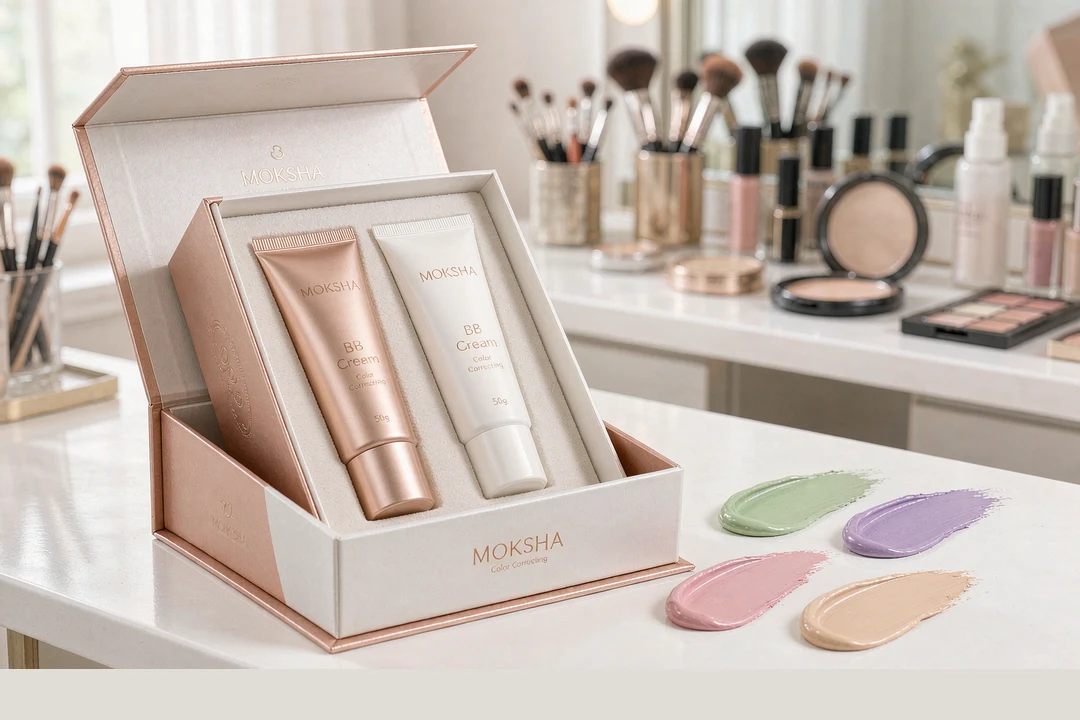
The live program behind it: our Color Correcting BB Cream OEM line — a 5-in-1 tinted moisturizer in four corrective shades, packed as twin 50 g tubes in a retail gift box at MOQ 3,000 — plus the BB cushion format that shares the same pigment platforms, and the wider BB Cream OEM catalog.
A 60-year format that keeps reinventing itself
The BB format — originally “blemish balm” — was developed in the 1960s by a German dermatologist as a post-treatment care product with a touch of tint, and Korean brands rebuilt it a decade ago into the skincare-makeup hybrid that now anchors complexion routines across Asia and beyond. That history explains the format’s unusual structure: a BB cream is asked to behave like a moisturizer, a primer, a light foundation and a treatment product at once, which is why the formula stack is closer to skincare than to color cosmetics.
Three consumer currents keep the format growing in 2026: the daily-SPF habit (a BB is the most convenient SPF vehicle many consumers will use), the “skinimalism” shift toward lightweight, natural-looking coverage, and shade-range expectations that now run well past the classic three. A BB cream manufacturer that can hold all three in one platform — pigment depth, SPF substantiation, shade breadth — is the one worth a 100,000-unit BB cream private label contract.
Color correction is pigment physics, not marketing
A color-correcting BB works on the complementary-color principle: opposing hues on the color wheel neutralize each other when blended at the right ratio. That is the entire mechanism behind the classic corrective shade family, and it is why a color correcting BB cream line can cover most complexion concerns without foundation-grade coverage:
| Corrective shade | Neutralizes | Typical use | Pigment approach |
|---|---|---|---|
| Green | Redness (rosacea patches, blemishes) | Redness-prone skin, spot use or all-over | Chromium oxide greens + iron oxides, low tint load |
| Purple / lavender | Sallow, yellow undertone | Dull or tired-looking complexion | Ultramarine violet + mica, sheer tint |
| Pink | Grey, lackluster tone | Brightening wash, fair to medium skin | Titanium dioxide + iron oxides at higher ratio |
| Water-oil / beige | Nothing — evens overall tone | Universal finishing tone | Full iron-oxide ramp for depth |
The engineering consequence: a four-shade line is four pigment ramps on one emulsion base, not four unrelated products. Buyers who spec the base once and the shade ladder second get a stable program; buyers who spec each shade separately get four stability programs — the fastest way to tell a serious BB cream manufacturer from a trading company.
What the BB cream market pays for in 2026
Mordor Intelligence sizes the global BB cream market at USD 5.43 billion in 2025, growing to USD 7.42 billion by 2030 at a 6.44% CAGR. The segment detail matters more than the headline for a private-label program:
- Tube formats lead: tube packaging held 41.87%% of product-type revenue in 2025 — the format our twin-tube gift box is built on — while cushions posted the fastest growth at 6.98%% through 2031.
- SPF is the entry ticket: SPF 15–30 took 52.33%% of revenue in 2025, and above-SPF-30 is the fastest-growing band at 7.81%% CAGR.
- Mass carries the units, premium carries the growth: mass held 66.31%% of 2025 revenue while premium advanced at 7.39%% CAGR.
- Geography: Asia-Pacific held 39.82%% of 2025 revenue; South America posted the highest projected regional CAGR at 6.75%%, and online retail is the fastest-growing channel at 8.01%% CAGR.
For a BB cream private label buyer, the read-through is that a corrective-shade line with credible SPF 15–30 positioning and a gift-box presentation sits at the intersection of every growth band in the report — the strongest wholesale BB cream position available.
The pigment and film-former stack behind a 4-shade line
A BB cream formula has four functional layers, and each carries its own compliance file:
| Layer | What it does | Typical materials | Compliance angle |
|---|---|---|---|
| Emulsion base | Moisturizing feel and spreadability | Water-in-oil or silicone-in-water emulsion, glycerin, niacinamide | Standard cosmetic safety assessment |
| Pigments | Tint and correction | Iron oxides (CI 77491 / 77492 / 77499), titanium dioxide (CI 77891), ultramarines | EU: listed in Annex IV colorants; US: iron oxides and titanium dioxide are color additives exempt from batch certification (21 CFR Part 73) |
| Film formers | Wear, waterproofing, transfer resistance | Acrylates copolymers, trimethylsiloxysilicate, dimethicone | “Waterproof” claims need the substantiation (see below) |
| Actives | Skincare benefit story | Niacinamide, hyaluronic acid, firming complex | Claim wording must stay cosmetic per market |
Two formulation notes buyers should verify on any factory call. First, shade matching across reorders is a pigment-lot discipline: ask how the supplier controls iron-oxide lot variance, because the 50,000th tube has to match the 3,000th — the single most common failure point in wholesale BB cream supply. Second, waterproof wear is a film-former decision with a testing obligation attached — in the US a water-resistance claim requires the standard 80-minute water test protocol, which is why our waterproof BB runs that protocol rather than printing the word loosely.
Where BB creams meet the sunscreen rulebook
The moment a BB cream carries an SPF value, two rulebooks apply at once. As a cosmetic it stays under the cosmetics regime; as a sun-protection product it acquires the sunscreen regime’s testing and labeling requirements. The practical rules we apply per market:
- EU: SPF claims must be supported by the COLIPA/ISO in-vitro and in-vivo SPF test series, and the claimed SPF must be achievable in the actual application amount (2 mg/cm²) — a BB applied like foundation rarely reaches it, so the labeled SPF is a formulation decision made before artwork.
- US: a product labeled with SPF is an OTC sunscreen drug under the FDA monograph: broad-spectrum testing, the 80-minute water-resistance test for any water claim, drug facts labeling, and — since MoCRA — facility registration and product listing for cosmetics as well.
- Brazil: ANVISA treats SPF products under its own photoprotection rules; the local importer files with the SPF test report attached.
- Gulf and SEA: SPF labeling is expected in Arabic and local languages; halal documentation applies to the full material chain, and in Indonesia halal certification is mandatory for cosmetics from 17–18 Oct 2026 (BPJPH).
If SPF compliance is new territory for your team, our sunscreen OEM testing-cost guide walks the full protocol list; the BB program simply reuses it.
Tubes, gift boxes and the component spec
A twin-tube gift box is a retail decision with real engineering behind it:
| Component | Standard spec | Premium option | Watch-out |
|---|---|---|---|
| Tubes | 2 × 50 g laminate tubes, screw cap | Soft-touch matte tube with spot UV | Laminate layer structure is the oxygen barrier — lock the supplier, not just the look |
| Shade coding | Cap color per shade | Cap color plus printed band | Shade names must be consistent across carton, tube and e-commerce listing |
| Gift box | Printed 3-piece box with insert | Magnetic-close box, FSC board | Insert must hold two tubes without rattle — transit test it |
| Carton | Printed shipper | Retail-ready shipper with hang hole | E-commerce drops are brutal on gift boxes — specify board weight |
One platform note: the cushion format and the tube format share pigment ramps, so a BB cream private label buyer can launch tube first and add cushion later without re-qualifying the color deck.
One more spec conversation worth having early: consumer testing. A four-shade corrective line should be validated on real skin before artwork is frozen — a 30-person panel across the target skin-tone range, applied with a fingertip and a sponge, is enough to catch the two failure modes that kill corrective formats: a green shade that reads minty on deeper skin tones, and a purple shade that turns ashy at the wrong ratio. Our standard program runs that panel in week 9, before notifications, so a shade adjustment never becomes a re-filing.
Market entry notes: EU, US, Brazil, Gulf and SEA
| Market | Regime | Notification / filing | The watch-out for a BB line |
|---|---|---|---|
| EU | Regulation (EC) 1223/2009 | CPNP notification; PIF signed by a safety assessor | Annex IV colorant list; SPF test file; claims per Regulation 655/2013 |
| US | FD&C Act + MoCRA | Cosmetics facility registration and product listing; sunscreen drug facts | SPF makes it an OTC drug; color additives per 21 CFR Parts 73/74; serious adverse events in 15 business days |
| Brazil | ANVISA RDC 15/2013 | Notification via local importer with AFE | Portuguese INCI; SPF report attached; importer CNPJ on label |
| Middle East | GSO standards; Saudi SFDA | SFDA registration; halal certificate | Arabic labeling; shade names translated, not transliterated |
| Southeast Asia | ASEAN Cosmetic Directive | National notification (BPOM etc.) | Indonesia halal mandatory from 17–18 Oct 2026 — BPJPH |
Scale economics at 3k, 10k, 50k and 100k sets
The cost curve on the BB Cream OEM twin-tube gift-box program from our 2026 files:
| Program volume | Unit FOB band (set) | Tooling | Lead time | What changes |
|---|---|---|---|---|
| 3,000 (entry MOQ) | USD 2.60–3.30 | Stock tubes, printed gift box | 35–45 days | You validate shades; we validate the pigment ramps |
| 10,000 | USD 2.10–2.65 | Dedicated tube tooling amortized | 30–40 days | Custom box unlocked; shade range extended on the same base |
| 50,000 | USD 1.70–2.15 | Multi-cavity tooling, dedicated line slot | 25–35 days | Priority scheduling; pigment-lot controls tightened for reorder matching |
| 100,000+ | USD 1.45–1.85 (annual contract) | Full line booking | 25–30 days + reserved capacity | DDP to EU/US/Brazil; quarterly SPF file reviews; halal and GSO documentation maintained on file |
Two logistics notes: gift boxes are cube-heavy, so container planning starts with box dimensions rather than unit count; and sea LCL works up to roughly 15 cbm, beyond which FCL typically saves 20–30%% per unit on freight.
Our facility is certified under ISO 22716 and GMPC, exports to 30+ countries, and runs four-shade corrective BB Cream OEM programs with in-house SPF testing, pigment-lot control and a per-market claim matrix. If you are building a complexion line for 2027 planograms, the fastest next step is a color correcting BB cream shade-and-SPF review against your target markets.
Ready to Launch Your BB Cream Line? Talk to Us
☎ Phone / WhatsApp: +86 133 6440 1300
✉ Email: sales@moksha-bio.com
🕐 Working Hours: Monday – Saturday, 9:00 – 18:00 (GMT+8)
✉ Inquiry This Product — Get a Free Quote
📍 Book a Factory Visit
Keep reading: BB Cushion OEM 2026: Shade Range, Puff Tech & Export Playbook · Sunscreen OEM 2026: SPF Testing Costs, Regulatory Path & Private Label Playbook · Hair Care Set OEM 2026: Formulas, Bottles & Export Playbook
No Comments