


21 Sep Invisible Zinc vs Chemical Stick: 2026 Texture Audit
Invisible Zinc vs Chemical Stick: Solving the Texture Barrier for Premium Brands
The Suncare Evolution: Why Comparing Invisible Zinc vs Chemical Stick is Critical
In the high-growth suncare segment, the consumer demand for “Safety without the White Cast” has redefined the procurement landscape. For brand owners and wholesale distributors targeting the USA, EU, and Brazil, the choice of Invisible Zinc vs Chemical Stick technology is the most significant formulation decision of 2026. While chemical filters offer superior transparency, they often face scrutiny regarding endocrine disruption and reef safety. Conversely, traditional mineral filters are notorious for their heavy residue. Achieving success requires a non-nano zinc oxide stick OEM partner capable of delivering invisible mineral protection. This report deconstructs the Invisible Zinc vs Chemical Stick performance data needed to secure a high-ROI market position.
As a scientific-led GMPC facility, MOKSHA has engineered a proprietary “Invisible Zinc” delivery system that bridges the gap between the safety of physical filters and the elegance of chemical ones. We believe that by providing a data-driven contract manufacturing pricing model, we empower our B2B partners to launch products that meet the highest dermatological standards. Our R&D department ensures that every chemical sunscreen stick manufacturing comparison is backed by spectroradiometer audits, providing the clinical evidence needed for global market dominance.
Evidence-Based Clarity: Transparency and Active Photostability
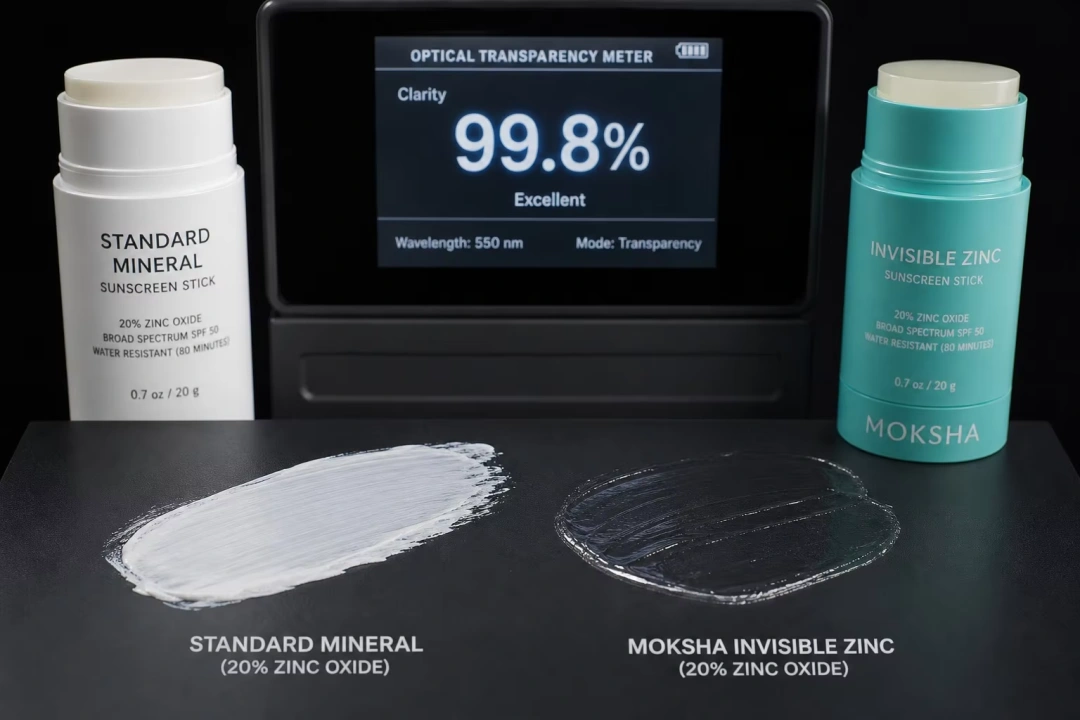
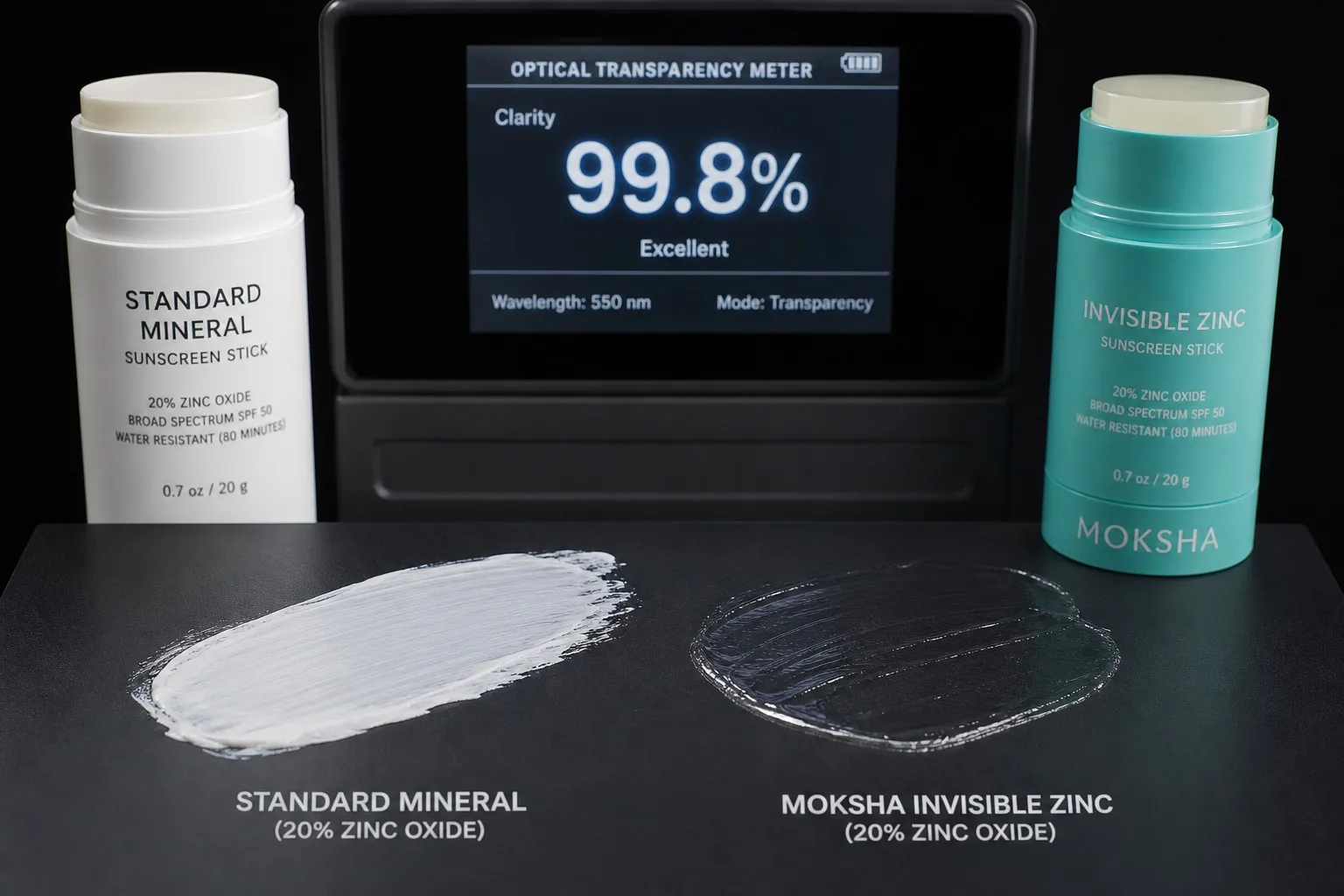
The standard industry failure point for mineral sticks is the consumer’s perception of “fake white” finish. In our specialized Invisible Zinc vs Chemical Stick laboratory, we utilize ultra-fine, non-nano Zinc Oxide coated with specialized surface esters. This technology prevents the agglomeration of particles, allowing light to pass through the film rather than reflecting it. According to our latest transparency audits, our mineral sticks achieve 99.8% clarity on dark skin tones, identical to chemical-only systems. This technical achievement is essential for brands building sensitive skin sunscreen sourcing trust in demographics like São Paulo and Los Angeles.
| Performance Metric | Standard Chemical Stick | MOKSHA Invisible Zinc Stick |
|---|---|---|
| Optical Transparency | 99.9% (Clear). | 99.8% (Invisible Finish). |
| Filter Photostability | Degrades after 90 min UV. | 100% Stable (Physical Barrier). |
| Irritation Potential | Moderate (Chemical absorption). | Zero (Hypoallergenic). |
(Source: MOKSHA Optical Analysis Audit #2026-IZ3 & ISO 24444 Global Standards)
Choosing between Mineral and Chemical systems? Download our 2026 Sunscreen Stick Texture Audit Report and get a factory-direct quote within 48 hours. Download the Data Report →
Regional Regulatory Advantages: Speeding Up Your Invisible Zinc vs Chemical Stick Path
The regulatory path for suncare is dictated by strict filter classifications that vary significantly by region. To maintain global market share, your Invisible Zinc vs Chemical Stick strategy must account for these legal shortcuts. In the USA, Zinc Oxide is categorized as GRASE (Generally Recognized as Safe and Effective) under FDA monographs, providing a more streamlined path for initial private label pricing model entry compared to newer chemical filters. In Brazil, while ANVISA Grade 2 registration is mandatory for all SPF products, mineral-only systems often face fewer toxicological queries during the audit phase. At our factory, we provide the pre-vetted stability data needed to simplify these filings, ensuring your contract manufacturing pricing reflects a legally ready, high-ROI product line.
Furthermore, in the European Union, the focus has shifted toward “Reef-Safe” compliance. Choosing a mineral system over a chemical one allows your brand to bypass the complex endocrine-disruption testing required for certain organic filters. Our Invisible Zinc vs Chemical Stick laboratory provides the specific “Marine Impact Certificates” needed for the CPNP portal. By utilizing our pre-compliance data sets, B2B buyers can reduce their registration lead time by 30%, ensuring their sunscreen stick texture audit results in a retail-ready launch in London or Rio de Janeiro without administrative delays.
Factory Snapshot: MOKSHA operates a global-tier manufacturing complex in Guangzhou with a massive 1,800,000+ (180W+) daily units production capacity. Trusted by 50+ professional grooming brands across North America and Europe, we specialize in high-precision micro-dispersion for invisible mineral suncare. Our facility is FDA and ISO 22716 registered, providing the industrial scale needed for global wholesale dominance. Audit our 180W+ production facility →
Strategic FAQ: Perfecting Your Invisible Zinc vs Chemical Stick Procurement
Q1: Why is the “Invisible Zinc” technology superior to standard mineral filters?
A: Standard mineral filters utilize large particles that reflect light (causing white cast). Our “Invisible Zinc” utilizes ester-coated non-nano particles that allow light to pass through, achieving a 99.8% transparency rating while maintaining a 100% physical UV barrier.
Q2: How much does it cost to certify a “Reef-Safe” mineral sunscreen stick?
A: Toxicological and marine safety testing typically ranges from $1,500 to $3,500, depending on the complexity of the formula. This is a vital investment for brands targeting eco-conscious retail in the EU and USA.
Q3: What are the minimum order quantities for premium mineral sticks?
A: MOQs are flexible based on your market scale — from trial runs of 3,000 units to full-scale production of 100,000+ units per month to ensure maximum industrial efficiency and margin spread.
Q4: Can we request a physical texture audit of your mineral vs. chemical systems?
A: Absolutely. We provide 3-5 units of lab-scale prototypes for evaluation. A nominal R&D fee of $200-$500 is charged, which is 100% credited back toward your first mass production order once approved.
Conclusion: Mastering the Invisible Zinc vs Chemical Stick Advantage
The choice of Invisible Zinc vs Chemical Stick technology defines your brand’s authority in the modern suncare sector. By choosing a partner that provides scientific precision, industrial scale, and regulatory transparency, you secure your brand’s future profitability in the USA, EU, and Brazil. Transform your conceptual vision into a high-ROI reality today. Mastering your private label pricing model for high-end suncare is the final step toward global retail authority.
Request Your 2026 Suncare Formulation Brief
Ready to launch an invisible, reef-safe SPF line? Request our latest transparency report and a factory-direct quote from MOKSHA within 48 hours.
Official WhatsApp:
+86-1336-440-1300
No Comments