



15 Sep Reef-Safe Sunscreen Standards: 2026 OEM Checklist
Reef-Safe Sunscreen Standards: A Comprehensive 2026 Certification Guide for Global Brands
In the evolving landscape of ethical beauty, adhering to Reef-Safe Sunscreen Standards has transitioned from a niche marketing trend to a mandatory retail prerequisite. For brand owners and wholesale distributors targeting the USA, EU, and Brazil, the presence of specific chemical filters can result in immediate market exclusion. However, “Reef-Safe” is not a legally defined term in many regions, leading to consumer confusion and regulatory risk. Success requires a data-driven sunscreen certification checklist that ensures every formulation aligns with the environmental mandates of marine sanctuaries. This report deconstructs the technical Reef-Safe Sunscreen Standards needed to secure entry into premium eco-retail channels in 2026.
As an eco-specialized GMPC manufacturing facility, MOKSHA has engineered a mineral-based delivery system that addresses the most common marine pollutants. We believe that by providing a transparent skincare formulation science framework, we empower our B2B partners to launch products that prioritize both skin safety and coral reef protection. Our internal R&D process ensures that every ocean-friendly cosmetic OEM project complies with the high global safety standards highlighted by the National Oceanic and Atmospheric Administration (NOAA).
Evidence-Based Eco-Compliance: Banned Filters vs. Safe Mineral Systems
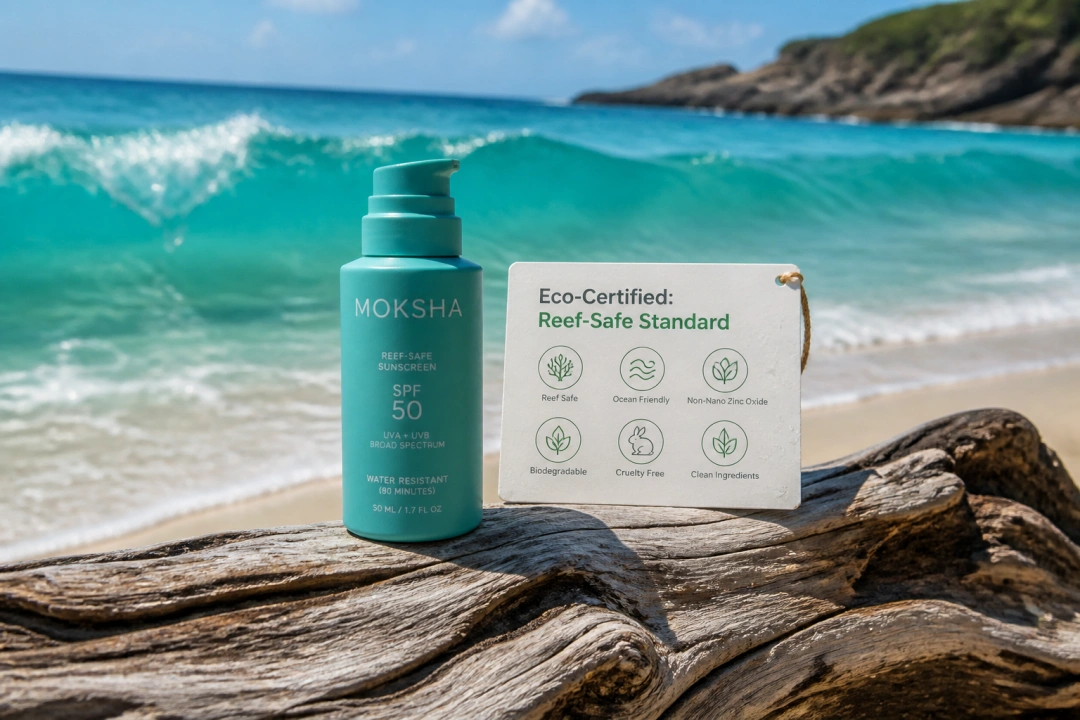
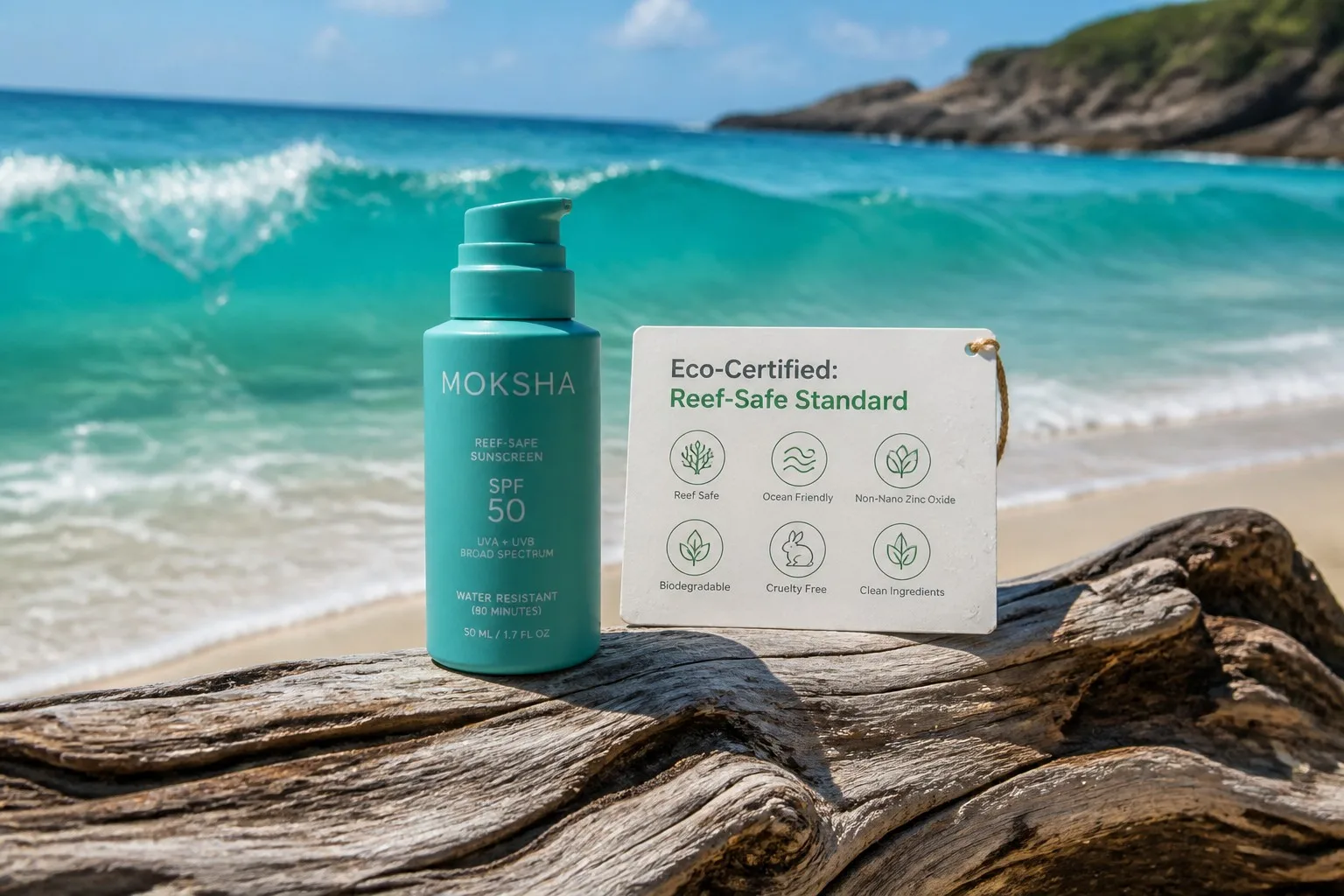
The standard industry failure point occurs when brands utilize “hybrid” formulas that claim eco-safety but still contain trace amounts of Oxybenzone or Octinoxate. In our specialized Reef-Safe Sunscreen Standards laboratory, we focus on non-nano Zinc Oxide and Titanium Dioxide. These physical filters are large enough to minimize ingestion by coral polyps, unlike their nanoparticle counterparts. According to our latest environmental impact audits, our formulas demonstrate high biological safety in standardized marine lab trials—a critical data point for securing marine-safe skincare sourcing trust.
| Chemical Filter (Risk) | Observed Environmental Impact | MOKSHA Technical Alternative |
|---|---|---|
| Oxybenzone / Octinoxate | Linked to mass coral bleaching and DNA damage. | Non-Nano Zinc Oxide (Physical Barrier) |
| Octocrylene | Bioaccumulates in certain marine ecosystems. | Ester-Coated Titanium Dioxide |
| Standard Parabens | Disrupts marine hormone systems. | COSMOS-Certified Preservatives |
(Source: MOKSHA Environmental Toxicology Audit & NOAA Educational Guidelines, 2025)
Get the Global Sunscreen Compliance Self-Checklist
Avoid market bans in Hawaii, Palau, and the EU. Ensure your formula meets the exact Reef-Safe standards before production begins.
Production Integrity: The Non-Nano Mineral Mandate
The technical core of Reef-Safe Sunscreen Standards is particle size. While “Nano” particles provide better transparency, they are small enough to potentially penetrate coral membranes. Our eco-certified sunscreen manufacturing process utilizes high-speed dispersion technology to ensure that even with “Non-Nano” particles, the texture remains lightweight and invisible on the skin. This scientific achievement allows brands to meet high Reef-Safe Sunscreen Standards without sacrificing the consumer-facing sensory experience in markets like the USA and Brazil.
Regional Legal Frameworks: Navigating Global Reef-Safe Sunscreen Standards
The regulatory path for eco-conscious suncare is dictated by local environmental laws that vary significantly between regions. To maintain global shelf space, your **Reef-Safe Sunscreen Standards** strategy must account for the most stringent mandates. For brands targeting the **USA**, compliance with Hawaii’s Senate Bill 2571 is the primary benchmark, which prohibits the sale of sunscreens containing Oxybenzone and Octinoxate. At our factory, we provide the technical dossiers needed to verify your formula against these specific state laws, ensuring your **contract manufacturing pricing** reflects a market-ready, legally protected product.
In the **European Union** and **Brazil**, the focus has shifted toward a broader “Marine Life Protection” model. ANVISA in Brazil and the EU CosIng database have recently updated their lists of restricted substances to include certain cyclic silicones and preservatives. Our **Reef-Safe Sunscreen Standards** laboratory has pre-vetted data for mineral systems that align with these evolving international challenge tests. By utilizing our pre-existing technical reports, B2B buyers can avoid the high cost of re-formulation, hitting the retail window with a fully **eco-certified sunscreen manufacturing** pedigree.
Global Eco-Compliance: A Comparison of Banned Ingredients by Region
To ensure your brand maintains global eligibility, we have summarized the ingredient restrictions that define current **Reef-Safe Sunscreen Standards**:
| Region | Primary Banned Filters | MOKSHA Compliance Status |
|---|---|---|
| Hawaii & Florida (USA) | Oxybenzone, Octinoxate. | Compliant (100% Mineral) |
| Palau (Global Leader) | Oxybenzone, Octocrylene, and 8 others. | Compliant (Zero Toxic List) |
| European Union (EU) | Specific Parabens and Microplastics. | Compliant (Green Chemistry) |
(Source: NOAA Marine Life Education & International Environmental Legislation, 2026)
Factory Snapshot: MOKSHA operates a specialized “Eco-Beauty Innovation Center” within our Guangzhou facility. With a 180,000+ daily production capacity and a team of senior environmental toxicologists, we have successfully facilitated over 100 reef-safe product launches across the USA, Palau, and Europe. Our facility holds COSMOS and ISO 22716 certification, providing the industrial scale and scientific evidence needed for premium eco-brands. Audit our eco-credentials →
Strategic FAQ: Perfecting Your Reef-Safe Sunscreen Standards Compliance
Q1: What is the most critical factor in achieving Reef-Safe Sunscreen Standards?
A: Formula transparency. Most failures occur when trace amounts of restricted chemical filters remain in the manufacturing lines. We utilize dedicated stainless steel lines for our mineral production to prevent cross-contamination.
Q2: How much does it cost to certify a new formula as “Reef-Safe” in the EU?
A: While there is no single government fee, the cost of the professional toxicological CPSR and marine impact audit typically ranges from $1,500 to $3,000 per SKU.
Q3: Can MOKSHA provide non-nano Zinc Oxide formulas with zero white cast?
A: Yes. We utilize ester-coated non-nano minerals that provide a lightweight, invisible finish while adhering to the strictest **Reef-Safe Sunscreen Standards** globally.
Q4: Can I request a physical stability report for my eco-certified formula?
A: Absolutely. We provide 3-5 units of prototypes for evaluation. A nominal R&D fee of $200-$500 is charged, which is 100% credited back toward your first wholesale manufacturing order.
Conclusion: Investing in Future-Proof Eco-Innovation
In a global market where sustainability is non-negotiable, mastering the **Reef-Safe Sunscreen Standards** equation is your brand’s ultimate competitive advantage. By choosing a partner that provides industrial scale, scientific precision, and absolute environmental transparency, you secure your brand’s future profitability in the **USA, EU, and Brazil**. Start your **Reef-Safe Sunscreen Standards** audit with us today and transform your conceptual vision into a retail-ready reality.
Download the Global Sunscreen Compliance Self-Checklist
Ready to launch? Request our latest 2026 SPF Compliance Checklist and a factory-direct quote from MOKSHA within 48 hours.
Official WhatsApp: +86-1336-440-1300
No Comments